Joel Solkoff's blog

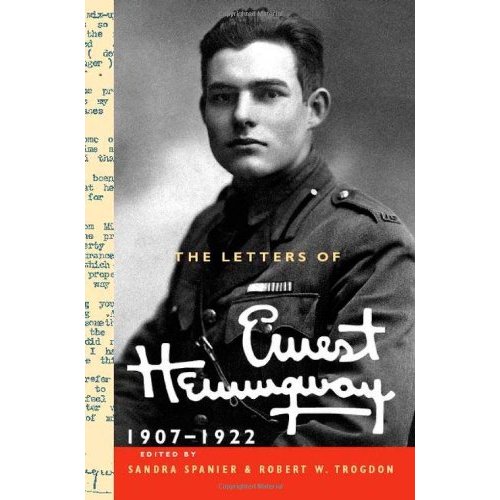
By any definition of scholarship, Penn State is the world center of Hemingway scholarship

“Scholarship implies the possession of learning characteristic of the advanced scholar in a specialized field of study of investigation (a first –rate literary scholarship).” This explanation comes from Miriam Webster’s Collegiate Dictionary. The quotation comes from a useful section which differentiates among knowledge, learning, erudition, and scholarship.

My experience with scholarship comes from classes at the Hebrew Academy of Greater Miami where I was taught, in grades one through eight, the distinction between the word of God and scholars interpreting the word of God.

For example, in Grades one and six we read Genesis in Hebrew. Our text dated to the 7th and 10th centuries CE era when the Masoretic text was codified, the earliest and most authoritative Biblical text available. Each letter in the book of Genesis we read, the publisher counted and proofread to make sure it was identical with the original and the publisher reproduced the word count to Genesis at the end to the book.

Distinction was made between the Bible and its many distinguished interpreters. The word of God was authoritative. Rashi and Maimonides both were scholars, high-respected as were other scholars, but no one presumed, including the scholars themselves, to distinguish between interpreting God and the word of God which we believed the Bible had given us.

I am not equating Hemingway with God (although reading George Plimpton’s interview with Hemingway in the Paris Review might cause the reader to conclude that at times Hemingway thought he was God). The point I am making is that the most important scholarship comes from the primary texts.

Lost in the current tragedy: Penn State is the world center of Hemingway scholarship

Lost in the current tragedy: Penn State is the world center of Hemingway scholarship

How Penn State came to be a center of Hemingway scholarship is a multiple tragedy in itself. The first tragic figure was Hemingway himself denying the validity of scholar Philip Young’s book. Hemingway tried to suppress the book because Young said to truly understand the author, the reader had to realize that Hemingway had been seriously injured during World War I. The consequence of his physical and emotional injuries, Young explained, was a therapeutic working out of his problems in Hemingway’s fiction.

Young explained Hemingway’s reaction to his book, “But then he really wondered if I really understood how damaging it could be to a practicing writer to tell him he has a neurosis. It damages him with all his readerss and could so injure the writer himself that he could no longer write.”

When Hemingway killed himself in July, 1961, Young received phone calls, telegrams, and letters at Penn State congratulating him. “You called it, Young! These messages belong to a rare species of the genus Congratulation, but the recipient was not gratified. Nor was the remark particularly accurate, as anyone who reads my book will see…”

Suzan Erem: An Appreciation

Suzan Erem: An Appreciation
Many women have disapproved of me. None has done so in a fashion likely to win my gratitude with the exception of Suzan Erem, whom I met during Barack Obama’s presidential campaign and who became my managing editor and friend. Knowing Suzan well, I have no idea whether she will react well to this appreciation. I once told her I was sorry for something I had done or not done and she said that she does not like apologies and I should not appologize again. It would not surprise me if she said, “Joel; I never want you to express your gratitude again.”
Suzan Erem is, to those of you who do not live in the currently freezing hothouse of State College, PA, the managing editor of Voices of Central Pennsylvania. Suzan will be leaving Centre County to move to Iowa City. The exact date of her planned hegira was published on the cover of the November monthly hard copy issue of Voices, in part as a way of forcing the Voices Board to name a successor, but subsequent conversation causes me to suspect that she may leave earlier than June 2011.
Last month, Suzan published the news that Lucy Green will be the next managing editor, succeeding to a publication whose existence over the past two plus years that I have been writing for it, often depended upon Suzan’s effort and Suzan’s efforts alone. Since this is not a blog posting on the future of Voices, but is instead focused on me and how Suzan has helped me, I trust that Lucy will succeed despite the difficulties of replacing someone whom I have come to regard as irreplaceable. The fact that Lucy is the daughter-in-law of Gary Green gives me cause for hope.

Won’t ride ‘em cowboy: This is my final column

 Note: The following is the text of my February, 2011 column at Voices where I announce the end of my From Where I Sit column. The hard copy text, complete with a phograph of me, is available at newstands in Centre County. I am reproducing it here for two reasons. First a reader insisted that I was required to explain my rationale more fully or, in her words, "face a grilling."  I therefore intend to call my next blog Grilling in which I not only explain but provide the reader with reassurance that the issues of the elderly and disabled will continue to be covered at Voices--only not from me. Not within the context of this From Where I Sit monthly column. Writers interested in covering such subjects are requested to get in touch with me at the email address below.] <?xml:namespace prefix = o />

 The handler applies the fully-charged cattle prod to the rear of a bull bred for ferocity. The cowboy—Slim really is his name—holds onto his hat with his left hand.

Exclusive Written Interview of Rep. Jim Langevin

Exclusive Written Interview of Rep. Jim Langevin (D-RI) by Joel Solkoff, Voices of Central Pennsylvania<?xml:namespace prefix = o />

1.      Why do you oppose the Obama Administration’s efforts to create competitive bidding for medical suppliers of durable medical equipment, such as medical oxygen, power chairs, scooters, wheelchairs, and other mobility devices?


The competitive bidding program was enacted as part of the Medicare Prescription Drug, Improvement, and Modernization Act of 2003 (MMA) in an effort to improve quality of service and eliminate excess costs in Medicare. While I support these overall goals, flaws within the bidding process sparked early concerns within the program. 

Competitive bidding was implemented in July 2008.

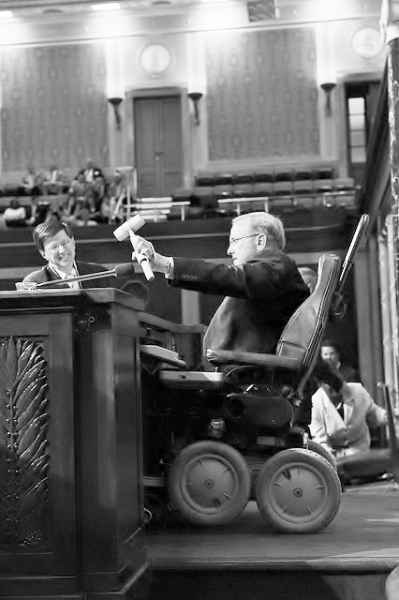
Photograph of Rep. Jim Langevin (D-RI) Presiding Over the U.S. House of Representatives

U.S. Rep. Jim Langevin presides over the House in celebration of the 20th anniversary of the signing
of the Americans with Disabilities Act. Langevin, who has partial control of his limbs, is the first quadriplegicto preside over the U.S. House of Representatives.

From Where I Sit: December/January 2001--Profile of Rep. Jim Langevin (D-RI)

From Where I Sit<?xml:namespace prefix = o />

“Individuals with Disabilities Remain One of Our Nation’s Greatest Untapped Resources”


A shot from the revolver of the <?xml:namespace prefix = st1 />Rhode Island policeman went off by mistake. The bullet hit Jim Langevin, a 16-year-old boy, who was a police cadet in a Boy Scout Explorer Program. It hit Langevin’s spine and kept going. The damage made him a quadriplegic (paralysis of both arms and both legs).

Rep. Langevin is the first quadriplegic to serve in the U.S. House of Representatives.  To enter the House chamber 10 years ago, when he was first elected, the maintenance crew made the chamber wheelchair accessible and removed two fixed seats in the front row so Langevin could maneuver his power chair and effectively address his fellow colleagues.

Invitation to Lady Gaga to Perform at the Bingo Parlor at Addison Court Plus Disability Suggestions for Paparazzi


Invitation to Lady Gaga to Perform at the Bingo Parlor at Addison Court Plus Disability Suggestions for Paparazzi

Living in Central Pennsylvania has isolated me from the world’s realities. Until last month, I was unaware of Lady Gaga. This Lady shattered my consciousness. Not paying much attention to the fact that Lady Gaga was on the cover of September’s Vanity Fair, I bought the issue anyway. I buy Vanity Fair for the political reporting and because it is one of the best paying magazines for writers. I figure buying and reading a copy is like buying a lottery ticket.

Penn State Homecoming—a view from the old age home; plus my stories about working at Scanlan’s Monthly the first national magazi

Blog: Penn State Homecoming—a view from the old age home; plus my stories about working at Scanlan’s Monthly the first national magazine to publish Hunter Thompson with whom I did meet.

[Some of this material is not suitable for children.]<?xml:namespace prefix = o />

It is 10:45 PM on Beaver Avenue, just off Allen, and the nightly noise on this Penn State’s Homecoming   Weekend is milder than I expected. There are, of course, the heavy traffic, the bar across the street, and every now and then….

It is 3:15 in the morning and I have come again focused on you—not focused on any realms but yours. The noise outside my window is disturbing. I heard a woman scream at the top of her voice and loud obscene noises without much interruption.

By way of amusement during this vigil until quiet prevails at 4 or 5 in the morning, I have been reading Scanlan’s Monthly, a publication for which I worked shortly after I graduated from Columbia College. I was hired as a research director of Scanlan’s at the downstairs bar at Sardi’s.

I needed a job. I had been unable to find a publisher.

Ye Olde College Diner Updates etc.

Ye Olde College Diner Updates etc.<?xml:namespace prefix = o />

In the current issues of Voices, my column compares segregation of the 1950s to the way the College Diner excludes people who cannot walk—people like me. I had hoped publication would excite the desire to build a ramp.

I wanted to portray two villains. The proprietor of course for not providing a ramp. Primarily, I wanted to address you the patrons—the people who get to go into the restaurant simply because they can walk.

I I have already quoted scripture on the subject and I will probably continue when you least expect it.

Before we get to my shrill and overwhelming insistence of my own rectitude, let’s talk specifics:

First in importance: I will call at 2 pm Danny Rallis, the proprietor of the Diner. Actually, I just called and left a message suggesting that we get together at the Corner Room and talk about making the Diner accessible. There are more issues involved here than would seem readily apparent simply by looking at the Diner’s entranceway.

Eulogy Interruption and a Movie

This is an introduction to the third eulogy of my mother. The introduction includes the movie Orphans of the Storm by D. W. Griffith, the brilliant, flamboyant, dashing director about whom Gore Vidal wrote in his novel Hollywood. Hollywood is about how Griffith and the movie industry collaborated with President Wilson during World War I to produce expensive anti-war propaganda.

As you can see, I sometimes veer from the track.

Track 1 is the third eulogy for my mother Dr. Miriam Pell Schmerler. This eulogy concerns the time from 1930, when my grandmother returned with my mother (Mother was just 5) to the Jewish family, to 1947 when Mother graduated from Hunter College pregnant with me.

The second track is how to prepare you for what is to come. Two movies are required viewing. The first is Orphans of the Storm and second is Marjorie Morningstar. They form what may regarded as book ends (of a sort). Orphans of the Storm, D.W Griffith’s final film released in 1921 but the site of a traumatic experience when first viewed by my mother in 1930. Stay tuned for the trauma.

The second movie is Marjorie Morningstar with Natalie Wood in the title role of a woman who graduates from Hunter College at about the same time that Mother attended Hunter.

Eulogy Blog: Funeral Day

In the golden heyday of silence, they were more than mere stars. They were gods and idols, and the fabulous picture palaces of the era were cathedrals where the adoring multitudes worshipped.

--from Movies of the Silent Years edited by Ann Lloyd


My mother got a raw deal when she was born on January 17, 1925 to a frightened teenage girl feeling pangs of guilt over her impulsivity. It all began two years earlier when a nearly-16 year-old Celia Schneider, my grandmother, went to the movies and fell in love (grandmother’s description was more licentious than mine) with a musician in the orchestra.

There was a uniform-wearing orchestra because those were the days of silent films and live music was routine. My grandfather, as he was to become, was Salvatore Pellecia who was born in the south of Italy and who played the clarinet and later the saxophone, then regarded as a risqué instrument.

Eulogy Blog: My Mother Died Today

“People do not wish to learn about how to deal with death until they are confronted by death, and when they are confronted with death they are not inclined to study how religion approaches it,” writes Maurice Lamm in The Jewish Way in Death and Mourning.

My mother, Miriam Pell Schmerler, died this morning September 6, 2010 at about 3 AM. She died after a lengthy stay at the Blumenthal Jewish Nursing Home and Rehab Center where the chart says she suffered from Alzheimer’s disease and dementia. <?xml:namespace prefix = o />

For all Mother’s professional life, which began at the age of 16, she was a Hebrew school teacher, principal, and administrator in the Jewish bureaucracy—known jocosely as “the Jewish civil service.”

In 1992, at the age of 67, Mother received her doctorate in Hebrew letters from the Jewish Theological Seminary. Her thesis was Graced Moments in Time: Undoing of Anti-Semitism as a Theologoumenon Within Post Vatican II Catholicism.

The Impended Closing of Webster’s is a Disability Issue, Not a Forthcoming Video Game

          Since the Fourth of July weekend massacre, I cannot go into Webster’s Cafe and Bookstore. On Thursday, I saw Cary, bracing herself in the doorway at Irving’s, weeping, her blonde hair contrasting a face so red it reminded me of a tomato. Her pain seemed to seep out every pore. “I have been selling books for nearly 14 years. I do not know what else to do.”

 I have been buying books from Cary, Anne, Robbie, Elaine, and the new guys at Webster’s where I ate my breakfast--7 AM weekdays; 8 weekends--(and other nutritious meals besides). For the past two years, ever since I was discharged from the hospital for nearly dying from diabetes, I have been a regular. As long as my social security check held out, each month I ate reading the poetry books and buying them as well as books on diabetes, art, history, and who did what to whom and why.

To help prepare for elections (certainly a patriotic act), proprietor Elaine Meder-Wilgus provided audiences in the 90 resident Addison Court (where I live with the elderly and disabled) with coffee and tasty snacks—helping in voter registration and absentee ballot drives and boosting attendance (food is a great audience draw for) candidates for the U.S.

Driving blind

My May column for Voices, Technology allows blind people to drive cars (http://disabilitiesjoelsolkoffblogs.blogspot.com/2010/05/technology-allows-blind-people-to-drive.html#links), is a story that changed the way I think about people who are visually impaired. Ultimately, it is a story that changes the way I think at all. Somewhere between now and ultimately is a story that does not stop because the technology is on-going and the demand is intense.

I just heard a Pennsylvania Industries for the Blind and Handicapped (PIBH) seminar in which members cited the desire for every blind Pennsylvanian (who meets the same age requirements as sighted drivers) to be able to drive within the next 10 years.

If I hear from enough visually-impaired readers, I am willing to organize a bus trip to a location the developers at Virginia Tech suggest so that readers can be in the presence of these special vehicles. I cannot promise that everyone who wants to drive can, but I can try.

Meanwhile, this blog will serve as a center for blind driving. To get us started, let us go to the link on the fastest record established in Turkey in April, 2010.

04_turkish_pop_singer_metin_senturk_becomes_worlds_fastest_unaccompanied_blind_driv.html


Syndicate content

Google Site Search

Voices of Central Pa
Loading

Paypal Donations to VOICES

  • You can help Voices and express your support by making a quick and easy PAYPAL donation with this button. The best way to let Voices know you appreciate our efforts is with a small donation! You don't need a PAYPAL account, but maybe it's time to start one? Thank you so much for helping!