
- Home
- Donate to Voices
- Contact Us
- Advertise with Voices
- About Voices
- Subscribe to Voices
- Archive
- Community Forums
- Event Calendar
- Recent posts
- Contact Your Legislators
- Facebook with Voices
- Casino Migliori Online 2025
- Fast Withdrawal Casinos Uk
- Betting Sites Not On Gamstop
- Casinos Not On Gamstop
- Non Gamstop Casinos
The Oil Drum
Tech Talk - Cutting Back on Supply in the Presence of Optimism
We have reached, I would suppose, a period of complacency in the perception of the coming of Peak Oil. We are in a period where, as recent posts have shown, the promises of bountiful supply are built on increasingly tenuous propositions. Unfortunately, the evolving story of the mess that we are heading into is at a point where the critical aspects of the problem rate minor paragraphs in articles that largely talk about something else. And the potential of the fossil fuels that lie within shale have commentators drooling over the benefits that will come from this abundant resource. Unfortunately, within this euphoria there are sufficient concerns that need airing, since overall, the situation has not changed that much since the Hirsch Report was published, just over eight years ago.
One of the points that was made in that report was that it would take some twenty years for new technologies to mitigate the foreseen shortages of liquid fossil fuels, made when gasoline prices averaged some $2 a gallon. Driven by concerns over climate change, there has been a significant effort to find alternate fuel options that can provide a renewable option. And the hopes for these producers lead to predictions of a different future.
The British Department of Energy and Climate Change (DECC) has just released a report on the future of coal-fired power plants in Germany, Spain and the Netherlands. It notes that although Germany will open more coal-fired power plants this year than at any time within the past twenty years, the future for coal is not that promising. In rough numbers, Germany has a peak demand of 85 GW of electricity with coal and lignite capacity of around 47.6 GW in 2011. From then until 2015, an additional 10.7 GW of coal-fired plant will come on line. The DECC report notes that while an additional 2.7 GW of plant are in development they have not advanced and, it is suggested, they will likely be cancelled. Some 22 coal-fired projects have been cancelled, and four postponed in recent years. A new plant does not spring, like corn, fresh out of the ground within months of planting. Rather there are years of effort, and millions invested, before power starts to flow. The report brings these views to the following:
We conclude that further new projects to build coal-fired generation in Germany, the Netherlands, and Spain are all very unlikely.
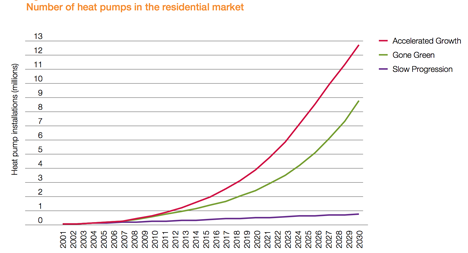
The three major oil companies each had different technologies on which they hung their hats to ease any fears of the future - including the widespread development of either methane hydrates or the oil shales of Colorado. (Neither of which can be realistically expected to come to pass in the next twenty years). The British National Grid in their view of the future seems to put is faith more in the widespread use of high-efficiency heat pumps.
Figure 1. Projected growth of heat pumps in the UK, under three future scenarios (National Grid)
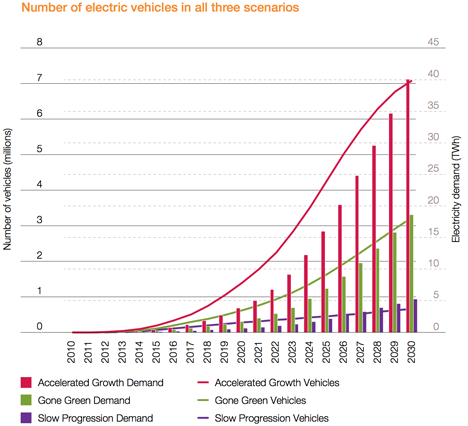
The also anticipate considerable growth in future sales of electric vehicles, though admitting that their earlier projections for these numbers were overly optimistic.
Figure 2. Projected growth in electric vehicle usage in the UK (National Grid)
As a result they anticipate significant reduction in the needs for fossil fuels, although the least optimistic of the scenarios (the Slow Progress one) means that:
In the Slow Progression scenario developments in renewable and low carbon energy are comparatively slow, and the renewable energy target for 2020 is not met until some time between 2020 and 2025. The carbon reduction target for 2020 is achieved but not the indicative target for 2030.
The concern with these optimistic projections, is that it also impacts the investment strategies of those who will need to supply those fuels in the future. Just as it takes time and money to build a power station, so it also takes time to permit and build a coal mine, or an oil or gas well, and the infrastructure to support it.
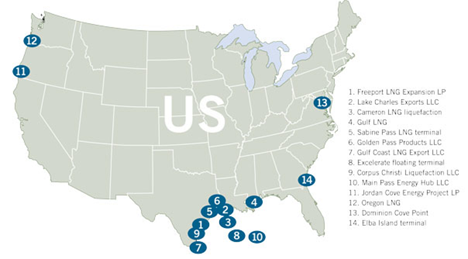
The current situation in the United States has proponents of the natural gas boom urging the development of export terminals to ship LNG to a global market at a very competitive price. By last December there were plans for a dozen such terminals in the works.
Figure 3. Proposed new LNG Export terminals in the United States (Oil and Gas Journal)
This additional supply, and the likely impact of cheaper natural gas into the European market has already caused Gazprom to rethink its strategy for natural gas development over the next few years.
The major Russian current development is taking place in the Yamal Peninsula, where the Bovanenkovo field, which came on stream last October had been projected to yield 4 Tcf by 2017, increasing 5 Tcf in the out years. Other adjacent fields, Kharasaveyskoye, Kruzensternskoye, Tambey and Nonoportskoye, were scheduled to follow in order to meet anticipated demand.
But those plans are now being scaled back. Russia has already lost some of their Chinese natural gas market to Turkmenistan, and now it can see that the US might take some of the European market. It cost $41 billion to develop Bovanenkovo, which made it “one of the most expensive industrial projects in the world.” Gazprom is cutting production by around 83% of capacity this year, and expects it may have to go lower. The natural follow-on to this will be a slowing of investment and development in Yamal, which also produces oil.
At present Russia is closing in on a record post-Soviet oil production
() reaching a level of 10.49 mbd (the Soviet peak was 11.48 mbd in 1987). Rembrandt recently noted that it is going to take a significant and ongoing investment in order to have any hope of sustaining those numbers.
My concern is that in the current Western euphoria, if all the current plans and projections for alternative supplies and conservation fail, those who must invest to build the alternative infrastructure that will provide sufficient fuel will not be motivated to make those investments in a timely manner. If they do not, or have not, then we will still need the 20-years that Robert Hirsch and his committee projected, when we run out of that time. (That clock is ticking). Unfortunately, those whosing this song, like Cassandra, are less likely to be heard in this interval.
Drumbeat: May 25, 2013
New Computer Attacks Traced to Iran, Officials Say
SAN FRANCISCO — American officials and corporate security experts examining a new wave of potentially destructive computer attacks striking American corporations, especially energy firms, say they have tracked the attacks back to Iran.
The targets have included several American oil, gas and electricity companies, which government officials have refused to identify. The goal is not espionage, they say, but sabotage. Government officials describe the attacks as probes looking for ways to seize control of critical processing systems.
Crude Caps Weekly Drop as Investors Weigh Stimulus West Texas Intermediate crude fell, capping its biggest weekly drop in more than a month, after rising U.S. durable goods orders bolstered concern that the Federal Reserve will scale back stimulus efforts.
Gasoline Slips on Speculation Demand to Fall After Memorial Day
Gasoline fell as equities declined and on speculation that demand will drop after the U.S. Memorial Day Holiday.
Futures headed for the biggest weekly decline since April 5 as the summer driving season began today with the start of the four-day holiday weekend. Demand rose 5.4 percent last week, and averaged over four weeks is down 3.3 percent from the year before, according to Energy Information Administration data. The S&P 500 slid 0.6 percent to 1,640.58 at 9:57 a.m. in New York.
Primorsk June Urals Crude Shipments Lowest Since at Least 2008
Russia, the world’s largest energy exporter, plans to ship less than one million barrels a day of Urals crude from Primorsk port on the Baltic Sea for the first time since at least 2008, a preliminary loading program showed.
Bolivia to boost incentives for gas exploration
Santa Cruz (Bolivia) (IANS) Bolivia's government, which asserted greater state control over the Andean nation's natural gas sector seven years ago, says it will issue a decree to encourage investment in exploration.
'State-run oil companies to gain more from new gas price'
NEW DELHI: Oil minister M Veerappa Moily on Friday said any revised price set for domestic natural gas would also apply to state-owned companies such as Oil and Natural Gas Corporation and Oil India , even as he joined issue with Left MP Gurudas Dasgupta to refute allegations of favouring Reliance Industries.
NY trial may clean Mexico’s oil mess
A trial in Manhattan federal court may help push Mexico to free its decaying oil industry from the state-owned monopoly known as Pemex, for Petroleos Mexicanos. And that’s good news for both sides of the border, indeed for the whole world.
Greece modifies DEPA privatisation terms to accommodate Gazprom: source
ATHENS (Reuters) - Greece agreed to change some terms in the planned privatisation of natural gas distributor DEPA, opening the way for Russian energy giant Gazprom to bid for the firm, a senior official directly involved in the sale talks said on Saturday.
Russia to cancel Gazprom’s liquefied gas export monopoly
Liberalizing liquefied natural gas (LNG) exports will take place on a legislative level once Novatek and Rosneft reach preliminary agreements with their international partners, according to Arkady Dvorkovich, the Deputy Prime Minister in charge of fuel and energy. He predicted the changes would take place this year.
Iran Sees Self-Reliance as Top Priority for Oil Industry
TEHRAN (FNA)- Deputy Iranian Oil Minister for Research and Technology Mohammad Reza Moqaddam said self-reliance and indigenization are among the Oil Ministry's top priorities.
Addressing the inaugural ceremony of the Membrane Technology Center Moqaddam said, "Today is an important day in the history of Iran's petrochemical industry."
Ineffectiveness of Sanctions Proved by Oil Industry
TEHRAN (FNA)- Iran's oil industry has proved ineffectiveness of the sanctions, Oil Minister Rostam Qassemi said.
Speaking at the inaugural ceremony of a membrane technology center, four catalysts and three technical knowhow at Petrochemical Research and Technology Company, Qassemi said, "Relying on their knowledge, Iranian researchers have been able to thwart sanctions imposed against the country and take great strides towards self sufficiency and indigenization oil industry equipments."
Gloomy predictions overlook change
A new assessment of the world’s oil reserves predicts a surge of supply from North America, mostly from new, unconventional sources. This will transform the global supply of oil and help ease tight markets.
By 2018, the International Energy Agency projects, global oil production capacity will grow by 8.4 million barrels a day — a significantly faster pace than demand. The headline reads: “Peak Oil Is Dead.” Peak Oil is a theory that at some point global oil production will peak, then steadily decline as oil reserves are depleted.
Almost everyone will be glad to know that this theory is dead.
Is peak oil never going to happen?
You can make a coherent, logical argument for cars that don't burn gasoline without once mentioning global petroleum supply. You can talk about international relations and the power of gasoline exporters (just read the first three paragraphs of this for a bit of history). You can talk about climate change. You can talk about the health effects of CO2 in the air. But the fact remains that gasoline (or diesel) remains the go-to fuel for almost every passenger vehicle on the planet, so the question of how much black gold is out there is an important one. The answer, though is not so clear.
Using up our finite resources will make us dependent on foreign oil
Regardless of the varying beliefs about climate change and whether mankind is impacting the climate, surely we all recognize that there is a finite supply of fossil fuels. At the same time, we can all agree the worldwide demand for fossil fuels will continue to grow along with population growth and with increased industrialization of countries in Asia and Latin America.
As demand for fuel grows, new sources are routinely being discovered and developed, but we know that there are limits to what is “out there.” We also recognize that many of the new fuel sources require greater resources for their development, and the capture of these fuels can have significant impacts on the environment.
Big Coal Faces Big Opposition In Pacific Northwest
Earlier this month, grassroots climate and anti-extraction activists in the Pacific Northwest scored a victory over one of the world’s most powerful industries. Kinder Morgan, an energy company that operates 26,000 miles of pipelines and owns 170 largely energy-related export terminals, announced it is scrapping plans to build a large coal export terminal on the Columbia River. The company has downplayed the role of community opposition to its terminal, claiming logistical considerations led to abandonment of the project. But local activists see more to the story than that.
Illinois proposes fracking tax that is lower than in other states
In Illinois, oil producers will enjoy their lowest tax rates when oil is flowing at its peak and tax rates would be about half that of some states with fracking operations.
The state would receive estimated $725,508 in taxes on each fracking well, assuming a life span of 10 years and a price of $85 per barrel of oil. A separate tax that would go to the local taxing districts in which the well is located would generate about $555,481, according to an analysis for the Tribune by Mark Haggerty of Headwaters Economics in Montana.
British Villagers, Fearing Fracking, Protest Plan for Drilling
BALCOMBE, England — Despite the stakes, there was almost a festival spirit in this wealthy little village nestled in the hills of West Sussex. Children buzzed around an open-sided tent by the street and families spread blankets on the tiny village green.
What brought them together on Thursday evening, though, was not a spring fair but deep worry. Cuadrilla Resources, a British energy company, is on the verge of drilling an exploratory oil well just down the road. Villagers see it as a possible precursor to the environmentally controversial drilling technique known as hydraulic fracturing, or fracking.
Is Nuclear Energy's Lightbulb Dimming?
Not only is dropping nuclear power a complicated issue, but it also challenges very recent data that show just how painful that endeavor could be. Advocates of a nuclear-free future should consider what would happen to the electricity bills of consumers in such a scenario. Meanwhile, the data may support the idea that exposing your portfolio to nuclear fuel won't be as radioactive to your portfolio as once thought.
Green phoenix rises from the ashes as Japan shifts its focus
The word "Fukushima" may be synonymous with nuclear meltdowns, ghost towns and contaminated rice fields.
The north-east region of Japan, however, once famed for its green mountains and fresh vegetables, is in the midst of the most ambitious of rebranding projects: it is attempting to transform itself into a global green energy hub.
Europe must get its head down
One professional judgement on Europe's advances in providing power from renewable energy sources reads a little like a promising but inconsistent pupil's school report card: "Makes steady progress but could do better."
The detail of the assessment may become clear when delegates meet in Vienna for a three-day European conference, hosted by the Renewable Energy World and Power-Gen and starting on June 4.
Ernest Moniz, Natural Gas And The “Forgotten Renewables”
In a town hall meeting with staffers last week, new Energy Secretary Ernest Moniz dropped a bombshell and a hint. The bombshell, at least as far as fans of natural gas are concerned, is that Moniz sees natural gas not as a permanent fixture in the U.S. energy landscape but merely as a temporary “bridge” to a globally competitive, low carbon future that is well within our grasp.
Better Place to file for bankruptcy
FORTUNE -- Electric car company Better Place is planning to file for bankruptcy within the next several days, Fortune has learned.
The move will come seven months after the ouster of charismatic founder Shai Agassi, and five months after his successor -- Evan Thornley, CEO of Better Place Australia -- also departed.
Car sharing with strangers a growing business in US
Los Angeles (IANS/EFE) The sight of a hitchhiker on the curb trying to hail some charitable driver could be a thing of the past as the practice of car sharing grows.
As a result of the recent economic crisis, the US has seen a wide range of companies ready to convert any and every car into a rental vehicle and provide its proprietor with extra income, while offering clients much lower prices than what a taxi or a rent-a-car like Avis or Hertz would charge.
Clemson police officer charged with theft of gasoline from motor pool
A Clemson University police officer is out of a job and faces multiple criminal charges.
The State Law Enforcement Division arrested Sgt. Jason D. Cassell, 39, of Pickens on Thursday on a charge of stealing gasoline from the university motor pool, according to a press statement from the university’s media relations office.
Bearing down: How safe is that bridge you're driving over?
To make all necessary repairs to America's bridges, the Federal Highway Administration estimates it will cost $76 billion.
Who's going to pay for that? Taxpayers? No thank you, say most of the Americans who answered a recent Gallup poll.
Two thirds said they're against paying more in gasoline taxes to fund bridge and road repairs in their own states. And it didn't matter if the respondents were Republican, Democrat or independent.
These 6 States Have the Most Dangerous Bridges
With help from the ASCE's report, let's look at the six states that have the greatest number of bridges that qualify as structurally deficient and therefore require substantial maintenance, rehabilitation, or replacement, with regular inspections to ensure continuing viability. We'll also look at some of the financial resources those states have to help pay for necessary work.
Floods could overwhelm London as sea levels rise - unless Thames Barrier is upgraded
There is significant risk of London being hit by a devastating storm surge in the Thames estuary by 2100 that could breach existing flood defences and cause immense damage to the capital, a study of global sea-level rise has found.
Melting of polar ice sheets and mountain glaciers could increase sea levels significantly over the coming decades leading to a 1 in 20 risk that the existing Thames Barrier would be unable to cope with an extreme storm surge, the study concluded.
Drumbeat: May 24, 2013
Crude Landlocked as Canadians Join U.S. to Halt Pipelines
British Columbia, the Canadian province whose official slogan to its own beauty is “Super, Natural,” is invoking another saying: “No more supertankers.”
That’s potentially big trouble in a nation where oil exports amount to $73 billion annually and the industry employs more than 550,000 workers. It’s also a bad omen for nations, notably China, that have invested billions in Canadian oil projects with expectations that they will one day be able to buy vast quantities of heavy Canadian crude.
House Passes Keystone Bill as White House Vows Veto The U.S. House of Representatives passed legislation to approve the Keystone XL oil pipeline, the eighth time congressional Republicans have advanced a measure promoting the project.
Democrats called yesterday’s vote in the Republican-controlled chamber a largely symbolic effort to score political points because the bill was unlikely to become law. The Senate, where Democrats have the majority, isn’t considering similar legislation, and President Barack Obama’s administration has threatened a veto should the bill emerge from Congress.
Texas Farmers Lose Another Bid to Block Keystone Pipeline
TransCanada Corp. won another of the remaining Texas state-court challenges by landowners trying to block construction of the Keystone XL tar-sands pipeline across their property.
Cheap shale gas bubble 'will burst within 2-4 years': Expert
The current shale gas boom which has bathed the US economy in cheap energy will soon go bust, a former gas industry geologist has told EurActiv.
The future of shale gas in Europe was high on the agenda at an EU summit in Brussels yesterday (22 May), with leaders stressing the “crucial” role that such indigenous energy resources could play in reviving industry.
But according to David Hughes, a geoscientist and former team leader on unconventional gas for the Canadian Potential Gas Committee, the US boom on which many base their expectations is founded on shifting sands.
WTI Heads for Biggest Weekly Decline in a Month on Supply
West Texas Intermediate headed for its biggest weekly drop in more than a month amid signs of rising U.S. oil inventories and a global economic slowdown.
Futures slid as much as 0.8 percent in New York. Prices may decline next week amid speculation that U.S. fuel supplies will be sufficient to meet summer demand after factory output in China shrank for the first time in seven months, according to a Bloomberg News survey. Goldman Sachs Group Inc. recommended selling WTI and buying Brent contracts for December 2014 as supplies accumulate on the U.S. Gulf Coast.
Oil Options Volatility Rises as Futures Decline Third Day
Crude oil options volatility rose as the underlying futures fell for a third straight session.
Implied volatility for at-the-money options expiring in July, a measure of expected price swings in futures and a gauge of options prices, was 22.5 percent at 1:35 p.m. on the New York Mercantile Exchange, up from 22.06 percent yesterday.
Gulf Crudes Strengthen as Volume Declines During Rollover Period
Gulf Coast crude oils strengthened on the spot market during the three-day rollover period characterized by below-normal volume and erratic pricing.
Russia to steeply cut Baltic oil loadings
LONDON: Russia will steeply cut Urals crude oil exports from Baltic ports in June and load a total of 58 cargoes compared to 70 cargoes in May, trading sources said on Friday citing a loading schedule.
OPEC to Keep Exports Stable Amid Supply Glut, Oil Movements Says
The Organization of Petroleum Exporting Countries will keep crude shipments little changed into early next month as abundant inventories cap demand, tanker tracker Oil Movements said.
Gasoil Ship Rates Rising in Northwest Europe as BP Takes Tankers
Rates to ship gasoil in northwest Europe are rising after BP Plc booked tankers to take refined fuel from the region to Algeria, draining vessel supply.
U.S. April Gasoline Use Fell From Year Earlier, API Says
U.S. gasoline consumption in April dropped to the lowest level for the month in 13 years, the American Petroleum Institute said.
Primorsk June Urals Crude Shipments Lowest Since at Least 2008
Russia, the world’s largest energy exporter, plans to ship less than one million barrels a day of Urals crude from Primorsk port on the Baltic Sea for the first time since at least 2008, a preliminary loading program showed.
India: Power Failures Set Off Protests
A blistering heat wave has swept across most parts of north and western India, causing widespread electricity cuts and leading residents to protest and even attack power company officials and property.
UK gas supply six hours from running out in March
Britain came within six hours of running out of natural gas in March, according to a senior energy official, highlighting the risk of supply shortages amid declining domestic production and a growing reliance on imports.
“We really only had six hours’ worth of gas left in storage as a buffer,” said Rob Hastings, director of energy and infrastructure at the Crown Estate, the property portfolio managed on behalf of the Queen. “If it had run any lower it would have meant . . . interruptions to supply.”
How to Invest in Peak Oil
In the following video, Motley Fool energy analysts Joel South and Taylor Muckerman discuss a theory that has been around for 40 years -- the idea of peak oil. Joel tells investors that this won't mean that we run out of oil completely; rather, it means the end of oil that is cheap to produce, as resources that are easily accessed begin to dwindle. He then gives investors a few possible long-term plays to make to capitalize on this trend.
Australia Lures $21 Billion Bet on Coal Rebound
Coal’s worst slump in seven years has failed to deter GVK Group and Adani Enterprises Ltd. from pressing ahead with a $21 billion bet on Australia’s Galilee Basin as other companies shelve projects amid rising costs.
Sinopec's Addax seeks more North Sea investments
GENEVA (Reuters) - Sinopec subsidiary Addax Petroleum wants to buy more North Sea assets this year, its Chief Executive said, in a sign that Chinese firms may further boost their regional investments after two multi-billion deals in 2012.
Addax, a Swiss-based oil producer and explorer which was bought by China's top refiner in 2009 for more than $7 billion, first entered the North Sea last July with the purchase of a 49 percent stake in Canada's Talisman.
Oil Revolt Generates $35 Billion as Icahn-Singer Agitate
Apache Corp. isn’t waiting for Carl Icahn to tell the energy company how to reverse a two-year decline that’s erased $14 billion from its market value.
BP, Chevron, Total and other major oil firms seek new terms in Iraq
International oil companies in Iraq are negotiating to revise their contracts with the government, as new production targets undermine the profitability of their operations.
Iraq's government earlier this year revised down its national oil output targets to 9.5 million barrels per day (bpd) by 2020, up from about 3 million bpd today, as part of a new blueprint for the development of its energy sector.
U.S. officials lauds India for reducing Iranian oil imports
PanARMENIAN.Net - A senior American official on Friday, May 24, praised India for reducing oil imports from Iran and said the U.S. government will decide soon on New Delhi’s request to renew a waiver from sanctions on Tehran, The Associated Press reports.
Gazprom announces ‘fundamentaly new’ LNG project
Russian gas major Gazprom will soon announce another "fundamentally new" liquefied natural gas project, according to company CEO Aleksey Miller. Sources say it’s likely to be an LNG plant in the Baltic.
Zurich Insurance Seeks China, Saudi Expansion on Growth Bets
Zurich Insurance Group AG plans to expand in China and Saudi Arabia as the insurer seeks to capitalize on economic growth in the world’s second-biggest economy and largest oil exporter.
Texas Cited by Democrat as Model for Less Flaring After Fracking
Texas should be the model for other states as officials seek to reduce the need to burn, or flare off, methane coming from oil and gas wells drilled by hydraulic fracturing, a top Senate Democrat said.
Senator Ron Wyden, chairman of the Energy and Natural Resources Committee, praised Texas for a flaring rate of 0.5 percent of the gas it produces.
Academics back BP's fight to cap oil spill payouts
LONDON (Reuters) - A group of accountancy professors is backing BP's fight to cap the U.S. oil spill compensation payouts it has to fund as the cash outflow threatens to add billions of dollars to its bill for the disaster.
Shipwreck Oil Spill Time Bombs Identified
Out of approximately 20,000 shipwrecks in U.S. waters, the National Oceanic and Atmospheric Administration recently identified 36 sunken vessels that most threaten to disgorge their oily innards. NOAA recommended further assessment and potential oil clean-up of seventeen of those shipwrecks. The list was further narrowed to six ships that were most probable to leak 10 percent of their fuel oil or oil cargo. These high risk ships were all off the coasts of New England or Florida.
IEA: protect consumers from energy price hikes
The International Energy Agency said Friday that Germany must shield its consumers from paying too much of the cost of its ambitious switch from nuclear power and fossil fuels toward renewable energy.
Solar plane completes second leg of cross-country flight in Texas
(Reuters) - A solar airplane that developers hope to eventually pilot around the globe landed safely on Thursday in Texas, completing the second and longest leg of an attempt to fly across the United States powered only by the sun.
The E-Cat is back, and people are still falling for it!
I’m done pretending that this is science, or that the “data” presented here is scientifically valid. If this were an undergraduate science experiment, I’d give the kids an F, and have them see me. There’s no valid information contained here, just the assumption of success, the reliance on supplied data, and ballpark estimates that appear to be supplied “from the manufacturer.”
This is not a valid way to do science at all. And this is certainly not even close to meeting the criteria required for extraordinary evidence to back up such an extraordinary claim.
The long road to the 2000-watt society
The vision of a society in which each inhabitant of the earth manages to consume only 2000 watts has already been around for 15 years. During this time, there has been a steady increase in environmental awareness in the West. Technology has become more efficient and there appears to be very little standing in the way of a sustainable lifestyle. However, as a study by Empa and the Federal Institute of Technology (ETH) Zurich now shows, Mr and Mrs Swiss are still a long way from achieving this.
2013 hurricane names: From Andrea to Wendy
Weather forecasters are predicting another busy Atlantic hurricane season. The storms will get their names from an alphabetical list of 21 names:
Andrea, Barry, Chantal, Dorian, Erin, Fernand, Gabrielle, Humberto, Ingrid, Jerry, Karen, Lorenzo, Melissa, Nestor, Olga, Pablo, Rebekah, Sebastien, Tanya, Van and Wendy.
Noaa predicts wildly active hurricane season out of Atlantic and Caribbean
Americans were warned on Thursday to brace for an extremely active hurricane season – less than a year after the devastation of Sandy, which hit the east coast in October 2012 – with 13 to 20 named storms, including seven to 11 hurricanes.
The National Oceanic and Atmospheric Administration, releasing its annual forecast, said 2013 would be prolific in raising storms out of the Atlantic and Caribbean. Of the predicted hurricanes, Noaa predicted that three to six could be major hurricanes, rated category three and packing winds of 111mph or higher.
Can We Protect Against the Next Moore Tornado?
Sad experience is teaching that some old tornado safety tricks aren't as effective as hoped — particularly when buildings aren't designed with tornado safety in mind. In Joplin, Miss., a 2011 tornado killed 158, according to the National Weather Service (the city of Joplin pegs the death toll at 161). Among the devastated buildings was a local high school, and some of the spots disaster experts would normally suggest people go for shelter turned out to be among the most badly damaged there.
Interior hallways are usually the suggested shelter spots, but in Joplin, doors and glass windows at either end of long halls were destroyed by debris, creating a dangerous situation, Gallus said.
"Hallways became wind tunnels," he said. Architects like natural light, he said, but "probably when we design schools in the future, we need to be careful how we design them."
US carbon price backed by independent office
A tax on carbon dioxide emissions could help the United States mitigate climate change while significantly increasing government revenue, the nonpartisan Congressional Budget Office said this week.
President Barack Obama supports plans to price carbon dioxide emissions from power plants, tailpipes and factories that have been blamed for worsening climate change.
A mission on climate change
President Obama should spend his remaining years in office making the United States part of the solution to climate change, not part of the problem. If Congress sticks to its policy of obstruction and willful ignorance, Obama should use his executive powers to the fullest extent. We are out of time.
Colorado's state climatologist says the High Park Fire granted him the permission, courage to talk about climate change.
Nolan Doesken used to have a hard time talking about climate change.
The topic has become so politically combustible that some scientists and researchers find it difficult to speak of or write about.
But, after the High Park Fire swept the foothills in 2012, Doesken decided to talk more openly about the reasons behind Colorado’s changing weather when talking to the agriculture community.
Russia evacuates drifting Arctic research station
Russia has ordered the urgent evacuation of the 16-strong crew of a drifting Arctic research station after ice floe that hosts the floating laboratory began to disintegrate, officials said Thursday.
Natural Resources and Ecology Minister Sergei Donskoi set a three-day deadline to draft a plan to evacuate the North Pole-40 floating research station, the ministry said in a statement.
Why Happy People Hide From Climate Change
New research found that when people have positive feelings toward climate change, such as hopefulness or excitement, they are more likely to avoid seeking information about it. Those who felt concerned, anxious or depressed about the topic, on the other hand, were more likely to seek information about it, new research shows.
What Does 400 PPM Mean for American Labor?
n 1940, as Nazi armies marched across Europe, United Automobile Workers Union (UAW) president Walter Reuther made a stunning proposal: Retool the Depression-ravaged auto industry to build 500 planes a year for national defense. Many scoffed. But a huge wartime mobilization put tens of millions of unemployed and underemployed workers to work producing what the war effort required, while shutting down wasteful and unnecessary production that would detract from it.
Screwed by climate change: 10 cities that will be hardest hit
Here at Grist, climate change is our bread and melting butter. But this month, we’re feeling especially hot and bothered. As part of our in-depth look at the warming planet, we’ve compiled a list of the U.S. cities that we think will be in the hottest water as the mercury rises — in some cases, up to their foreheads.
Spared by climate change: The 10 best cities to ride out hot times
Yesterday, we brought you our remarkably unscientific (seriously, it was written by this guy) list of the 10 cities most likely to get hammered by climate change. Today, we thought we’d give you the bright side, such as it is: the 10 towns to which we’ll all be flocking as the rest of the world goes to hell. You’re welcome. (Hey, we don’t call Grist “a beacon in the smog” for nothing.)
Saving Delaware's coast from sea-level rise
In a symbolic blow to state climate change adaption efforts, the Delaware county with most at stake in future sea-level rise forecasts abruptly declined to take any stand on the issue Thursday as a state panel approved dozens of recommendations for dealing with the threat.
Global Energy Systems - June 26-28 2013
Our energy system is evolving due to depletion of cheap fossil fuels and the need for carbon emission constraints. Government and business are under pressure to tackle the energy challenges of rising energy costs, energy security, and reducing greenhouse gas emissions. We witness rapid changes across countries as this evolution takes place, steered both by markets (investment decisions) and government (policy decisions).
It is essential for energy professionals to stay well informed with the latest insights in this evolving world. For this reason, Euan Mearns of The Oil Drum, myself and several others, are organizing the first three-day Global Energy Systems conference, which will take place in Edinburgh, United Kingdom from June 26 - 28 2013. The conference is meant to deliver key updates on the most pressing energy issues and challenges facing our energy system, as well as providing a forum for exchange of substantially different viewpoints. It is supported by several universities and research institutes including University of Aberdeen, University of Edinburgh, Oxford Research Group, Chatham House and others.
The scope is deliberately very broad, covering most primary energy sources, so that a global view of the current energy system can be presented. Session topics include “the limits to easily accessible fossil fuels”, “frontier fossil fuel technologies and basins”, “the viability of nuclear power”, “the costs and benefits of fossil versus renewable electricity”, and “the economics and policy of energy systems”. A few of our confirmed speakers include Michael Kumhof (IMF), Sir David King (former Head Smith School Oxford University), Friedrich Schulte (Head of Technologies RWE), Dr. William Blyth (Director Oxford Energy Associates) , Peter Jackson (IHS CERA), Lord Ron Oxburgh (House of Lords UK Parliament), Richard Stainsby (Chief Technologiest UK National Nuclear Laboratories), Alexander Naumov (Group Economics BP), Guy de Kort (Shell Vice President GTL), and Tatiana Mitrova (Head Oil & Gas Energy Research Institute Russian Academy of Sciences).
Read below the fold for an overview of the conference programme and confirmed speakers to date.
General information
1st Global Energy Systems Conference
Our Dynamic Earth, Edinburgh, United Kingdom
Wednesday June 26 to Friday June 28, 2013
Registration open - early bird deadline passed
General interest, media and sponsorship enquiries
The conference is organized on a non-profit basis by a group of energy professionals concerned about the challenges that we face. Any expressions of interest, suggestions for content and analysis, and contributions of sponsorship, are most welcome. Your content, media, and sponsorship related communication can be directed to: alexr at scenetwork.co.uk
Conference Programme
Programme Committee and Sponsors 09:40 – 10:25 Keynote Address on the Global Energy Challenges
Lord Ron Oxburgh, House of Lords UK Parliament 10:25 – 10:50 Coffee & tea The Limits to Easily Accessible Fossil Fuels 10:50 – 11:15 Fossil Fuel Production forecasts: analysis of resource and reserve assumptions and model mechanics
Joint Paper convened by Dr. Roger Bentley 11:15 – 11:40 Perspectives on China's Coal Industry and Future
Kevin Jianjun Tu, Senior Associate Carnegie 11:40 – 12:05 The Architecture and Drivers of Future Oil Supply
Dr. Peter Jackson, Head of Research IHS CERA 12:05 – 12:30 Russia's Natural Gas Production & Export Policy
Dr. Tatiana Mitrova, Head Oil & Gas, Energy Research Institute Russian Academy of Sciences 12:30 – 13:30 Lunch Break Frontier Fossil Fuel Technologies and Basins 13:30 – 13:55 The future of US shale/tight oil
Dr. Kenneth Chew 13:55 – 14:20 Oil and gas recovery from continuous (unconventional) resources: Technology innovation options for improving the economic baseline
Dr. Ruud Weijermars, Director TU/Delft Unconventional Gas Research Initiative 14:20 – 14:55 Key developments and challenges of Enhanced Oil Recovery techniques and CO2 Solutions
Prof. Mehran Sohrabi, Institute of Petroleum Engineering, Heriot-Watt University 14:55 – 15:10 Refreshment Break 15:10 – 15:35 The current status of Underground Coal Gasification as a Commercial Technology
Dr. Peter Dryburgh, Wardell Armstrong 15:35 – 16:00 Gas to Liquids - an opportunity to convert natural gas for use in the transport sector
Guy de Kort, Shell Vice President GTL 16:00 – 16:30 Coffee & tea Debate: Energy Scarcity, Threat or Fiction? 16:30 – 17:30 Chaired By - Paul McConnell, Wood MacKenzie Consulting Viewpoint A: "Upcoming technologies will unlock the unconventional resource base"
- Panelist to be announced
Program Committee 18:00 – 21:00 Drinks & Networking Event
Separate tickets available
Day 2 – The Future of the Electricity System Conference Opening 08:00 – 09:00 Registration | Coffee & tea 09:00 – 09:40 Welcome and Sponsor addressProgram Committee and Sponsors 09:40 – 10:25 Keynote Address
Dr. Jeremy Leggett, non-Executive chairman Solarcentury, Chairman Solaraid 10:25 – 10:50 Coffee & tea The viability of Nuclear Power 10:50 – 11:15 Should the UK nuclear programme be a model for the rest of Europe?
Prof. Steve Thomas, Greenwich University 11:15 – 11:40 The costs and economic viability of nuclear energy
David Shropshire, Head Planning and Economic Studies, International Atomic Energy Agency 11:40 – 12:05 Trends towards Sustainability in the nuclear fuel cycle
Dr. Ron Cameron, Head Nuclear Development Division, OECD Nuclear Energy Agency 12:05 – 12:30 Generation IV fast reactors and the re-use of long-lived nuclear waste
Dr. Richard Stainsby, Chief Technologist, UK National Nuclear Laboratories 12:30 – 13:10 Lunch Break The challenges of a renewables based electricity grid 13:10 – 13:30 The Renewables Policy Challenge: Scottish context
Dr. Nicola McEwen, Director of Public Policy, Academy of Government, University of Edinburgh 13:30 – 13:55 The Benefits and Costs of Renewable Energy deployment
Dr. Ulrike Lehr, Institute of Economic Structures Research GWS 13:55 – 14:20 Grid balancing and development in an era of renewable energies
Andrew Hiorns, Network Strategy Manager, National Grid UK 14:20 – 14:55 Demand side electricity grid management
Alastair Martin, Founder, Flexitricity 14:55 – 15:10 Refreshment Break 15:10 – 15:35 The potential and costs of electricity storage
Friedrich Schulte, Head of Technologies, RWE AG 15:35 – 16:00 Electrochemistry and the energy storage gap
Dr. David Fermin, University of Bristol 16:00 – 16:30 Coffee & tea Debate: Where to invest in for the electricity system of the future? A choice between Shale Gas, Nuclear, Renewables, and Coal with CCS? 16:30 – 17:30 Chair to be announcedPanelists: Day Summary 17:30 – 18:00 Closing of Day 2
Programme Committee 18:00 – 19:30 Policy Workshop: the information, data, and policy gaps on meeting the Energy Challenges
Breakout group of speakers plus invited delegates
Day 3 – The Economics & Policy of Energy Systems Conference Opening 08:30 – 09:00 Coffee & tea 09:00 – 09:15 Welcome and Sponsor address
Programme Committee and Sponsors 09:15 – 10:00 Keynote Address
Professor Sir David King, Former Director Smith School Oxford University Understanding Energy Supply, Demand, Price, and the role of policies 10:00 – 10:25 The energy outlook to 2030: Global Trends in energy-economic relations
Dr. Alexander Naumov, Group Economics, BP plc 10:25 – 10:50 The influence of price risks on policy design and investment
Dr. William Blyth, Director Oxford Energy Associates 10:50 – 11:15 Coffee & tea 11:15 – 11:40 The capital cost requirements of energy transitions
Dr. Michael Dale, Stanford University 11:40 – 12:00 The demand side: energy intensity of the economy
Dr. Sgouris Sgouridis, Masdar Institute Panel Discussion on Key Knowledge, Data & Policy Gaps in the Energy sphere 12:00 - 12:45 Honorary Panel Leader - Professor Charles Hendry MP 12:45 – 13:00 Conference Summary
Final Sponsor Thanks Energy Modelling workshop 14:00 – 14:15 Introduction 14:15 – 14:45 Selected Individual Presentation rounds 14:45 – 16:00 Discussion
- Dr. J-F. Mercure, Cambridge University Centre for Climate Change Mitigation Research, 4CMR modelling
Predicting the Weather, Corn, Ethanol and Oil Production
News of the future was, in my youth, something that one found by crossing the palm of a lady in a dark tent with a piece or two of silver (or the modern equivalent) at one of the fairs that came to town. Such opportunities still exist, with all the caveats that existed back then likely still being in force. However, projecting the future, whether of the weather, the likely corn crop this year in the United States, or the production of crude oil by the nations of the world has become a much bigger business with copious tables, graphs and theories replacing the rather worn pack of cards or crystal ball of my youthful experience.
Our part of the world underwent a drought last year severe enough to kill several trees in our yard, for example, as well as hurting the corn crop. This year, corn plantings have been severely impacted by the heavy rains and cold weather, so that decisions on crop plantings have become more complicated and delayed, with follow-on impacts on the ultimate yield in a number of Midwestern states. Corn yield apparently falls at an average rate of 2.3 bushels per acre per day of delay in northern Wisconsin. These changing conditions make it difficult to assess how much ethanol, for example, will be available to meet demand, although the latest EIA TWIP holds out some optimism for this year.
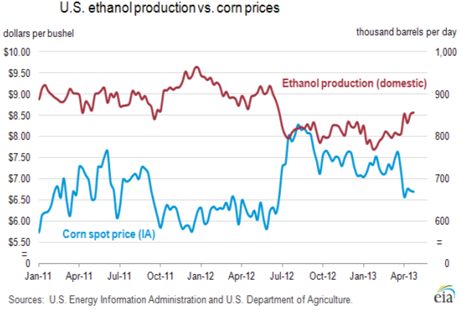
The impact of the drought on corn prices, and the consequent fall in ethanol production, as production costs rose, are directly visible from their plot of the two over the last year.
Figure 1. A comparison of corn prices and ethanol production in the USA (EIA TWIP )
However, with the weather impacts still being assessed, it is already being concluded that the US corn crop is unlikely to reach the record level of close to 14.6 billion bushels that were earlier projected. It still, however, has the potential to reach around 12.3 billion bushels, which would satisfy the just under 5 billion bushel need for ethanol, as well as other demands of the market. By May 12 only 28% of this year's expected crop had been planted, in contrast with a normal year where 65% would be in the ground. Thus, even the relatively short-term projections of the EIA could yet be in trouble for this year.
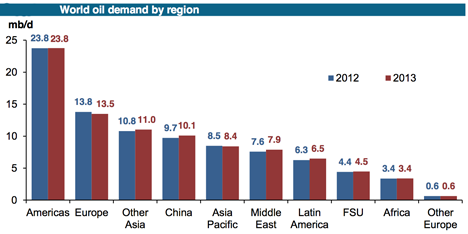
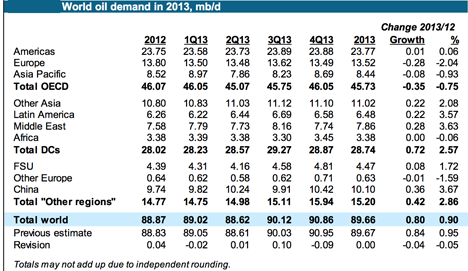
Moving to the slightly longer-term, the nations that form OPEC must try to estimate global demand for their products and the amount that other non-OPEC nations will produce, so that they can balance supply and demand at such a level that will sustain prices they are comfortable with. Their estimates come out as Monthly Oil Market Reports and in the latest (May) version they continue to expect global demand to increase by 0.8 mbd over 2013, but are beginning to hedge that bet as the global economy continues to appear anemic, with Russian and Asian economies slowing. Yet by the fourth quarter of the year, they anticipate that global demand will reach 90.9 mbd.
Figure 2. Global oil demand by region (OPEC MOMR)
OPEC anticipates that with the major increase coming from the Americas, that non-OPEC oil production will increase by just under 1 mbd to reach an a level of 54.41 mbd in the fourth quarter of the year. The majority of that growth (some 0.59 mbd) will come from the United States, with the Permian, Bakken and Eagle Ford being cited as the anticipated source of these gains. OPEC, having looked at current rig counts, project that these numbers may be revised upwards over the course of the year. And yet it is worth noting this:
On a quarterly basis, US oil supply is seen to average 10.62 mb/d, 10.67 mb/d, 10.62 mb/d and 10.61 mb/d respectively.
The sustained gain in North American production comes about because:
On a quarterly basis, Canada’s production is anticipated to average 4.02mb/d, 3.97 mb/d, 4.02 mb/d and 4.12 mb/d respectively.
Russia is expected to continue to lead in oil production over the course of the year, although it is not longer expected to increase production above current levels.
On a quarterly basis, Russian oil supply is seen to average 10.45 mb/d, 10.43 mb/d, 10.43 mb/d and 10.43 mb/d respectively.
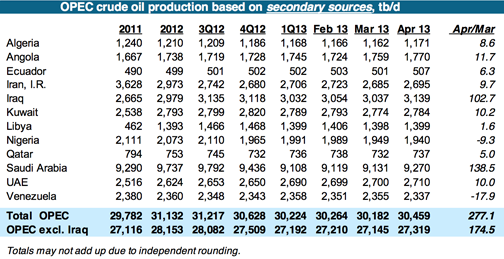
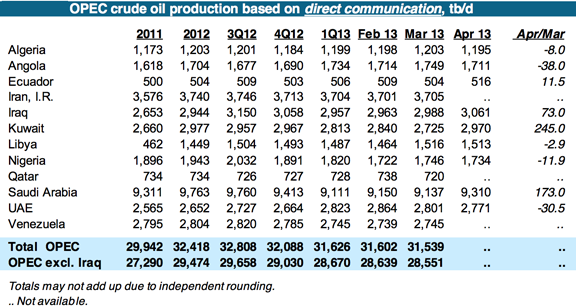
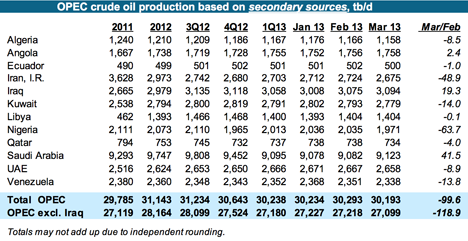
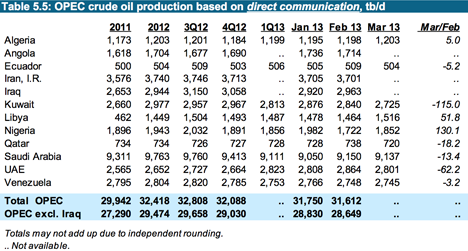
And this brings us back around to OPEC as they try and balance their production against the gap between global demand and non-OPEC supply. As has been the case for a while, OPEC produced two separate tables showing production, as reported by secondary sources as well as those directly reported by the countries themselves.
Figure 3. OPEC member production as reported by secondary sources (OPEC MOMR)
Figure 4. OPEC member production as reported directly (OPEC MOMR)
It would appear with Manifa coming on line, that Saudi Arabia is increasing production again, while Venezuela and Iran would have you believe they are producing more than they are, and Iraq, which is now producing above 3 mbd, is directly reporting less (though that could be because some of that production is coming from the north, and there are some communication problems between there and Baghdad).
As long as OPEC has available reserves, it can continue this balance to keep enough oil available at an acceptable price to allow the world economy to continue at its present pace. And with that ongoing adjustment available, their projections for this year of a relatively stable price would seem fairly founded, absent some major change in one of the larger producing states.
Iraq overtook Iran as the second largest producer in OPEC last year (according to secondary sources) and expects that with production from Majnoon, it will increase production capability by upwards of 200 kbd by the end of the year. Ultimately the goal is to achieve a target production of 1.8 mbd. However, as overall production levels increase, Iraq may join with the Kingdom in controlling production to maintain price.
Yet even with those abilities, OPEC is becoming cautious about predicting that their estimate of the demand:supply balance numbers for this year will be accurate over that time interval.
With these uncertainties in even short-term projections of future production, whether it be corn, ethanol or crude, it is perhaps wise to continue a somewhat cynical view of projections over a longer time period. Although the bounding bar of a decline in existing field production continues to exist, and will continue to require an offset in increased production from new wells to offset. Perhaps that lady in the tent of my youth may prove as prescient as some of the more optimistic forecasts that we continue to see.
Drumbeat: May 15, 2013
Oil Shockwaves From U.S. Shale Boom Seen by IEA Ousting OPEC
The U.S. shale boom will send “shockwaves” through the global oil trade over the next five years, benefiting the nation’s refiners and displacing OPEC as the driver of supply growth, the IEA said.
North America will provide 40 percent of new supplies to 2018 through the development of light, tight oil and oil sands, while the contribution from the Organization of Petroleum Exporting Countries will slip to 30 percent, according to the International Energy Agency. The IEA trimmed global fuel demand estimates for the next four years, and predicted that consumption in emerging economies may overtake developed nations this year.
“The supply shock created by a surge in North American oil production will be as transformative to the market over the next five years as was the rise of Chinese demand over the last 15,” the Paris-based adviser to 28 oil-consuming nations said in its medium-term market report today.
The IEA Says Peak Oil Is Dead. That’s Bad News for Climate Policy No one—aside maybe from survivalists who’d stocked up on MREs and assault rifles—was really looking forward to a peak-oil world. Read this 2007 GQ piece by Benjamin Kunkel—while we’re discussing topics from the mid-2000s—that imagines what a world without oil would really be like. Think uncomfortable and violent. Oil is in nearly every modern product we use, and it’s still what gets us from point A to point B—especially if you need to get from A to B in a plane. If we were really to see the global oil supply peak and decline sharply, even as demand continued to go up, well, apocalyptic might not be too large a word. And for several years in the middle of the last decade, as oil prices climbed past $100 a barrel and analysts were betting it would break $200, that scenario seemed entirely plausible.
But there was an upside to peak oil. Crude oil was responsible for a significant chunk of global carbon emissions, second only to coal. Only the shock of being severed from the main fuel of modernity would be enough to make us get serious about tackling climate change and shifting to an economy powered by renewable energy and efficiency. We’d have to because we’d have no other choice, save a future that might look something like Mad Max. We’d lose oil but save the world.
The World is Not Running Out of Oil – but Europe Is
Contrary to popular belief, peak oil alarmists and Greenpeace propaganda, the world is still and will continue to be for at least a century, largely powered by oil. And not just for transport. An endless number of consumer goods depend on a steady supply of petroleum products for their manufacture. As Marin Katusa, chief energy investment strategist for Casey Research points out, “A country without oil simply cannot continue to expand or even be competitive on the world stage.” Katusa explains, most of Europe’s oil comes from the North Sea region. A source where production has dropped to less than half of what it was in 2002. Much of the rest of it comes from countries such as Libya, Saudi Arabia and Nigeria, all countries threatened by political instability and social unrest. Europe could, of course, push development of its own potential oil resources. Or they could if the ludicrously inept EU Energy Road Map wasn’t studded with anti-fossil fuel pot holes and renewable energy cul-de sacs that are deterring investors.
It Doesn't Matter If We Never Run Out of Oil: We Won't Want to Burn It Anymore
Like whale oil in the 1860s, oil today has become uncompetitive -- even at low prices -- and that will only become truer with time.
No, Really: We're Going to Keep Burning Oil—and Lots of It
No matter how much we wish it were otherwise, the economics favor burning fossil fuels.
Peak oil, climate change and pipeline geopolitics driving Syria conflict
Syria's dash for gas has been spurred by its rapidly declining oil revenues, driven by the peak of its conventional oil production in 1996. Even before the war, the country's rate of oil production had plummeted by nearly half, from a peak of just under 610,000 barrels per day (bpd) to approximately 385,000 bpd in 2010.
Since the war, production has dropped further still, once again by about half, as the rebels have taken control of key oil producing areas.
Faced with dwindling profits from oil exports and a fiscal deficit, the government was forced to slash fuel subsidies in May 2008 - which at the time consumed 15% of GDP. The price of petrol tripled overnight, fueling pressure on food prices.
The crunch came in the context of an intensifying and increasingly regular drought cycle linked to climate change. Between 2002 and 2008, the country's total water resources dropped by half through both overuse and waste.
China Seen Boosting Emergency Oil-Storage Capacity, IEA Says
China will probably commission additional storage sites for its strategic petroleum reserve this year, boosting crude demand even as construction work on the program takes longer than expected, according to the International Energy Agency.
The nation, the world’s second-biggest crude consumer, will add 245 million barrels of capacity in the second phase of its emergency stockpile plan, the Paris-based IEA said in its Medium-Term Oil Market Report released today. That’s up 45 percent from the IEA’s original estimate of 169 million barrels. Completion may be delayed to 2015, according to the agency, which originally forecast the project would be finished by the end of this year.
Shell Targeted With BP in EU Price Fixing Probe for Oil
Three of Europe’s biggest oil explorers are among companies being questioned by European antitrust regulators about potential manipulation of prices in the $3.4 trillion-a-year global crude market.
EU Oil Manipulation Probe Shines Light on Platts Pricing Window
Two weeks after Royal Dutch Shell Plc and Platts changed the way more than half of the world’s crude is valued, the companies along with BP Plc and Statoil ASA are being probed by European antitrust regulators about potential manipulation of oil prices.
The investigation by the European Commission shines a light on how price reporting companies including Platts, the energy news and data provider owned by McGraw Hill Financial Inc., help determine the cost of raw materials used in everything from plastic bags to jet fuel. The suspected violations are related to the Platts’ Market-On-Close assessment process, or so-called window, and may have been ongoing since 2002, Statoil said.
Britain urges oil firms to comply with probe
LONDON (Reuters) - Britain expects oil firms to fully comply with a European Commission's probe into energy pricing and would be deeply concerned if prices have been driven up, a spokesman for Prime Minister David Cameron said on Wednesday.
WTI Crude Near Two-Week Low; Europe Probes Oil Pricing
West Texas Intermediate crude fell for a fifth day in its longest run of declines since December. Antitrust regulators are questioning European oil companies about possible manipulation of prices.
Futures traded near their lowest closing level in almost two weeks in New York. Crude inventories gained 1.1 million barrels last week, the industry-funded American Petroleum Institute said yesterday. A government report today may show stockpiles climbed 450,000 barrels, according to a Bloomberg survey. Royal Dutch Shell Plc, BP Plc, Statoil ASA and Platts said they’re being investigated after the European Commission conducted raids on their offices in three countries.
“The world will remain well-supplied,” said Andrey Kryuchenkov, an analyst at VTB Capital in London. “Higher prices lately have triggered a boost to capacity that will continue to outpace slack post-crisis demand growth.”
Nebraska could see another spike in gas prices
Drivers in the Plains states, including those in Nebraska, could be paying another 10 to 20 cents a gallon for gasoline in the next few days, and that's on top of the 15- to 20-cent increases of the past week, according to industry analysts at GasBuddy.com
“Most states have seen increases over the past week, and the national retail average reflects that with a 6-cent-per-gallon increase, but clearly, these states have gotten the brunt of it,” said Patrick DeHaan, senior petroleum analyst, GasBuddy. He was referring to North Dakota (up $0.19 per gallon over the past week), Kansas ($0.17), Nebraska ($0.16), Iowa ($0.15), Oklahoma ($0.14), South Dakota ($0.13) and Minnesota ($0.12).
Ex-Goldman Trader Saiz’s Fund Assets Drop 86% Following Loss
Vector Commodity Management LLP’s assets under management slumped 86 percent this year after losing money since 2011.
The energy hedge fund run by former Goldman Sachs Group Inc. trader Gilbert Saiz managed $43 million by the end of April, according to a letter to investors obtained by Bloomberg News. Its December statement showed assets of $318 million. Vector’s trading of mainly crude and oil products resulted in a 4.9 percent loss from January through April, the letter showed. A Vector executive in London, who asked not to be named in line with company policy, declined to comment by phone today.
Pertamina embarks on shale gas exploration
Indonesia’s biggest energy firm, PT Pertamina, will tap into shale gas exploration this year in the state-controlled company’s bid to discover unconventional natural gas amid dwindling crude oil production.
Pertamina CEO Galaila Karen Agustiawan signed the production-sharing contract of the Sumbagut block in North Sumatra during the inauguration of the of the 37th Indonesian Petroleum Association (IPA) convention in Jakarta on Wednesday.
Brazil Oil Auction Gathers Drillers With Taste of Africa
More than 60 oil companies are set to bid on exploration permits offshore Brazil, taking on risks of drilling in virgin waters after similar geology across the Atlantic in Ghana and Ivory Coast yielded major discoveries.
Contestants in Brazil’s first oil auction in five years range from Exxon Mobil Corp. and Chevron Corp., the largest U.S. producers by market value, to Brazilian startup Ouro Preto Oleo & Gas, a government registry shows. They’re betting that deep-water deposits off the northern coast hold reserves like those found thousands of miles across the ocean in Africa’s Gulf of Guinea. The two-day sale, estimated to generate as much as $5 billion for the government, started today in Rio de Janeiro.
Russia Seeks $2 Billion Gain With Oil Extraction Tax Increase
Russia’s Finance Ministry is seeking to raise $2 billion by raising taxes on crude output as the world’s largest oil-producing nation seeks to boost budget revenue, according to a plan presented to government officials.
A higher mineral extraction tax rate will be partly offset by a decrease in export duties, according to the document. The budget’s gain is based on an average oil price of $100 a barrel.
Anadarko’s Walker Named Chairman as Hackett’s Reign Ends
Hackett remade Anadarko through deep-water exploration projects in Africa and the Gulf of Mexico and more than $21 billion in acquisitions. Analysts are looking for Walker, 56, to extract more value from the oil and natural gas assets Hackett assembled, while helping the company move beyond an environmental lawsuit and its association with BP Plc’s 2010 Macondo oil spill in the Gulf of Mexico.
Greece to break up state-owned power company by 2016
ATHENS -- Greece's conservative-led government has announced plans to break up the state-run Public Power Corporation by 2016, as part of a privatization program demanded by the crisis-hit country's creditors.
Taiwan to sanction Philippines, send naval ships in fishing spat
TAIPEI (Reuters) - Taiwan on Wednesday recalled its envoy to the Philippines, froze applications for work permits and ordered military exercises in waters between the two sides to press its demand for an apology for the shooting death of a Taiwanese fisherman.
Andrew Weaver makes history in BC, becomes first Green in provincial legislature
Andrew Weaver — a University of Victoria climate scientist — has won his seat in the Vancouver Island riding of Oak Bay-Gordon Head becoming the first Green Party candidate elected to a provincial legislature in all of Canada.
B.C. vote shifted on one word: Pipelines
The NDP looked way ahead before voters went to the polls in British Columbia. Then it all changed. Why? One word: “Pipelines.” Or more precisely, two: “Kinder Morgan.”
Until two weeks ago it was the election of the NDP’s Adrian Dix to lose. Then he got greedy. Worried about an emerging Green threat, Mr. Dix sought to pre-empt the party by going greenier-than-thou, specifically by promising to ban significantly greater tanker traffic out of the port of Vancouver, which would doom the export of Alberta oil to the Pacific. This was a stunning turnabout on a clear promise to withhold judgement until the pipeline application had been filed with details made available.
His gamble failed and, more importantly for the future of the NDP, the Greens elected their first MLA. This will split the vote on the left for years to come.
Ex-BP Engineer Says U.S. Withheld Evidence in Spill Case
A former BP Plc (BP/) engineer charged in the first criminal case arising from the 2010 Gulf of Mexico oil spill said U.S. prosecutors withheld evidence that might clear him and urged a judge to sanction them.
Why natural gas exports would benefit clean energy
The renewable energy industry would benefit from higher natural gas prices--and higher coal prices, for that matter--since, as these fuels for electric power plants become dearer, renewable energy sources become more competitive. The costs for renewables are in the production and installation of the solar panels, wind towers and dams; the fuels--sunlight, wind, and water--are essentially free.
Fuel-Cell cars set to gain momentum in US, but will consumers want to pay for the vehicles?
Considered by many to be more efficient than even electric vehicles, fuel cells aren’t limited by the dynamics of thermodynamics, notes NextGreenCar, which enables them to achieve higher conversion efficiencies than conventional engines that only make use of 20 percent-25 percent of the fuel’s energy (as in gas-powered cars) – fuel cells can achieve up to 60 percent.
M-B-Hydrogen-FCVHowever, unlike a battery the reactants – fuel and oxygen – have to be continually supplied for an electric current to be produced.
Fuel cell vehicles have been known to have a driving range of up to 240 miles or more.
North Carolina May Ban Tesla Sales To Prevent “Unfair Competition”
From the state that brought you the nation’s first ban on climate science comes another legislative gem: a bill that would prohibit automakers from selling their cars in the state.
The proposal, which the Raleigh News & Observer reports was unanimously approved by the state’s Senate Commerce Committee on Thursday, would apply to all car manufacturers, but the intended target is clear. It’s aimed at Tesla, the only U.S. automaker whose business model relies on selling cars directly to consumers, rather than through a network of third-party dealerships.
Petrobras Besting Sugar Mills in Ethanol Boom
Petroleo Brasileiro SA, the state-run oil producer, stands to profit the most from Brazilian measures to boost ethanol output as rising biofuel supplies reduce the need to sell imported gasoline at a loss.
£11billion energy smart meter roll out delayed by a year because 'more time is needed for testing'
The roll out of energy smart meters in to 30 million UK homes is being delayed by a year because more time is needed to design and test products, the government has announced.
The £11billion project will start in the autumn of 2015, rather than next summer, the Department of Energy and Climate Change (DECC) said.
Homeowners Warm to Solar Power
When Linda and Jay Mathews moved back to their native California nearly two years ago — after 20 years in New York and Washington — they found their dream home in Pasadena. It had everything they wanted, plus a few items not on their shopping list. Among the latter: solar panels on the roof that keep their electric bill to about $100 a year, less than what they paid each month when they were living in the East.
Moreover, because the power generated by their panels contributes to the region's overall electric grid, they also receive credit for energy they produce but don't use — a policy known as "net metering," which adds additional savings to their overall electric costs.
US holds wind farm radar tests
The US Federal Aviation Administration (FAA) has conducted trials on technologies designed to solve the problem of wind farms’ impact on radar.
The tests were organised by the Federal Aviation Administration, Department of Defense, Department of Homeland Security and Department of Energy, and assessed by the Massachusetts Institute of Technology Lincoln Laboratory.
Fewer Rain Forests Mean Less Energy for Developing Nations, Study Finds
The loss of tropical rain forests is likely to reduce the energy output of hydroelectric projects in countries like Brazil that are investing billions of dollars to create power to support economic growth.
UN: Eat more insects; good for you, good for world
ROME (AP) — The latest weapon in the U.N.'s fight against hunger, global warming and pollution might be flying by you right now.
Edible insects are being promoted as a low-fat, high-protein food for people, pets and livestock. According to the U.N., they come with appetizing side benefits: Reducing greenhouse gas emissions and livestock pollution, creating jobs in developing countries and feeding the millions of hungry people in the world.
Potato may help feed Ethiopia in era of climate change
With unpredictable annual rainfall and drought once every five years, climate change presents challenges to feeding Ethiopia. Adapting to a warming world, the potato is becoming a more important crop there – with the potential to feed much of Africa.
Canada Sells Out Science
Over the past few years, the Canadian government has been lurching into antiscience territory. For example, they’ve been muzzling scientists, essentially censoring them from talking about their research. Scientists have fought back against this, though from what I hear with limited success.
But a new development makes the situation appear to be far worse. In a stunning announcement, the National Research Council—the Canadian scientific research and development agency—has now said that they will only perform research that has “social or economic gain”.
Crucial Carbon Dioxide Reading Revised Downward
One of the two programs that monitor greenhouse gases said on Monday that it had revised a reading from last week suggesting that carbon dioxide in the air had surpassed the symbolic level of 400 parts per million.
The new reading by the National Oceanic and Atmospheric Administration is 399.89 parts per million for the 24 hours that ended at 8 p.m. Eastern Daylight Time on Thursday. However, a second monitoring program run by the Scripps Institution of Oceanography continues to show a level of 400.08 parts per million for the same period — a historic level indicative of the rapid rise in human-produced emissions.
Biggest Emitter China May Not Import Carbon Credits for Decades
China, the world’s biggest emitter of greenhouse gas, will probably avoid importing carbon credits for two decades, as diplomats worldwide craft a new emissions market that will increase supply, the nation’s climate negotiator said.
Using offsets from outside China in that period is an “unlikely scenario,” Su Wei said in a May 2 interview in Bonn. “Rather, internally we will have a lot of offsetting credits.”
Cutting Carbon Dioxide Isn’t Enough
This effort should not be confused with ongoing efforts to capture CO2 and sequestering it at its source, for example, from outgoing flue gas from coal-fired power plants. That area is important, too, but it’s already being explored, and the technological demands are quite different.
Extracting CO2 from the atmosphere, even with its current level of 400 ppm, is very different—and in some ways more difficult—than extracting it from flue gas, where the CO2 concentration is much greater. But on the brighter side, extracting ambient CO2 from the atmosphere does not have to be anywhere near 100 percent efficient. Both of these factors imply different constraints on the extraction process that will affect its ultimate cost.
6 big challenges confronting the Arctic Council
During Wednesday's sessions, the conference agreed to let nations that are far from Earth's north to become observers to the council's operations.
The decision boosts rising superpowers China, India and Korea, which seek to mine the north of its untapped energy and other natural resources. The European Union also was tentatively granted observer status but must first address several questions about its bid, including concerns about its ban on Canadian seal exports.
Arctic nations must urgently improve rescue services - Canadian experts
OSLO (Reuters) - Arctic nations must urgently improve rescue services in the resource-rich region that is opening up fast to shipping, energy and mining companies, Canadian experts said on Monday.
As sea ice thaws rapidly, ships are increasingly using a shortcut between the Atlantic and the Pacific, and competition is intensifying for Arctic oil and gas - estimated at 15 percent and 30 percent respectively of undiscovered reserves.
Ice melt, sea level rise, to be less severe than feared - study
OSLO (Reuters) - A melt of ice on Greenland and Antarctica is likely to be less severe than expected this century, limiting sea level rise to a maximum of 69 cm (27 inches), an international study said on Tuesday.
Even so, such a rise could dramatically change coastal environments in the lifetimes of people born today with ever more severe storm surges and erosion, according to the ice2sea project by 24, mostly European, scientific institutions.
For Insurers, No Doubts on Climate Change
rom Hurricane Sandy’s devastating blow to the Northeast to the protracted drought that hit the Midwest Corn Belt, natural catastrophes across the United States pounded insurers last year, generating $35 billion in privately insured property losses, $11 billion more than the average over the last decade.
And the industry expects the situation will get worse. “Numerous studies assume a rise in summer drought periods in North America in the future and an increasing probability of severe cyclones relatively far north along the U.S. East Coast in the long term,” said Peter Höppe, who heads Geo Risks Research at the reinsurance giant Munich Re. “The rise in sea level caused by climate change will further increase the risk of storm surge.” Most insurers, including the reinsurance companies that bear much of the ultimate risk in the industry, have little time for the arguments heard in some right-wing circles that climate change isn’t happening, and are quite comfortable with the scientific consensus that burning fossil fuels is the main culprit of global warming.
“Insurance is heavily dependent on scientific thought,” Frank Nutter, president of the Reinsurance Association of America, told me last week. “It is not as amenable to politicized scientific thought.”
Drumbeat: May 13, 2013
Old Technology Fuels New Energy Boom
What’s happening today is not a new-technology revolution; it’s an evolution of new applications for existing technology. Oil companies are doing things that they’ve been doing for decades more efficiently, more effectively, and in much wider applications.
That may sound like a fine distinction, but it’s an important one: Silicon Valley has for years invested in sexy new technologies, from smartphones to social media to exotic solar power materials. The cleantech industry itself has not benefited from a fascination with the new, the exotic, and the high-tech. The technology for embedding sensors with fiber-optic connections in a drill head so that technicians on the surface can map a formation as they drill it is not all that sexy, and it didn’t come from a VC-funded startup in a Mountain View garage. It came from drilling engineers in the field figuring out, gradually, how to do things better, cheaper, and smarter. Often, as in the case of the 21st century oil and gas boom, imaginative tinkering can be more fruitful than reinvention or laboratory R&D.
WTI Drops a Third Day; OPEC Output at Five-Month High
West Texas Intermediate crude fell for a third day, the longest run of declines in four weeks, as OPEC boosted output to the highest level in five months.
WTI futures slid as much as 1.2 percent in New York, and London-traded Brent decreased for a second day. The Organization of Petroleum Exporting Countries produced 30.46 million barrels a day last month, up from 30.18 million in March, the group’s secretariat said May 10. That’s the most since November. Morgan Stanley predicted that the spread between WTI and Brent will widen as U.S. supplies accumulate.
Singapore bunker fuel sales rise 8.5 pct in April on lower prices
The outright price for the Singapore marine fuels benchmark
380-centistoke (cst) between April 1 and 18 fell $42.50 a tonne
to $592.50 a tonne, which was also the lowest price for the
month, Reuters data showed.
This drop was triggered by a plunge in global crude oil benchmarks in April, following a slew of negative economic data from the world's largest oil consumers, the United States and China. Brent crude was down nearly 7 percent on the month, while U.S. oil was 3.9 percent lower.
Iran says $100 per barrel is 'fair' price for oil
TEHRAN, Iran (AP) -- Iran's oil minister says the country supports prices of $100 for a barrel of crude.
A Monday report by the ministry website quotes Rostam Ghasemi as saying, "For the price of crude to remain at about $100 is fair, and Iran supports it."
China Oil Refining Falls to Eight-Month Low; Power Output Gains
China’s crude processing fell to the lowest level in eight months in April as refineries shut units for maintenance and industrial production expanded at a slower pace than forecast. Electricity output increased.
Refining in the world’s second-largest oil consumer dropped to 9.36 million barrels a day last month, according to data published today on the website of the Beijing-based National Bureau of Statistics. That’s the lowest since August and 8 percent below December’s record.
Chinese Sneeze Startles OPEC
China has been the driving force behind oil-demand growth since 2008, when much of the rest of the world stalled.
Now OPEC has added its voice to the debate, warning that weaker-than-expected economic growth in China may dent oil consumption. OPEC may well be concerned—Saudi Arabia, the cartel’s kingpin, is the No. 1 supplier of oil to China and the Middle East represents some 40% of Chinese oil imports, according to the Saudi Gazette.
China's debt: a crisis in the making?
HONG KONG (CNNMoney) The world's second largest economy has a debt problem.
China's credit boom has saddled unworthy businesses with large loans, fueled the country's shadow banking system and put local governments on the hook for billions.
Swiss bank UBS calculates that central government debt was equal to 15% of the economy at the end of 2012. That number spikes to 55% when debt racked up by local governments and agencies is included.
If corporate and household debt is also counted, China's total debt load balloons to more than 200% of gross domestic product.
Indonesia to Seek Higher Price From China for LNG
Indonesia will send a delegation to China later this month to seek a higher price for its liquefied natural gas, the head of oil and gas upstream watchdog SKK Migas said Monday.
Kazakhstan and Turkmenistan Launch Caspian Rail Link
Turkmenistan and Kazakhstan have launched a direct railway linking their oil-and-gas-rich Caspian Sea regions, bypassing Uzbekistan. The new line promises to benefit "tens of countries" in the region, opening the remote areas to major markets, says Kazakh President Nursultan Nazarbayev.
Mexico sees oil and gas theft upsurge in 2013
Hydrocarbon theft in Mexico so far this year has nearly doubled in comparison with 2012, with the worst hit zones corresponding to some of Mexico's drug war hotspots.
Oil Minister: Iran Plans New Petrochemical Hubs
TEHRAN (FNA)- Iranian Oil Minister Rostam Qassemi lauded the eye-catching growth of Iran's petrochemical industry, and said that new petrochemical hubs will be created in the country.
British Columbia Vote Risks Oil-Sands Exports
British Columbia’s provincial election threatens to stymie efforts by Canadian Natural Resources Ltd. (CNQ) and other Alberta oil-sands companies to sell crude to Pacific markets.
Transocean Chairman Talbert to Step Down Amid Fight With Icahn
Transocean Ltd., the world’s largest offshore oil rig contractor, said Chairman Michael Talbert plans to step down as the company fights board nominees from billionaire investor Carl Icahn.
Chesapeake Ruling Shocks With $117 Million Loss: Credit Markets
Last week’s court ruling against a group of Chesapeake Energy Corp. bondholders exposes another risk for investors seeking gains in a market where securities valuations are already at record highs.
Prices on the second-biggest U.S. natural gas producer’s notes have fallen by as much as 9 cents on the dollar, erasing $117 million, after a judge ruled May 8 that Chesapeake could redeem the securities at par. Investors including the hedge-fund firm run by former Lehman Brothers Holdings Inc. President Bart McDade were betting the Oklahoma City-based company had missed a deadline and would have to pay as much as $400 million to retire the debt early.
Our Enron-style justice system
There is Too Big to Jail – and now there is Too Big to Keep In Jail.
This is the envelope-pushing precedent being set by the Justice Department in its dealings with convicted Enron executive Jeffrey Skilling – a.k.a. one of the hucksters whose rip-off schemes were responsible for, among other things, losing more than $2 billion of retirees’ pension funds.
Is Canada’s Oil Too Dirty for Europe?
As the debate over the construction of the Keystone XL pipeline continues in the United States, a Canadian trade delegation is insisting that Canadian oil extracted from tar sands — the product that would be transported by an expanded pipeline — should not be classified as being dirtier than other types of oil.
Last week Canada’s natural resource minster, Joe Oliver, threatened to take the European Union to the World Trade Organization over its plans to classify oil harvested from tar sands as “highly polluting.”
Cameron Says Oil, Mineral Companies Need Improved Transparency
U.K. Prime Minister David Cameron set his sights on oil, gas and mining companies in his drive for greater corporate and government transparency ahead of the summit of G-8 industrialized nations next month.
Cameron, who will chair the summit in Northern Ireland in June, singled out the sector as he outlined his plans to forge an international deal to tackle tax evasion and avoidance and increase the openness of corporations.
Canadian oil company threatens the survival of Peru’s ‘Jaguar people’
The Yaquerana River in the Amazon rainforest marks the border between Peru and Brazil, but to the Matsés tribe, who live on both sides of it, this international border is meaningless. To them the streams, floodplains, and white-sand forests make up an ancestral territory that is shared by the entire tribe.
Today they are at risk of losing their land to a Canadian oil company which plans to cut hundreds of miles of seismic testing lines through their forest home and to drill exploratory wells.
Gas tax alternative drive takes wrong turn
Gas taxes are not perfect. Unlike transponders, they don't allow for peak-hour pricing to reduce congestion. And, as many states have figured out, they raise less money when people buy more efficient cars.
But they have the great virtue of being uncomplicated and fair. The people who pay the most gas tax are those who drive the most and use the most gas. Makes sense to us.
Mileage fee now
Congress has not raised the federal gas tax in 20 years, partly because gasoline is the only commodity Americans purchase with real price information supplied every time they pass gas station signs. Given the roller coaster of gas prices, it is no mystery that people don't like the gas tax, which half of Americans mistakenly think is increased every year.
With the purchasing power of the gas tax dwindling, the most promising funding alternative is a vehicle-mile-traveled fee (VMT), which Oregon is helping to develop as an alternative revenue source.
New taxes make electric vehicle owners pay their share
(WIRED) -- Electric vehicles use the same roads, the same bridges and the same infrastructure as the rest of us. But because they don't burn gasoline, they're immune from paying taxes at the pump to fund that infrastructure. That's going to change.
Tesla sales beating Mercedes, BMW and Audi
NEW YORK (CNNMoney) You know the Tesla Model S, the $70,000 (and-up) electric car that "nobody can afford"? Well, evidently, more than a few people can afford it.
In fact, in the first quarter of this year, more people bought a Tesla Model S than bought any of the similarly priced gasoline-powered cars from the top three German luxury brands, according to data from LMC Automotive. About 4,750 bought a Model S while just over 3,000 bought Mercedes' top-level sedan.
Dubai looks to rooftop solar power revolution
Dubai is finalising legislation that will enable property owners to feed solar power into the grid and may even allow them to make money from it.
The Government last year unveiled plans for a 1,000-megawatt solar park, but it believes that small-scale applications are important for meeting its renewable energy targets.
Better batteries could revolutionize solar, wind power
The battle to build a better battery is intensifying as the United States and other countries, faced with growing global demand for electricity and a need to reduce the greenhouse gas emissions that worsen climate change, look to expand carbon-free renewable energy such as wind and solar.
The Hidden World Under Our Feet
There are numerous threats to soil life. Modern tillage agriculture is a big one, because it deprives soil life of organic matter it needs for food, allows it to dry out and adds pesticides, herbicides and synthetic nitrogen. Soil “sealing” from the asphalt and concrete of suburban sprawl destroys soil life, as do heavy machinery and pollution. Even long-ago insults like acid rain still take a toll on life in the soil by having made the soil more acidic.
Clock is ticking, slowly, on rules for coal-fired power plants
The fate of many coal-fired power plants may rest on how boldly Obama tries to fulfill his pledge to cut greenhouse gas emissions.
India must develop own climate model: US expert
New Delhi (IANS) India is amongst the countries most vulnerable to climate change and must develop its own model to study changes at the regional level and take necessary mitigation measures, a senior US scientist of Indian origin said.
Anjuli S. Bamzai, program director of the Climate and Large Scale Dynamics Program of the National Science Foundation (NSF), a US government agency, said India has a historic database of 130 years of weather and it can be used for climate modelling. The country has a monsoon model but not a climate model.
Cities need the resilience to face future Sandys
Whether or not Hurricane Sandy had a connection to climate change, climate change will make future Hurricane Sandys more common, imposing enormous costs on cities.
Since we seem to lack the will to reduce this threat by cutting greenhouse-gas emissions, we should at least make ourselves more resilient to severe weather.
Tech Talk - The Dangers of Complacency
Perceptions based on perhaps too small a collection of information can lead into opinions that, on investigation, turn out to be incorrect. Just recently a couple of friends had mentioned that charities that they are associated with were seeing a decline in donations. I built this into a picture of the general public being less able to afford earlier levels of giving, perhaps because of the continued impact of higher costs of fuel. However, the perception is as a general statement, wrong, and (via the National Park Service from The Giving Institute) I learned that:
Americans gave more than $298.42 billion in 2011 to their favorite causes despite the economic conditions. Total giving was up 4 percent from $286.91 in 2010. This slight increase is reflective of recovering economic confidence.
The greatest portion of charitable giving, $217.79 billion, was given by individuals or household donors. Gifts from individuals represented 73 percent of all contributed dollars, similar to figures for 2010.
In the perception that is becoming increasingly prevalent on the future of energy supplies, and particularly on crude oil, the current adequacy of supply is projected forward to anticipate no problems with supply in the future. Peak oil is now suggested to occur not because the supply is limited, but because with the increasing use of renewable energy, demand will peak, and then decline. Bloomberg New Energy Finance founder Michael Liebreich is quoted as projecting that the growth in fossil fuel use will almost stop by 2030, while Citi Commodity Researchers are suggesting that the increases in prices will drive increases in efficiency that will bring a peak in oil demand “much sooner than the market expects.”
Figure 1. Projected changes in global oil demand (Citi Commodity Researchers)
This anticipation of future gains in efficiency of use is a common thread to pictures of the future from the three major oil companies that I recently reviewed. All three, ExxonMobil, Shell and BP expect that energy efficiency gains will have a major impact on demand. BP, for example, anticipates that through 2030 energy demand will increase 36 percent, but that without this improvement in efficiency global energy would have to double by 2030.
One of the problems in assessing the changes in efficiency over time is that when looking at the past decade, one has to recognize the significant impact of the recession. For example, the Odyssee project looked at energy use in Europe and clearly showed the impact of the recession on demand.
Figure 2. Changes in electricity use in the countries of Europe following the start of the recession (Odyssee)
What also caught my attention in looking where most of the energy savings were occurring was that it was in countries catching up to Western Europe, rather than in the more established West, and that when the overall savings are totaled these appear to have slowed significantly.
Figure 3. Overall energy savings in the EU relative to a 2000 baseline (Odyssee)
The second problem with the curve that Citi projects lies in the rate at which vehicles are switched from diesel and gasoline to natural gas power. There is currently an economic incentive in parts of the world to make this change. It currently sells at around the equivalent of $2.10/gallon in the USA. Yet it requires both infrastructure and an investment of capital to make the change at any level of significance. Nevertheless it remains a key ingredient of the Pickens Plan that Boone Pickens has been selling around the country for a number of years now.
The fact that Clean Energy Fuels can list all 22 stations that added natural gas pumps along the “Natural Gas Highway” in the November-January period, this does not indicate a great rush to build that infrastructure. It is easier to change the local distributor networks, with companies such as Waste Management indicating that they will use CNG in 80 percent of their new trucks, than it is to see the rapid change of the longer distance haulers, and for passenger vehicles. A recent article in the Washington Post noted that only 20,381 vehicles ran on natural gas of the 14.5 million new cars and trucks sold last year. Further not only does a CNG vehicle cost more to purchase, it also has a lower range, although for some applications that may not be much of a handicap.
Figure 4. Average Annual Vehicle miles travelled by category (Alternate Fuels Data Center)
Yet, at the moment, it is the use of ethanol that is having the most impact on alternate fuel use. Other than that, there has been little indication of much change in the market.
Figure 5. Alternate Fuel Vehicles in use from 1995 to 2010 (Alternate Fuels Data Center )
And in this regard, Europe has also seen little movement toward the use of natural gas in contrast with the use of biofuels, and neither has made large gains.
Figure 6. Comparative penetration of liquid fuels market in Europe by biofuels and natural gas (Odyssee)
The problem, of course, is that if these improvements in efficiency and switches to alternate fuels do not occur, then the demand will continue along the Business-As-Usual line, and, as BP forecasts, demand will double by 2030.
The question as to what will be available to meet that enhanced demand remains one of the great imponderables that folk seem, again, unwilling to face. Certainly with a steadily increasing demand, and the constraints on supply that these pages have continued to document over the years, it becomes very difficult to see how price stability can be maintained where demand exceeds supply at a given price. The problems that this will bring, particularly to those nations that now subsidize fuel, a policy that is unlikely to change in Asia, are likely to be major. Yet for countries such as India, which last year spent the allocated fuel subsidy budget for the year by the end of July, the political costs of change remain very high and could well remain in place until the financial burden becomes intolerable.
Unfortunately, with the current complacency, at that point it will then be too late to start searching for alternate answers.
Drumbeat: May 11, 2013
Icy Arctic rising as economic, security hot spot
WASHINGTON (AP) — The icy Arctic is emerging as a global economic hot spot — and one that is becoming a security concern for the U.S. as world powers jockey to tap its vast energy resources and stake out unclaimed territories.
Diplomats from eight Arctic nations, including Secretary of State John Kerry, will meet next week over how to protect the thawing region as its waterways increasingly open to commercial shipping traffic.
U.S. officials estimate the Arctic holds 13 percent of the world's undiscovered oil reserves, and 30 percent of undiscovered gas deposits. Until recently, however, the lucrative resources that could reap hundreds of billions of dollars in revenues were frozen over and unreachable.
But global warming has melted sea ice to levels that have given rise to what experts describe as a kind of gold rush scramble to the Arctic.
WTI Crude Falls a Second Day on Dollar Rally West Texas Intermediate crude fell for a second day as the dollar climbed, reducing the appeal of raw materials priced in the U.S. currency.
Futures declined 0.4 percent as the Dollar Index advanced above 83 for the first time in more than two weeks. Gold dropped 2.2 percent. The 12 members of the Organization of Petroleum Exporting Countries bolstered oil output last month, a report from the group’s Vienna-based secretariat showed. OPEC’s demand forecast was little changed. Crude rebounded sharply in the last 30 minutes of floor trading.
Brent Pressured by U.S. Tripling Crude to Canada
U.S. oil exports are poised to reach the highest level in 28 years as deliveries to Canada more than triple, helping bring down the price of the global benchmark Brent crude relative to U.S. grades.
The shipments will rise to at least 200,000 barrels a day by the end of the year, according to Ed Morse, head of global commodities research at Citigroup Global Markets Inc. Exports were 59,600 in 2012 and haven’t averaged more than 200,000 since 1985. The U.S. restricts companies from sending American crude abroad, with Canada an exception.
Middle East-U.S. Tanker Rates Seen Higher as Ships Head to Asia
Charter rates for the largest oil tankers hauling Middle East crude to the U.S. climbed after stronger demand drew vessels to Asia, according to shipbroker Braemar Seascope Ltd.
Earnings to carry cargoes to China topped those for crude bound for the U.S., London-based Braemar Seascope said today in an e-mailed report. Rates “jumped up” because shipowners were unwilling to accept lower returns, it said.
No ‘Peak Natural Gas’ Anytime Soon
ne does not hear much these days about “peak oil”, as new technologies are developed and implemented that, together with market conditions, make feasible the exploitation of previously uneconomical or irretrievable deposits. A new report by the Diplomatic Center for Strategic Studies (DCSS), based in Kuwait, just published, confirms an International Energy Agency report from two years ago, estimating that under present rates of consumption, global supplies of natural gas could last up to 250 years, until the middle of the twenty-third century.
The Obama Administration's Natural Gas Policy Is Tragically Misguided
The Obama administration has come out in support of the idea of exporting U.S. natural gas. This stance is counterproductive and shortsighted, and if followed, it will prove harmful to domestic manufacturing (i.e., value generation) and to future generations of Americans.
While exporting natural gas would certainly prove to be an economic boon for a very select minority of companies and individuals, it makes no sense from an energy standpoint and undermines our national interests. All it will do is enrich a few while boosting prices for all domestic consumers and shortchanging the energy and environmental inheritance we pass along to our children.
Struggling at home, US coal finds markets overseas
Coal companies in the US have been unable to compete with natural gas at home, Alic writes, but overseas this coal market is getting hotter by the minute.
Algeria after terrorist attack: Don't count on security promises
Four months after militants linked to Al Qaeda attacked the In Amenas gas facility in eastern Algeria – triggering a four-day confrontation with the Algerian army and the deaths of nearly 40 hostages – the Algerian government has beefed up border security and pledged to deploy the army to protect energy sites.
Threatened with a potentially weakened oil and gas sector, which accounts for more than 95 percent of Algeria’s exports, Algerian authorities had every incentive to quickly shore up confidence. This is particularly true at In Amenas, which represented over 10 percent of Algeria’s natural gas production and nearly 18 percent of its gas exports prior to January’s attack. The concerns of foreign governments, energy companies, and other investors, however, should not be assuaged by Algeria’s security window-dressing or assertions that the country’s woes can simply be traced back to a resurgent Al Qaeda.
18 dead in explosions on Turkey's border with Syria
Istanbul (CNN) -- At least 18 people were killed and more were wounded when two car bombs exploded Saturday afternoon in the Turkish town of Reyhanli, along its southern border with Syria, Turkish Interior Minister Muammer Guler said.
Guler said one of the bombs erupted in front of the post office and the other in front of the municipality building.
Electric energy requirement for 13 Indian mega cities estimated at 168 billion units by 2017
KOLKATA: Data compiled by the Electric Power Survey Committee (EPSC) estimates that total electric energy requirement (EER) for the 13 Indian mega cities by the end of 12th Plan (2016-17) will be about 168 billion units and by end of 13th Plan the requirement would be 233 billion units.
Turkey to help Iraq build oil pipeline
ANKARA: Opec member Iraq will need new oil pipelines to export its crude to world markets as it prepares to raise production, and Turkey is keen to help its neighbour build the infrastructure, Turkey’s Energy Minister said yesterday.
Iraq, the world’s fastest-growing oil exporter, aims to boost the 2.4 million barrels per day of oil it ships to world markets this year, mostly by increasing output from the fields around the disputed northern oil city of Kirkuk in the semi-autonomous Kurdistan region.
Clashes likely to delay Myanmar-China pipeline start-up - official
YANGON (Reuters) - Security concerns will likely
delay the first shipments of gas and oil from the Myanmar coast
to China through a new pipeline running across territory
controlled by ethnic militia groups, a Myanmar energy official
said on Saturday.
Down the line: How TransCanada fumbled the Keystone pipeline project
TransCanada wanted to build its Keystone XL project through the middle of the Thompsons’ corn field. The family was worried that it would disrupt the farm’s irrigation system. But there was a solution. If TransCanada would move the pipeline an eighth of a mile – 200 metres – the Thompsons could live with that.
“We said, ‘you just run this thing down to the end of our field so it’s not cutting our field in half, and we’ll sign the damn easement,’ ” he says.
TransCanada said no, arguing that the move would require too sharp a bend in the pipe. It threatened expropriation if the family would not sign a deal. Mr. Thompson grew angry. His face, the Stetson-bearing image of the “pissed-off farmer” he calls himself, became the symbol of an opposition that sprung out of the corn fields and spread all the way to the White House. Mr. Thompson would go on to personally meet with some of the most powerful political leaders in the United States to argue against Keystone XL.
But, he says six years later, it didn’t have to be this way – TransCanada could have just moved the pipe route at the time and settled the matter.
It is a common sentiment.
Apache Seen Leading Industry in Offshore Lapses
Three years after BP Plc’s oil spill fouled Gulf of Mexico beaches, drilling safety is improving, though deficiencies remain at some of the same companies operating offshore, Democrats on a House panel said in a report.
The downwinders: Fracking ourselves to death in Pennsylvania
More than 70 years ago, a chemical attack was launched against Washington state and Nevada. It poisoned people, animals, everything that grew, breathed air and drank water. The Marshall Islands were also struck. This formerly pristine Pacific atoll was branded "the most contaminated place in the world". As their cancers developed, the victims of atomic testing and nuclear weapons development got a name: downwinders. What marked their tragedy was the darkness in which they were kept about what was being done to them. Proof of harm fell to them, not to the US government agencies responsible.
Now, a new generation of downwinders is getting sick as an emerging industry pushes the next wonder technology - in this case, high-volume hydraulic fracturing. Whether they live in Texas, Colorado, or Pennsylvania, their symptoms are the same: rashes, nosebleeds, severe headaches, difficulty breathing, joint pain, intestinal illnesses, memory loss and more. "In my opinion," says Yuri Gorby of Rensselaer Polytechnic Institute, "what we see unfolding is a serious health crisis, one that is just beginning."
China battery plant protest gives voice to rising anger over pollution
SHANGHAI (Reuters) - Hundreds of protesters gathered in the Chinese financial hub of Shanghai on Saturday to oppose plans for a lithium battery factory, highlighting growing social tension over pollution.
This Bill Wants to Cut Ethanol Production in Half
The Renewable Fuel Standard, or RFS, was first passed in 2005 to mandate the use of biofuels in America's transportation sector. Despite being amended in 2007, it still has some pretty big flaws that need to be addressed. Now, four members of Congress have drafted legislation that seeks to make some pretty important changes. The proposed bill is far from perfect, but it could devastate the country's biggest ethanol producers and even disrupt the global ethanol market. Here's what investors need to know and two potential opportunities to keep in mind.
The Real Reason Tesla Is Still Alive (And Other Green Car Companies Aren't)
So what’s different about Tesla?
Experience, for one thing. While most of the other green car start-ups were founded by traditional car guys with a dream but little experience running a company, Tesla founder Elon Musk, with degrees in physics and business, had already built and sold one successful company, PayPal, (to eBay in 2002 for $1.5 billion) and also runs SpaceX, a maker of rockets and spacecraft. He had the stomach to push through difficult times, and the chutzpah to twist the arms of reluctant investors.
Environmental Review to Delay Two Engineered Crops
Genetically engineered crops that could sharply increase the use of two powerful herbicides are now unlikely to reach the market until at least 2015 because the Department of Agriculture has decided to subject the crops to more stringent environmental reviews than it had originally intended.
Why Federal Efforts to Ensure Clean Tap Water Fail to Reach Faucets Nationwide
MONSON, Calif. — Laura Garcia was halfway through the breakfast dishes when the spigot went dry. The small white tank beneath the sink that purified her undrinkable water had run out. Still, as annoying as that was, it was an improvement over the days before Ms. Garcia got her water filter, when she had to do her dishes using water from five-gallon containers she bought at a local store.
Ms. Garcia’s well water, like that of her neighbors, is laced with excessive nitrates, a pollutant associated with agriculture, septic systems and some soils. Five years ago, this small community of 49 homes near the southern end of the Central Valley took its place on California’s priority list of places in need of clean tap water.
Today the community is still stuck on that list, with no federal help in sight.
Paris projected as pivotal climate point
So, in other words, it's Paris or bust, he suggests, for COP meetings to deal with climate change on the international level, because he doubts that the COP process will survive if agreement fails at such a notable meeting. We'll see. At least the meeting participants should be able to find a good meal, as they see how this climate prediction pans out.
Carbon dioxide level crosses milestone at Hawaii site
WASHINGTON (Reuters) - The amount of climate-warming carbon dioxide in the atmosphere topped 400 parts per million at a key observing station in Hawaii for the first time since measurement began in 1958, the National Oceanic and Atmospheric Administration said on Friday.
Drumbeat: May 10, 2013
At Least 9 More Decades for North Sea Oil
Oil and gas production in the UK North Sea can continue until the end of this century provided the right government policy decisions are made, according to Scottish Energy Minister Fergus Ewing.
..."In domestic terms, the [Scottish] industry is having a second major opportunity with a huge number major new developments going ahead, some of which are extensions of existing developments. For example, the Clair Ridge field has the potential to produce oil until 2055 according to BP."
..."The Clair field was actually discovered in 1977, and that's ironic because we were told by London that the oil would run out in the 90s, and then in the 90s that it was going to run out in the Noughties," Ewing said.
"I think it's a theme that's losing credibility because if BP comes along and says the Clair Ridge field will continue to produce until 2055 it's a bit liberal to say the oil is going to run out because it ain't."
Saudi Arabia Seeks Stable Crude Prices, Minister Al-Naimi Says Saudi Arabia, the world’s biggest crude exporter, welcomes additional supplies from other producers that may help to stabilize prices, Oil Minister Ali Al-Naimi said.
“New supplies are welcome,” Al-Naimi said today in a speech in Istanbul, where he traveled to meet Turkey’s energy minister Taner Yildiz. “They will add depth and, I hope, greater stability to world markets.”
Saudi Arabia “remains committed to its role as a stable and reliable supplier” that has consistently stepped up production to offset any shortfalls, Al-Naimi said.
WTI Drops a Second Day; Goldman Sees Brent Gap Narrowing
West Texas Intermediate crude fell a second day, reversing a third weekly gain, as rising supplies countered signs of economic growth.
Futures slid as much as 1.8 percent, extending yesterday’s 0.2 percent drop, as the dollar gained versus the euro, damping the appeal of commodities priced in the U.S. currency. Brent crude retreated 1.5 percent, leaving its premium versus WTI at $8.24 a barrel. Goldman Sachs Group Inc. said in a report today that spread may narrow to $5 in the third quarter.
OPEC Crude Production Rises to Five-Month High on Saudi Increase
OPEC boosted crude output in April to the highest in five months as Saudi Arabia increased production, helping lower oil prices amid concern that global economic growth is slowing.
The Organization of Petroleum Exporting Countries produced 30.46 million barrels a day last month, up from 30.18 million in March, the group’s Vienna-based secretariat said today in its Monthly Oil Market Report. That’s the most since November. The estimates are based on secondary sources.
OPEC, before meeting, sees higher oil demand in second half
LONDON (Reuters) - OPEC will need to pump slightly
more oil than it thought in 2013 and expects global consumption
to be much higher in the rest of the year, signs of a stronger
market that argue against any calls for supply restraint when
the group meets on May 31.
The Organization of the Petroleum Exporting Countries in a monthly report on Friday forecast 2013 demand for its crude will average 29.84 million barrels per day (bpd), up 90,000 bpd from the previous estimate.
Mideast Gasoline Imports Shrinking on Refinery Boom
The largest-ever expansion of Middle Eastern oil-refining is poised to curb the region’s imports of gasoline, reducing dependence on shipments from India and Singapore and sapping margins for European and Asian processors.
Saudi Arabia, the region’s biggest gasoline importer, will add enough processing capacity to cut purchases of the fuel 50 percent by this time next year, according to a Bloomberg survey of four traders and analysts based on data from state-owned Saudi Arabian Oil Co. The United Arab Emirates expects to become self-sufficient in gasoline when it starts units at the Ruwais plant in 2014, Sultan Al Mehairi, the head of refining at Abu Dhabi National Oil Co., said April 22, while Kuwait, Qatar, Bahrain and Oman are also developing operations.
Shale gas could curb Gazprom prices: EU commissioner
(VILNIUS) - The development of shale gas in Europe could help the continent obtain better deals from its current key supplier, the Russian giant Gazprom, EU Energy Commissioner Guenther Oettinger said on Friday.
"I am sure (that) to have some shale gas option is a good instrument for our long-term negotiations (with) Gazprom and Russia", Oettinger told journalists in the Lithuanian capital Vilnius.
Success with shale gas in the United States has encouraged exploration in several EU states including Britain, Poland and Hungary. Lithuania is also considering an exploration deal with Chevron.
Availability of oil in the long term is dubious, as oil prices could in fact retreat, helping the tanker market
The finite supply of oil could result in a highly unstable market environment if the oil market reaches its peak. According to a recent report from market analyst's Poten & Partners, "conservationists and industry have been at odds over the ability of crude oil to continue to serve as a primary conduit for meeting the energy needs of an ever-expanding population and associated economic output almost since the inception of commercial-scale crude oil production. Although preceded by other doomsayers, the theory of “peak oil” is most frequently associated with “Hubbert’s peak,” which argues that oil production rates generally follow a bell-shaped curve, tapering off once infrastructure investment reaches a point of diminishing returns and the resource begins to be depleted. While production has struggled in some regions (notably in the North Sea), a common argument among commodity analysts of late has been that we are approaching not “peak oil” in a supply sense, but rather “peak demand”, the report stated.
Peak Oil Revisited - Oil Limits Are Now Debt Limits
Oil and energy limits are more complex than what we have imagined so far. The crossover from OECD Old World dominance of oil market demand, to Rest Of World dominance was more than 7 years ago, but the perception of what this means has been slow. Very slow.
Fracking and Shale May Keep the Price of Oil Low Forever
Good news is here for consumers who hate high gasoline prices. There is something at work that may keep the price of oil from rising too much, but the price may not fall too much either. A fresh report from ETF Securities is underpinning oil at $80 and also putting $100 as the implied peak oil price for the foreseeable future.
California Postpones Oil, Gas Lease Auctions
California's Monterey Shale is continuing to be the talk of the industry after the U.S. Bureau of Land Management (BLM) recently announced plans to postpone upcoming federal lease auctions in the state. The prolific play, that holds more shale oil than anywhere else in the country, has the potential to pull the state out of its downward debt spiral but has been caught in a tug of war between proponents and environmentalists since the shale boom occurred in the nation.
India Says Canada Investment Rules May Cut LNG Spending
Changes to Canada’s rules governing investment by foreign state-owned enterprises may discourage Indian oil companies from participating in projects to ship natural gas from the North American country, India’s top diplomat in Ottawa said.
Indian state-controlled energy companies, seeking to meet domestic demand for the heating and power-plant fuel, want to source natural gas from Canada, Admiral Nirmal Verma, India’s high commissioner said today at a conference in Calgary. Revisions to the Investment Canada Act may stop companies from buying stakes in export projects, Verma said.
U.S. Should Export Natural Gas, Not Coal
President Barack Obama’s suggestion last weekend that he may favor greater U.S. exports of liquefied natural gas is a welcome sign. More exports would spur more domestic production and help balance U.S. trade.
LNG exports could also help counter the unsettling increase in American exports of coal to Europe. In 2012, the U.S. sent about 66.4 million short tons (60.2 million metric tons) of coal across the Atlantic, 23 percent more than the year before. Exporting coal works against the progress the U.S. has made in lowering its own greenhouse-gas emissions by replacing coal power with cleaner-burning natural gas.
Apache to Divest $4 Billion in Assets and Buy Back Shares
Apache Corp., this year’s third-worst performing oil and natural gas producer on Standard & Poor’s energy index, plans to sell $4 billion in assets by yearend and buy back shares as first-quarter profit missed analysts’ estimates.
China's CNOOC to pay more for BP Indonesia gas
(Reuters) - China National Offshore Company, China's largest offshore oil and gas producer, will increase the price it pays for gas from BP's Tannguh project in Indonesia, the head of Indonesia's energy regulator said on Friday.
The existing 25-year supply deal, under which CNOOC ships around 2.6 million tonnes of liquefied natural gas (LNG) annually from Indonesia's West Papua province to China's second LNG terminal in Fujian, was signed in September 2002.
US Imposes Ban on 2 Firms over Trade with Iran
TEHRAN (FNA)- The US Treasury Department blacklisted two companies for their trade with Iran irrespective of Washington's unilateral sanctions against Iran's oil sector.
Source: Patients from Syria being tested for chemical weapons
(CNN) -- The Turkish government is treating around a dozen patients who have exhibited unusual symptoms suggesting they were exposed to a chemical weapons attack, a Turkish source said.
"They were not injured by any kind of conventional arms. Tests showed excessive results which produced findings to let us make that statement," a Turkish source with access to Turkish government findings told CNN, on condition of anonymity due to the sensitivity of the allegations.
5 reasons Syria's war suddenly looks more dangerous
(CNN) -- While the world's attention was focused on Boston and North Korea, the conflict in Syria entered a new phase -- one that threatens to embroil its neighbors in a chaotic way and pose complex challenges to the Obama administration.
What began as a protest movement long ago became an uprising that metastasized into a war, a vicious whirlpool dragging a whole region toward it.
Ex-Enron workers: Keep Skilling in prison
NEW YORK (CNNMoney)
News that former Enron Chief Executive Jeffrey Skilling may get out of prison early isn't sitting well with some of the company's former employees.
Skilling has cut a deal with the Justice Department that could see his 24-year sentence for his role in Enron's collapse cut by almost 10 years.
For some employees -- who collectively lost more than $2 billion in retirement funds -- that just isn't right.
Senate Republicans Block Committee Vote on Obama EPA Nominee
Republicans on the Senate Environment and Public Works Committee blocked a vote on confirming Gina McCarthy to head the Environmental Protection Agency by boycotting a meeting called to consider the nomination.
Foes Suggest a Tradeoff if Pipeline Is Approved
WASHINGTON — President Obama’s first major environmental decision of his second term could be to approve the Keystone XL pipeline, profoundly disappointing environmental advocates who have made the project a symbolic test of the president’s seriousness on climate change.
But could some kind of deal be in the offing — a major climate policy announcement on, for example, power plant regulation or renewable energy incentives — to ease the sting of the pipeline approval?
Chevron Wins Suit Against U.S. Over California Oil Field
Chevron Corp. is entitled to unspecified damages against the federal government in a contract dispute over oil deposits in California worth $37 billion, the U.S. Court of Claims ruled.
The Department of Energy “repeatedly and materially violated” two agreements governing determination of equity interests in oil and gas deposits located in the Elk Hills Reserve of California, Judge Susan Braden in Washington wrote in a 90-page ruling.
N.Y. Senate Fracking Backer Tied to Firm With Gas Lease
Senator Tom Libous, a champion of fracking in the New York Legislature, is blocking a bill that would delay drilling for natural gas for at least two more years. Passage of the measure would harm the prospects of a real-estate company founded by Libous’s wife and run by a business partner and campaign donor.
The donor, Luciano Piccirilli, operates Da Vinci II LLC, which owns 230 acres near Oneonta, west of Albany. Da Vinci II’s rights to underground natural gas are leased to a drilling company, property and corporate records show.
Russia plowing $32 billion into nuclear over next two years
When a country sits on the world’s largest proven natural gas reserves, possessing nearly a quarter of the known total, it plans an energy future dominated by natural gas plants, right?
Not if the country is Russia. The vast land with 47.6 trillion of the planet’s 208.4 trillion cubic meters of the stuff is plowing 1 trillion rubles - $32 billion - into nuclear power development, state-owned news agency Itar-Tass reports. And that’s just through 2015.
Aquino Sweats to Solve Mindanao Power Failure: Southeast Asia
Shrinking water levels threaten to cut Mindanao’s power supply by as much as a third just as President Benigno Aquino seeks to convince voters he’s reducing electricity shortages in the Philippines’ second-biggest island.
The water elevation at Lanao Lake, which powers the 700-megawatt Agus hydroelectric plant, may decline this month and require state-run National Power Corp. to cut output from the facility supplying more than a third of the island’s electricity, it said on April 8. Factories and shops must shut May 13 to ensure voting precincts have power for nationwide elections, Energy Secretary Jericho Petilla said May 8.
The market 'bubble' you've never heard of
FORTUNE – Following the collapse of U.S. home prices in 2007, analysts and economists have been eager to spot the next big bubble. There's been talk of a bond bubble. And as U.S. stocks hover near a five-year high, many have wondered if a bubble is in the works. There have also been worries over the market for student loans in which defaults have recently risen.
Then there's apparently a new bubble that few have ever heard about: America's farmlands.
Freeloading Yeast Make Unstable Communities
Cooperation is common in nature, but there will always be some who cheat the system. A new study on yeast shows that cheaters can persist in populations but put the entire group at greater risk for extinction.
A colony of yeast (Saccharomyces cerevisiae) survives by breaking down sugar (sucrose) into simpler sugars. Freeloading yeast that survive by mooching off others can exist at ratios as high as 90 percent of the population, but a shock to the environment could wipe out the whole population, the new study reported.
Goats to clean up at Chicago's O'Hare International
And while goats are new to O’Hare Airport, environmentally conscious efforts to operating an aviation facility are not.
“The CDA strives to be the most sustainable airport in the country,” said Pride.
O’Hare already has a soil-free, aeroponic garden in one terminal growing vegetables and herbs that are used by many airport restaurants and sold to travelers at a kiosk. There are also beehives on property and a host of other good-for-the earth initiatives underway.
Flood alarms threatened by budget cuts
WASHINGTON (CNNMoney) - The U.S. flood alarm system is about to get smaller.
On May 1, the U.S. Geological Survey began turning off some 150 stream gauges that monitor water levels on the nation's rivers and streams, thanks to the federal spending cuts, also known as sequester.
It's a one-two punch for the flood monitoring system -- the agency could be turning off another 200 gauges because of funding cutbacks at states, cities and towns that are struggling with their own budget crises.
Why You Can’t Talk About Fixing The Electric Grid Without Talking About Climate Change
This morning, CAP Senior Fellow Daniel J. Weiss testified before the Subcommittee on Energy and Power of the Committee on Energy and Commerce about electric grid reliability. He made a strong case for confronting the elephant in the room –the impact climate change has on the reliability and security of the electric grid. The other elephant in the room is the effect that burning fossil fuels for electricity has on our climate.
Carbon Champions Undeterred by Kyoto Dead-End, EU Envoy Says
Carbon-market supporters from China to California will push for emissions trading even as they prepare for the end of the United Nations Kyoto Protocol in seven years, Europe’s top climate negotiator said.
Nations including China and New Zealand and some U.S. states have formed an informal group, “kind of the champions of the carbon market,” Artur Runge-Metzger said in a May 2 interview in Bonn, Germany. “It’s that club that’s going to set international standards” rather than UN talks, he said.
UN Carbon Has Biggest Jump Since 2011 as EU Factories Tap Quota
United Nations Certified Emission Reduction credits had their biggest one-day gain since Dec. 20, 2011 amid speculation factories and utilities are using the carbon offsets to meet European Union pollution targets.
CERs for December rose 18 percent to close at 40 euro cents ($0.52) a metric ton on the ICE Futures Europe exchange in London. The contract has jumped 33 percent since May 3 and is heading for its biggest-ever weekly increase.
Does Obama Have a Secret Plan to Combat Climate Change?
The Clean Air Act gives the Environmental Protection Agency the duty to regulate carbon dioxide emissions, and the Obama administration has been using this authority in a number of important ways over the years. What it hasn't yet done are promulgate regulations on existing sources of climate pollution rather than on hypothetical new sources. One reason it hasn't done that is that for a long time nobody could really think of an economically feasible way to do this. Just shutting down random power plants would be extremely disruptive. But back last winter I wrote about a very clever strategic outline from the Natural Resources Defense Coucnil that paints a path forward for using this power in a way that would give states more flexibility in terms of how to reduce emissions, while still making huge progress on climate issues.
Jon Chait has recently revived interest in this issue among generalist pundits by arguing that Obama not only can but probably will do this.
Alberta's oil sands crude: the science behind the debate
Canada’s oil sands have been called “dirty oil,” a “carbon bomb,” and “game over” for the world’s climate. But beyond the caustic descriptions of one of the world’s biggest oil resources, almost everyone agrees that production from Alberta’s oil sands takes more energy to extract and process than conventional oil – thereby producing more greenhouse gas emissions. How much more is the focus of widespread study and debate, as researchers assess the oil sands industry’s impact on climate.
Shale gas: green groups condemn methane flaring plans for wells
The two companies exploring for shale gas in the UK have confirmed that they intend to flare methane gas from their wells in a move that has been condemned by environmentalists. It is likely to be the most visible sign of the fracking revolution that many in business and government would like to bring to the UK.
When it comes to climate change, Shell is backing the wrong horse
‘Shell faces up to climate change challenge” ran the headline in this paper last week. I wish it were true but the company has a credibility problem when it comes to the issue. It is betting everything on the presumption that we will keep burning the fossil fuels that it keeps pulling up out of the ground.
It is hard for Shell to be talking climate one minute and a new “golden age of gas” the next. It is a major player in the energy game and that cannot but affect how it sees our energy future.
Greenland's Glacial Melt May Slow, Study Suggests
Greenland's galloping glaciers will likely slow their rapid retreat in the coming century, scientists project based on a new computer modeling study.
In the study, published today (May 8) in the journal Nature, researchers resolve one of the biggest uncertainties about Greenland's future contributions to sea-level rise: the behavior of its outlet glaciers. These massive ice rivers drain to the ocean, adding both surface runoff water and icebergs to the sea. The researchers discovered that Greenland's outlet glaciers retreat in episodic pulses, which account for the past 10 years of dramatic ice loss.
Studies of the Past Show an Ice-Free Arctic Could Be in Our Future
There are still pieces to the climate puzzle that need to be filled in. The study shows that unusually warm temperatures in the Arctic seemed to persist even as glaciers we’re begin to expand in the Northern Hemisphere. But studies like this one help us understand just how changeable our climate—so secure during the history of human civilization—has been in the past, and underscores just how momentous our impact on the planet through the burning of fossil fuels is likely to be. We are well into uncharted territory.
But there’s something about the sheer scale of what’s happening that makes it hard for us to really comprehend. The same day the Science paper came out, a new Yale University poll came out showing that the percentage of Americans who believed global warming had dropped to 63% from 70% in the fall—a change that pollsters blamed on the unusually cold winter and spring that hit parts of the country. That’s not surprising—belief in climate change has usually been broad but deep, easily affected in either direction by passing weather events. But as the deep past show us, the climate works on time scales far bigger than a single season. It’s something we may have to experience before we can ever understand it.
Drumbeat: May 8, 2013
Shale Oil and Gas: The Contrarian View
No one is questioning the fact that we have either reached or will soon reach “peak oil”; that existing fields are being depleted at the rapid rate of 7 percent a year, and that the search is on for “unconventional oil” as alternative forms of energy are slow to reach critical mass.
There are many kinds of “unconventional oil” – meaning hydrocarbons that are not found in fluid form, but that can be “fluidised” in a straightforward way (unlike coal, for instance). These resources include Venezuelan heavy oil and Canadian tar sands.
But the big change in the last two decades is shale gas and “tight oil” – a liquid, trapped in shale (rock), where it doesn’t flow naturally but can be extracted by horizontal drilling and “fracking”. Fracking uses high-pressure water to fracture the shale and then chemicals that reduce the viscosity of the oil trapped in the interstices of the rock and allow it to flow.
King Coal Losing Crown as U.S. Gains Energy Independence After working 37 years in the coal mines of West Virginia, Ronny Justice punctuates his sentences with coughs. He lost his job a year ago, leaving him without health insurance just as he’s battling the early stages of black-lung disease.
Justice, 57, had planned to work four more years in a job that paid him about $58,000 a year, enough to eat out anytime he wanted. Now he can’t remember the last time he hit the Park Avenue Restaurant and Motel for a $6.95 steak dinner.
Boone County, where he lives, hosts 91 mines and an annual festival meant to celebrate “coal and its heritage.” Like Justice’s health, that heritage is under siege. In the next three years America will close a record number of coal-fired power plants, enough electricity to power 18.4 million households for a year, government estimates show. Lower-cost gas, new environmental rules and increased use of renewable energy sources, such as wind and solar, are reducing coal usage.
Oil companies target America for investment
NEW YORK (CNNMoney) - Here's an intriguing switch in the energy market: U.S. oil firms have been selling off their assets overseas and investing the money in America's domestic fields.
Brent Drops for Second Day Amid Rising U.S. Crude Supply
Brent futures dropped for a second day after industry data showed U.S. crude inventories climbed for a second week.
Futures dropped as much as 0.8 percent after declining 1 percent yesterday. U.S. crude supplies increased 680,000 barrels last week, the American Petroleum Institute said. An Energy Information Administration report today may show stockpiles gained 2 million barrels, rising from the most in more than 82 years, according to a Bloomberg News survey. The EIA cut its forecasts for West Texas Intermediate and Brent on increasing output and lower global consumption. Bank of America Corp. said WTI will drop to average $90 a barrel this year.
Chesapeake wins bond dispute with Bank of NY Mellon
(Reuters) - A federal judge on Wednesday ruled in favor of Chesapeake Energy Corp in a dispute with Bank of New York Mellon Corp over the natural gas company's effort to buy back $1.3 billion of notes early.
Shell to develop Stones deepwater oil field in Gulf of Mexico
(Reuters) - Royal Dutch Shell Plc said on Wednesday it plans to go forward with the Stones ultra-deepwater oil and natural gas project in the Gulf of Mexico.
Minister: Iran's Oil Industry Moving Ahead Despite Sanctions
TEHRAN (FNA)- Iranian Oil Minister Rostam Qassemi played down the effectiveness of the US-led western sanctions against Iran, and reiterated that the country's oil and gas industries are moving on the right track of development.
DNO profits slip as output falls in Kurdish region
Profits halved for DNO, the Norwegian oil producer with part-UAE ownership, following pared-back output in Kurdistan.
Profits at Abu Dhabi's Taqa fall on outage at North Sea oil platform
Abu Dhabi National Energy Company (Taqa) on Wednesday said first-quarter net profit tumbled 80 per cent partly because of an outage at one of its facilities.
Taqa, 75 per cent owned by the government of Abu Dhabi, reported a net profit of Dh106 million for the first quarter compared with Dh534m in the year-ago period.
EON’s First-Quarter Proprietary Energy Trading Returns to Profit
The utility’s profit from trading energy for its own account was 7 million euros ($9.18 million) on an earnings before interest and tax basis in the three months through March, according to the Dusseldorf, Germany-based company’s report published today. That compares with a loss of 4 million euros in the same period last year, the utility said.
Enbridge's adjusted profit rises on higher volumes
(Reuters) - Enbridge Inc , Canada's largest pipeline company, reported a 31 percent rise in first-quarter adjusted profit, driven by higher oil export volumes.
Enbridge, whose pipelines carry the bulk of Canada's crude oil exports to the United States, said adjusted earnings rose to C$488 million, or 62 Canadian cents per share, from C$373 million, or 49 Canadian cents per share, a year earlier.
Taqa Quarterly Net Falls as North Sea Oilfield Halt Hurts Sales
Abu Dhabi National Energy Co., the state-owned utility and oil producer, said first-quarter profit fell to about a fifth of last year’s level as a production halt in the North Sea hurt revenue and asset sales weren’t repeated.
CNPC Said in Talks to Buy Brazil’s Barra for $2 Billion
China National Petroleum Corp., China’s largest oil producer, is in talks to acquire Barra Energia Petroleo e Gas, a Brazilian oil startup, for about $2 billion, people with knowledge of the matter said.
The negotiations are under way and a deal could be reached as soon as this month, said the people, who asked not to be identified because the discussions are private. First Reserve Corp. and Riverstone Holdings LLC have invested a combined $1 billion in the Rio de Janeiro-based company, in addition to $200 million in pledged investments from other funds, according to Barra’s website.
Marathon Oil to quit Poland's shale gas operations on poor results
(Reuters) - U.S. oil and gas exploration company Marathon Oil decided it would quit its Polish shale gas operations due to unsatisfactory drilling results, the company said in a statement.
Natural gas no longer just a footnote in nation's hydrocarbon story
Abu Dhabi's recent history, economy and even identity are dominated by oil. From modest beginnings the emirate is now one of the world's largest producers.
Natural gas has been a footnote in the emirate's hydrocarbon story so far. It accounts for only a fraction of export revenues and is rarely mentioned in the same breath as Abu Dhabi abroad.
But the low visibility of gas hides its growing domestic importance, and the fuel has played a central role in energy plans for some time. Abu Dhabi is not without gas. It holds the fourth-largest reserves in the Middle East, and is also the region's fourth-largest producer.
EU leaders to square the circle of cheap energy
EU leaders will grapple with controversial issues including shale gas development and climate change mitigation at an energy summit on 22 May, documents obtained by EurActiv show.
As agreed at the 14-15 March summit (see background), EU leaders will meet to discuss how to lower energy prices and so improve the Union’s industrial competitiveness.
Record $2.25-billion fine urged in deadly San Bruno blast
Utility giant Pacific Gas & Electric should pay a record $2.25-billion penalty for a 2010 natural gas explosion in San Bruno that killed eight people and devastated a neighborhood, regulators recommended Monday.
If approved by the California Public Utilities Commission, it would be by far the largest penalty even levied by the agency. The largest fine ever handed out by the PUC was $38 million against PG&E for a 2008 natural gas explosion in Rancho Cordova.
Pipeline Wars Seen Spreading After Fight on Keystone XL
The fight over TransCanada Corp.’s proposed Keystone XL project probably will be repeated as companies build more conduits to carry oil and gas to U.S. markets, the former chief pipeline safety regulator said.
Brigham McCown, who led the U.S. Pipeline and Hazardous Materials Safety Administration for President George W. Bush, said the lengthy review for TransCanada’s application to transport a type of heavy crude from Alberta’s oil sands to refineries along the U.S. Gulf Coast will embolden opponents of fossil fuels.
‘No such thing as ethical oil,’ Al Gore tells Toronto audience
When Mr. Stackhouse asked whether Alberta oil was more ethical because it came from a democratic nation with a commitment to human rights, Mr. Gore rejected the term.
“There’s no such thing as ethical oil,” he said. “There’s only dirty oil and dirtier oil.” The remark triggered applause from a nearly full house at the Globe-sponsored event at a Ryerson University auditorium.
Japan eyes opportunities in UAE's new nuclear age
ABU DHABI // Shinzo Abe has not been shy about putting Abu Dhabi at the top of his agenda, whether in 2007 when he became the second Japanese prime minister to visit the emirate, or today as he arrives for an official visit just months into his second run as head of state.
But a different set of opportunities today hang in the balance, from an onshore oil concession where Japan's Inpex has emerged as one of an elite set of nine bidders, to potential nuclear service contracts, a lifeline for Japanese companies with little business at home after the Fukushima disaster.
Not to mention the prime set of offshore oilfields where Japan's stake expires in five years.
As Price of Nuclear Energy Drops, a Wisconsin Plant Is Shut
WASHINGTON — The Kewaunee nuclear power plant in Wisconsin shut down for the last time on Tuesday, but it is preparing to break new ground for the American nuclear industry.
It may go to sleep, Snow White-style, for 50 years, to be awakened when its radioactivity has subsided. Or it may be dismantled in the next decade or so. In either case, the responsibility and the expense, probably near $1 billion, will be borne for the first time by a for-profit company, not a regulated utility.
Is China Mining a Rare Earth Monopoly?
What if there were rare minerals so valuable to many of the United States' most advanced weapons systems that their disappearance from the marketplace could threaten America's national security interests? And, what if those rare minerals were, in fact, almost solely in the hands of the country's fiercest global economic competitor — who held a monopoly over them?
Well, guess no more — it's true. Despite years of concern in the United States and around the world, China still holds a monopoly on rare earth elements (REEs) that are critical to a number of advanced weapons systems, mobile devices and emerging green technologies. And the situation isn't likely to change any time soon.
Is Tesla Made of More Than Just Green Credits?
Through these political efforts to bring electric cars to the wider market, Tesla has been endowed with credits worth about $35,000 for each Model S sedan that the company sells. While these ‘subsidies’ are viewed as a wholly positive aspect of helping gasoline-alternative vehicles reach the masses, there is a slight twist to the tale: Tesla can then sell the green energy credits to other car manufacturers, who snap them up as fast as it chooses to put them up for sale. Car makers need a certain number of credits to operate in California, where pollution regulations are especially strict. And Tesla has plenty of credits on hand to pass along.
According to analyst estimates, while these credits have earlier been responsible for Tesla’s survival, this year the system may put an extra $250 million in its pockets. ”At the end of the day, other carmakers are subsidizing Tesla,” said Thilo Koslowski, a Gartner analyst.
How Congress Can Expand Clean Energy Investment
Last year, The Pew Charitable Trusts organized roundtable discussions across the country to gather input from clean energy industry leaders on strategies for enhancing U.S. competitiveness in this key sector of the global economy. Throughout these discussions, we heard from business leaders, investors, and innovators about the importance of eliminating barriers to competition and low-cost capital for clean energy technology development. The Master Limited Partnership Parity Act, or MLP Parity Act, provides an opportunity for U.S. businesses to mobilize private capital and better compete.
Our research indicates that nations with consistent, transparent clean energy policies do better in attracting private investment. This bill, a measure with bipartisan support in both chambers of Congress, is an important step toward providing the U.S. clean energy sector with a steady, long-term policy that can help leverage private capital and provide financial certainty to investors and companies alike. For investors, it will provide the same tax treatment for certain investments in fossil fuels and, for the first time, clean energy.
German Scientists Use Offshore Wind Farms to Replenish Lobsters
German scientists are betting that offshore wind farms can help replenish the North Sea’s fledgling lobster population.
Scientists from the Alfred-Wegener Institute in Bremerhaven will release 3,000 lobsters next year around the stone field section of the foundations of EWE AG’s 108-megawatt Riffgat project. The gaps between the rocks make for ideal lobster habitat, said Heinz-Dieter Franke, a biologist at the institute.
Scientist: Cassava Disease Spread at Alarming Rate
Scientists say a disease destroying entire crops of cassava has spread out of East Africa into the heart of the continent, is attacking plants as far south as Angola and now threatens to move west into Nigeria, the world's biggest producer of the potato-like root that helps feed 500 million Africans.
"The extremely devastating results are already dramatic today but could be catastrophic tomorrow" if nothing is done to halt the Cassava Brown Streak Disease, or CBSD, scientist Claude Fauquet, co-founder of the Global Cassava Partnership for the 21st Century, told The Associated Press.
A Dream of Trees Aglow at Night
Hoping to give new meaning to the term “natural light,” a small group of biotechnology hobbyists and entrepreneurs has started a project to develop plants that glow, potentially leading the way for trees that can replace electric streetlamps and potted flowers luminous enough to read by.
The project, which will use a sophisticated form of genetic engineering called synthetic biology, is attracting attention not only for its audacious goal, but for how it is being carried out.
Rather than being the work of a corporation or an academic laboratory, it will be done by a small group of hobbyist scientists in one of the growing number of communal laboratories springing up around the nation as biotechnology becomes cheap enough to give rise to a do-it-yourself movement.
Giant Swamp Rats Are Literally Eating Louisiana
On the southern edge of Louisiana, there is almost as much water as land. You can't drive to anyone's house, you have to travel by boat, and sometimes there are hours of water between neighbors. It takes a special breed to make a home here, in the swamp, amongst the mosquitos and almost annual hurricanes. But those who do call it home, love it. They see a magical space of strange stillness and subtle rippling greens and grays where time worries no one and the freedom of the water is at your doorstep.
But this Huck Finn way of life is being attacked on multiple fronts. Climate change's stronger storms are beating away at the fragile coastline, and the oil and gas industries are scarring the skyline while luring younger generations away from the local farming and fishing way of life. As if that weren't enough, 20-pound, semi-aquatic rodents, called nutria, which are native to Argentina, are taking over the marshes, devouring the native plants that hold the soil in place, and causing massive coastal erosion.
Coal Mines’ Methane Curbs Fall Victim to EPA Budget Cuts
Methane emissions from coal mines escaped being curbed by the Environmental Protection Agency, which said mandatory U.S. budget cuts didn’t leave it with the resources to determine if the pollution is a significant risk.
The EPA rejected a petition from environmental groups, which three years ago asked the agency to limit the greenhouse gases released from the mines.
Will California fall into the REDD trap?
California is world famous for its visionary environmentalism. So the state's Global Warming Solutions Act (AB32), intended to reduce carbon emissions from nearly all sectors of the economy, was welcomed as forward-thinking legislation. Yet good intentions may turn sour if California decides to use rainforests in Mexico and Brazil as sponges to absorb its emissions instead of reducing pollution at source.
How science works: follow the money
There's a growing campaign in the US to get universities to stop investing in fossil fuels. UK science should take note.
US defends plan for countries to set their own climate goals
A global deal on greenhouse gas reductions can be effective even if countries are allowed to set their own targets, the US special envoy for climate change Todd Stern has said. “It is very hard for us to imagine a negotiation with dozens and dozens and dozens of counties actually negotiating everybody else’s targets and timetables,” said Stern from the sidelines of the Petersberg Climate Dialogue in Berlin.
The main criticism levelled at such a system is that nations would be able to set the bar low.
New emissions plan could energise global climate talks, says US envoy
The United States' proposal to let countries draft their own emissions reduction plans rather than working toward a common target can unlock languishing UN climate negotiations, the US climate change envoy said on Tuesday.
The proposal that a global climate deal by 2015 should be based on national "contributions" gained traction at last week's round of UN talks in Germany, although China, the world's biggest carbon emitter, said it wanted far more binding commitments by wealthy countries.
Seven Reasons Why China May Be the World Leader in Fighting Climate Change
China is an environmental mess. Smog in Beijing is so bad it’s literally broken the air-quality index. In Shanghai, it’s at times turned the city into a scene from Blade Runner. (It almost matches the infamous Cleveland smog of the 1970s.) Meanwhile, thousands of dead pigs—cause of death not yet known—have been floating down a river that cuts through Shanghai and provides part of the region’s drinking water. More than half of China’s water is so polluted, in fact, that even treatment plants can’t make it safe to drink. And China is now responsible for almost half the world’s coal consumption. That coal burning not only contributes to climate change—it’s also saddled China with severe cases of acid rain, something the United States dealt with a generation ago.
All of that makes what I’m about to say sound even crazier: China may one day be the world’s leader in combating climate change. In almost every way you cut it, China is already taking a much more aggressive approach toward climate change than the United States is.
Ed Davey hits out against coalition climate change sceptics
Ed Davey, the energy and climate change secretary, is to use a major speech at Clarence House on Wednesday afternoon to fight back against the increasingly vocal climate change scepticism of other sections of the coalition.
What do taxpayers owe at-risk communities?
Floodwaters or not, it’s still buyer beware in Delaware. Last month, a state advisory panel on sea level rise decided against requiring sellers to tell buyers how vulnerable a house is to future flooding. We suppose no one can blame the panel from backing away from a controversial action like that. But, considering the topic the group is charged with studying, one might think the members would opt for something a little stronger than recommending an education campaign.
Climate Change Makes Life Tougher for Solomon Island Farmers
HONIARA, Solomon Islands (IPS) - Life is difficult enough for communities on the remote southern Weather Coast of Guadalcanal in the Solomon Islands. Sustaining a livelihood from the land is a daily struggle on the steep coastal mountain slopes that plunge to the sea, made worse by the absence of adequate roads, transport and government services. And now, climate change is taking its toll on the already precarious food situation here.
“From mid-March to June it is always raining and whatever crops we grow will not go to harvest,” Alice, a member of a farming family on the Weather Coast, told IPS, referring to the period locals here call “time hungry”.
Rising seas in southern Caribbean offer dark preview of future amid climate change
TELESCOPE, Grenada — The old coastal road in this fishing village at the eastern edge of Grenada sits under a couple of feet of murky saltwater, which regularly surges past a hastily-erected breakwater of truck tires and bundles of driftwood intended to hold back the Atlantic Ocean.
For Desmond Augustin and other fishermen living along the shorelines of the southern Caribbean island, there’s nothing theoretical about the threat of rising sea levels.
“The sea will take this whole place down,” Augustin said as he stood on the stump of one of the uprooted palm trees that line the shallows off his village of tin-roofed shacks built on stilts. “There’s not a lot we can do about it except move higher up.”
Drumbeat: May 6, 2013
The Oil and Gold Booms Are Over
The Malthusian specter of rising demand and shrinking supply has been replaced by a new realization that, for most commodities, demand is flat and supply is rising fast. Oil demand in developed nations has been stable since 1995, because high oil prices have inspired conservation efforts in countries such as Japan and the U.S.
Now, as emerging nations begin to embrace energy efficiency as well -- China is working hard on electric cars, for instance, despite continuing to build dozens of coal plants -- global demand might flatten out this decade. The debate over “peak oil” scenarios may shift from the threat of dwindling supply to the threat of peaking demand.
The fallacy of ‘Peak Oil’ theory There are plenty of reasons to fret about our nation’s future.
Government debt is growing at an unsustainable rate. Increased taxation and regulations calcify the sinews of the economy and monetary distortions threaten to sow the seeds of a future economic calamity. However, many people fear a world bereft of energy resources.
Politicians and scaremongers stoke these fears through fallacious theories like Peak Oil, which foretell an imminent world shortage of oil, and warn that we must follow a centrally-planned energy policy that conveniently steers millions of dollars to well-connected donors and lobbyists of so-called green energy firms.
Energy Independence and Other Myths: A Q&A with Michael Levi, Author of The Power Surge
Levi has a new book out on the energy debate called The Power Surge: Energy, Opportunity and the Battle for America’s Future. It’s one of the best analyses of the amazing changes taking place in the energy sphere today, touching on everything from fracking to climate change to the Keystone XL pipeline debate. I had a chance to talk with him about Canadian oil sands, the myth of energy independence and why we need a negotiated peace settlement to end the energy wars.
WTI Crude Advances After Syria Blames Israel for Attacks
West Texas Intermediate crude headed for the biggest three-day gain in nine months as air strikes in Syria renewed concern that unrest will spread in the Middle East and disrupt supply. London’s Brent oil rose.
WTI futures climbed as much as 1.6 percent in New York after Syria’s state news agency said Israeli aircraft attacked a military research center on the outskirts of Damascus yesterday. The offensive was a “declaration of war,” Syria’s deputy foreign minister told CNN. Israel didn’t confirm involvement. The Middle East accounted for 33 percent of global crude output in 2011, according to BP Plc (BP/)’s Statistical Review of World Energy. WTI capped a second weekly gain May 3 after U.S. employment rose more than forecast.
Surging US Oil Production Strains Distribution System
NEW YORK - Surging oil production has put the United States on track toward greater energy independence, pushing U.S. reserves to their highest levels in 30 years.
But analysts say bottlenecks in the distribution system are keeping oil from reaching markets.
U.S. Gasoline Prices Rise to $3.545 a Gallon in Lundberg Survey
The average price for regular gasoline at U.S. pumps rose 0.84 cent a gallon in the past two weeks to $3.5447 a gallon, according to Lundberg Survey Inc. It’s the first price increase in eight weeks.
The survey covers the period ended May 3 and is based on information obtained at about 2,500 filling stations by the Camarillo, California-based company. The average price has fallen 25.03 cents from the peak on Feb. 22, and 30.05 cents from this time last year, the survey showed.
Saudi oil output rises in April
Saudi Arabia produced 9.3 million barrels per day (bpd) of oil in April, up from 9.14 million bpd in March, an industry source said on Monday.
Supply to the domestic and export markets was around 9.2 million bpd, up slightly from the 9.15 million bpd supplied in March, the source said. The other 100,000 bpd of oil produced is likely to have been put into storage.
Saudi Aramco Raises June Premium for Arab Light Crude to Asia
Saudi Arabian Oil Co., the largest crude exporter, raised the premium used to determine June official selling prices for its Arab Light blend for customers in Asia and cut premiums for other light grades to the Far East.
Norway's Statoil warns proposed tax change could harm future oil, gas projects
ondon (Platts) - Norway's Statoil warned Monday that a proposed change by the government in the tax regime could have a damaging effect on the development of future new oil and gas projects offshore Norway.
Statoil, 67% owned by the Norwegian state, said a proposed reduction in a tax break on new energy projects from 7.5% to 5% could slow the impetus for development which is gearing up after years of production declines.
U.N. official: There are strong suspicions Syrian rebels used sarin gas
Damascus, Syria (CNN) -- A U.N. official says there are strong suspicions that Syrian rebel forces have used the deadly nerve agent sarin gas in the country's civil war.
Israeli Jet Strike Near Damascus Sends Fireball Over City
Syria threatened retaliation against Israel after an aerial strike on the outskirts of Damascus caused explosions that rocked the capital, increasing the risk of a wider regional conflict.
Israel didn’t confirm involvement in the assault yesterday. Its military also carried out an airstrike in Syria on May 3, The Associated Press reported, citing unidentified Israeli officials who said the attack targeted a shipment of missiles thought to be bound for Hezbollah militants in Lebanon.
Eight killed in Nigeria's Delta oil region gunfight
Gunmen opened fire on a group of former militants in the oil producing Niger Delta late on Saturday, leading to a shootout that left eight people dead, a security official said.
Plans to Harness Chinese River’s Power Threaten a Region
BINGZHONGLUO, China — From its crystalline beginnings as a rivulet seeping from a glacier on the Tibetan Himalayas to its broad, muddy amble through the jungles of Myanmar, the Nu River is one of Asia’s wildest waterways, its 1,700-mile course unimpeded as it rolls toward the Andaman Sea.
But the Nu’s days as one of the region’s last free-flowing rivers are dwindling. The Chinese government stunned environmentalists this year by reviving plans to build a series of hydropower dams on the upper reaches of the Nu, the heart of a Unesco World Heritage site in China’s southwest Yunnan Province that ranks among the world’s most ecologically diverse and fragile places.
Squeezing More From Ethanol
WASHINGTON — Faced with a crop of lemons — too much ethanol, a population of cars not tuned to burn it effectively and a driving public leery of the fuel’s properties — the Environmental Protection Agency is proposing to make lemonade.
The effort to untangle itself from this sticky situation is part of a larger proposal by the federal government to make the most sweeping changes in gasoline since lead additives were banned.
State Sale of 100 Longhorns Stirs Debate, and Proposed Law, on the Breed’s Future
Supporters say that maintaining the herd is vital to preserving Texas’ ranching heritage. But opponents say longhorns strain natural resources and are difficult and costly to maintain.
Neighbors Resist a Plan to Clean a Toxic Canal
Almost everybody wants the Gowanus Canal cleansed of its toxic gunk.
But a $500 million plan by the Environmental Protection Agency to do just that has run into protests from otherwise environmentally conscious residents in several Brooklyn neighborhoods. They want the canal purged of pollutants like PCBs, lead, mercury and raw sewage, but are fighting the methods the agency has chosen.
Canadian minister takes fight for oil sands crude to Europe
OTTAWA (Reuters) - A European Union plan to label crude from the Alberta oil sands as dirty is unfair and could damage Canada's bid to find new export markets, the Canadian resources minister said at the start of a mission to lobby against the idea.
As part of a plan to cut greenhouse gases from transport fuel, the EU's executive commission has developed a Fuel Quality Directive that would single out oil from Alberta's tar sands as more polluting than conventional crude.
Getting rich off global warming
A decade ago, the word adaptation was dirtier than coal. Among professional greens and activists focused on mitigation, even discussing it meant surrender. Only the long stall of international climate negotiations and stark signs of irrevocable climate change put an end to their distaste. If we have already caused warming, possibly setting unstoppable feedback loops into motion, then opposing adaptation was the intellectual and political equivalent of carbon sequestration, of burying our brains in the ground. During the aughts, the major green groups began to build adaptation divisions, one by one.
The Third Option
This time the problem is a “carbon bubble”. The market valuation of the world’s 200 biggest oil, gas and coal companies is about $4 trillion, a figure based on the assumed value of their confirmed reserves that are still in the ground. Or, more precisely, a figure based on the assumption that they will eventually be able to sell all of those reserves to customers who want to burn them.
On the strength of that assumption, the fossil fuel companies have been able to take on $1.5 trillion of debt, and last year alone they spent $647 billion in the search for even more oil, gas and coal reserves. But what if they will never be able to sell all of their reserves? What if the need to avoid runaway warming forces governments to curb the burning of fossil fuels, so that much of those reserves has to stay underground forever?
Hawaii in Climate Change Bullseye
Tropical cyclones of the future may have the Hawaiian islands in their cross hairs, according to a new study of how climate change will alter eastern Pacific Ocean storms near the end of the 21st century.
Va. scientist finds rising East Coast sea levels
In a 2010 study, Virginia Institute of Marine Science oceanographer John Boon looked at decades of tide-gauge readings for evidence of this ever-faster-rising water.
Boon didn’t find the accelerating sea levels, and he was skeptical that they existed.
But using a more sophisticated statistical method, Boon looked at the tide-gauge readings again in a 2012 study. This time, he found that sea levels are indeed rising at an increasing rate from Norfolk to Nova Scotia.
To a layman, this might look like a flip-flop. But to scientists, this is how the job is done.
Rising sea levels threaten migratory birds
Sydney: Millions of birds that stop at coastal wetlands during annual migrations could die as rising sea levels and land reclamation wipe out their feeding grounds, researchers warned Monday.
The study into the migratory habits of shorebirds predicted that a loss of 23 to 40 per cent of their main feeding areas could lead to a 70 per cent decline in their population.
Arctic Ocean 'acidifying rapidly'
The Arctic seas are being made rapidly more acidic by carbon-dioxide emissions, according to a new report.
Scientists from Norway's Center for International Climate and Environmental Research monitored widespread changes in ocean chemistry in the region.
They say even if CO2 emissions stopped now, it would take tens of thousands of years for Arctic Ocean chemistry to revert to pre-industrial levels.
Greenhouse Gas to Reach 3-Million-Year High
The proportion of carbon dioxide in the atmosphere is set to break 400 parts per million this month, levels not seen in 3 million years, according to one of the best climate records available.
Drumbeat: May 4, 2013
A City That Turns Garbage Into Energy Copes With a Shortage
Oslo, a recycling-friendly place where roughly half the city and most of its schools are heated by burning garbage — household trash, industrial waste, even toxic and dangerous waste from hospitals and drug arrests — has a problem: it has literally run out of garbage to burn.
The problem is not unique to Oslo, a city of 1.4 million people. Across Northern Europe, where the practice of burning garbage to generate heat and electricity has exploded in recent decades, demand for trash far outstrips supply. “Northern Europe has a huge generating capacity,” said Mr. Mikkelsen, 50, a mechanical engineer who for the last year has been the managing director of Oslo’s waste-to-energy agency.
Yet the fastidious population of Northern Europe produces only about 150 million tons of waste a year, he said, far too little to supply incinerating plants that can handle more than 700 million tons. “And the Swedes continue to build” more plants, he said, a look of exasperation on his face, “as do Austria and Germany.”
Approaching 'peak oil'? The idea of 'peak oil' - or the point in time when maximum petroleum extraction has been reached - is something that has been around since the 1950s.
These days though, the debate centres on whether oil has or has not yet reached its 'peak', given that we have extracted so much of it, and that reserves are declining.
But as new extraction techniques evolve - things like fracking, tar sands, deep water drilling - do we really have fuel that could last for centuries?
Global oil reserves
In response to the comments/discussion I had received in relation to the article that I wrote and was published in this column two weeks ago under the title: ‘The Falsehood of Peak Oil Theory’, I would like to further clarify my opinion by defining the term “Hydrocarbon Reserves” as per the official definition of the Society of Petroleum Engineers (SPE), the international official nonprofit Petroleum Engineering Professional Society. Hydrocarbon Reserves are defined as “those quantities of petroleum resources claimed to be commercially recoverable by application of development projects to known accumulations under defined conditions”.
Crude Advances to One-Month High as U.S. Payroll Gains
West Texas Intermediate crude surged to the highest level in a month as U.S. employment rose more than forecast in April, stoking speculation that demand in the world’s biggest oil-consuming country will increase.
Prices capped a second weekly advance after the Labor Department said nonfarm payrolls grew by 165,000 workers last month. Economists surveyed by Bloomberg had expected a 140,000 gain. The jobless rate unexpectedly declined to a four-year low of 7.5 percent. Crude also climbed as U.S. stocks rallied.
Iranian Governor: Oil Market Oversupplied
TEHRAN (FNA)- Iran's OPEC Governor Mohammad Ali Khatibi said the oil market is currently oversupplied by 1.5 million barrels a day, a situation causing weak prices.
Khatibi made the remark to Dow Jones after oil prices this week fell under the key threshold of $100 a barrel and as the Organization of the Petroleum Exporting Countries prepares to discuss its output May 31.
Ras Tanura Oil-Tanker Capacity Seen Gaining 30% in Latest Week
The combined carrying capacity of oil tankers calling at Saudi Arabia’s Ras Tanura gained 30 percent in the week ended April 27, vessel-tracking data compiled by Bloomberg show.
The implied capacity of vessels calling at the world’s largest crude-export complex climbed to the equivalent of 9.94 million barrels a day from 7.66 million barrels for the prior week, according to signals gathered by IHS Fairplay, a Redhill, England-based maritime research company. The data may be incomplete because not all transmissions are captured.
North Dakota Bakken Weakens to Largest Discount Since January
Crude from the Bakken shale formation declined to a three-month low against domestic benchmark West Texas Intermediate.
Prices dipped even after Enbridge Inc. said crude deliveries to the Clearbrook, Minnesota, hub were interrupted by a shutdown of Line 81 because of a 10-gallon spill.
Marathon Barge Damage Halts Loading of Crude at Wood River Dock
Marathon Petroleum Corp. is unable to load oil from a barge dock on the Mississippi River at Wood River, Illinois, which may depress Canadian oil prices if repairs are lengthy.
The unloading arm at the dock was damaged early today when a barge it was filling with crude was struck by other vessels in the river that became unmoored, Shane Pochard, a Findlay, Ohio- based spokesman for the company, said in a phone interview. Repairs will begin soon.
Northeast Gas Poised to Surge on Pipeline Limits
Natural gas prices in the U.S. Northeast are poised to reach five-year seasonal highs this summer because increasing demand from power plants may be too much for pipelines to handle.
Japan seeks to extend oil concessions from UAE
Abu Dhabi: Japan has sought extending its existing oil and gas concessions from the UAE, which is its second largest oil import source after Saudi Arabia. .
Japanese Prime Minister Shinzo Abe in his official meeting on Wednesday evening with General Shaikh Mohammad Bin Zayed Al Nahyan, the Deputy Commander of the UAE Armed Forces and Abu Dhabi Crown Prince, requested to provide oil supplies to Japan in a stable manner, Japanese officials said at a press conference in Abu Dhabi yesterday.
Death toll rises in Syrian city of Baniyas
(CNN) -- Fears rose in Syria on Saturday that widespread killing in the coastal city of Baniyas would continue for a third consecutive day.
At least 247 people have died in fighting across Syria since Friday -- 105 of them killed by government troops in Baniyas or its suburbs, an opposition activist network reported.
Israel bombs Hezbollah-bound missiles in Syria: official
(Reuters) - Israel has carried out an air strike targeting a shipment of missiles in Syria bound for Hezbollah guerrillas in neighboring Lebanon, an Israeli official said on Saturday.
Israel had long made clear it is prepared to resort to force to prevent advanced Syrian weapons, including President Bashar al-Assad's reputed chemical arsenal, reaching his Shi'ite Muslim Hezbollah allies or Islamist insurgents taking part in a more than two-year-old uprising against his government.
Brzezinski Joins Lugar Warning Against U.S. Role in Syria
President Barack Obama’s declaration that a Syrian use of chemical weapons would cross a “red line” was a mistake, according to two veteran U.S. foreign policy leaders who warned against deeper U.S. engagement there.
Namibian Well May Revive Oil Drilling After Misses
HRT Participacoes em Petroleo SA is expecting results this week from a well off Namibia’s Skeleton Coast that may revive interest in oil exploration after two failures last year in the southwest African nation.
Occidental’s Irani Out as Investor Revolt Ends Rule
Irani’s departure is more than a year ahead of the retirement date he announced following previous shareholder criticism of his industry-leading compensation package. According to a new policy the company announced April 29, Irani’s successor as chairman would have to be an independent director.
Shell says Basrah Gas Company starts operations
South Gas Company, Shell and Mitsubishi have officially announced the commencement of operations of Basrah Gas Company (BGC), which will be the largest gas project in Iraq’s history and the world’s largest flares reduction project, global energy major Royal Dutch Shell said last week.
Iran's Central Oil Fields Produce More Than Envisaged
TEHRAN (FNA)- Managing-Director of the Iranian Central Oil Fields Company (ICOFC) Mehdi Fakour said the company produced 264 mcm/d of gas in the last Iranian year (which ended in March 2013)
Fakour said that the output was 32 mcm/d more than planned.
He said the company is investing 29.67 trillion rials in its nine oil fields in a bid to enhance their output by 140,000 b/d.
Iran to Start Gas Delivery to Iraq in Summer
TEHRAN (FNA)- Iran's deputy oil minister announced that Tehran would start supplying natural gas to Iraq by summer.
Javad Oji said that Iran would be exporting 45 million cubic meters a day (mcm/d) of natural gas to its western neighbor.
Iranian Insurance Company Ready to Insure Tankers
TEHRAN (FNA)- Head of Iran's Bimeh Markazi (Central Insurance) organization said the country is ready to insure oil tankers against Western sanctions.
"In case of tighter insurance sanctions by Western governments, Iran's insurance industry is capable of insuring oil tankers," Mohammad Karimi told Shana.
Iran offers new oil contracts to lure India
Tehran: As US and European sanctions cripple its economy, Iran today offered India a new production sharing regime for oil exploration in an attempt to keep its third largest buyer of oil engaged.
Indonesia to woo Iraq to invest in oil refineries
Indonesia, a main importer of crude oil and its refined products in Southeast Asia, is likely to partner with Iraq, one of the world’s largest petroleum producers, to build local oil refineries in a bid to meet domestic needs.
Gas tax based on mileage -- yes or no? Yes: It's a fairer system no matter what you drive
There's a price to pay as the fuel mileage of the cars we drive increases. Increases in miles per gallon mean less gasoline is consumed. That means less fuel tax revenue for highways. Unless new revenue is found, the result is more potholes and more traffic jams.
Many experts believe we should eliminate the fuel tax and replace it with a user fee based on the number of miles we drive. That's easier said than done given the current political climate around taxes. So here are some ideas that add a spoonful of sugar to help the mileage user-fee go down. The first challenge is coming up with an accurate way to determine the number of miles you drive.
$120 million water plant to capture Y-12 mercury
OAK RIDGE — A water treatment plant in the heart of a nuclear weapons complex is the cornerstone of a new strategy to keep the toxic element mercury from seeping into a creek that flows through Oak Ridge.
Protests in Chinese city over planned chemical plant
(Reuters) - Hundreds of people took to the streets of the Chinese city of Kunming on Saturday to protest against the planned production of a chemical at a refinery, in the latest show of concern over the effects of rapid growth on the environment.
China's increasingly affluent urban population has begun to object to the model of growth at all costs that has fuelled the economy for three decades, with the environment emerging as a focus of protests.
You are a guinea pig
A hidden epidemic is poisoning America. The toxins are in the air we breathe and the water we drink, in the walls of our homes and the furniture within them. We cannot escape it in our cars. It is in cities and suburbs. It afflicts rich and poor, young and old. And there's a reason why you have never read about it in the newspaper or seen a report on the nightly news: it has no name - and no antidote.
US beef prices set new high as spring barbecue season heats up
CHICAGO (Reuters) - U.S. wholesale beef prices rose to an all-time high on Friday as the delayed spring grilling season is heating up and as supermarkets buy meat for the May 27 U.S. Memorial Day holiday weekend, commonly seen as the unofficial start of the summer cookout season, analysts said.
Early Wildfire Drives Thousands From Homes in Southern California
LOS ANGELES — Walls of wind-driven fire swept across Ventura County on Friday, forcing thousands of home evacuations, shutting down schools and offices and ravaging acres of woodland as firefighters struggled for a second day to bring an ominously early California wildfire under control.
There were no reports of injuries or homes destroyed as the heat abated and fierce winds began tapering off Friday evening. But the intensity and early arrival of the year’s first major wildfire — months before such fires normally break out, just a few weeks after the end of the rainy season — offered a worrisome sign of what appears to be a severe fire season on the horizon.
Nations seek flexible climate approach, but no breakthrough in Bonn
BONN, Germany (Reuters) - New, more flexible ways to fight climate change were sketched out on Friday at the end of a week of talks between 160 nations, but there was no breakthrough in bridging a deep divide between China and the United States.
Historical responsibility of developed countries unevadable: China's chief negotiator
BONN (Xinhua) -- As global representatives gathering at German city of Bonn for a new round of UN climate change talks, China's Chief Negotiator Su Wei warned developed countries that their historical responsibility for climate change is unevadable.
Extreme weather is making Americans climate-change believers, study finds
WASHINGTON – A year of strange and often devastating weather that included extreme hurricanes, drought and wildfires appears to have increased the number of Americans who want government action on climate change, a new study shows.
Unfortunately, researchers say, this higher level of global-warming awareness is not translating into political action.
Study: When Republicans understand climate science, they support climate action
Republican voters are told over and over by Fox News, Rush Limbaugh, and GOP leaders in Congress that climate change is a sham, a scare campaign orchestrated by scientists with liberal agendas. Ergo, Republicans are less likely than others to believe that fossil-fuel burning is changing the climate. It stands to reason, therefore, that they are less likely to support efforts to tackle the problem.
But once Republicans come to understand that the world is indeed imperiled by global warming, they begin to support government actions to try to rein in greenhouse gas emissions.
Study: Global warming could shift global rainfall patterns
GREENBELT, Md. (UPI) -- NASA says a study it led suggests global warming will drive changes in global rainfall patterns, with increased risks of both extreme rainfall and drought.
Model simulations spanning 140 years show warming from carbon dioxide will change the frequency that regions around the planet will receive rain, and while periods of no rain and heavy rain will increase, moderate rainfall will decrease, the space agency said Friday.
Drumbeat: May 3, 2013
JPMorgan Caught in Swirl of Regulatory Woes
Government investigators have found that JPMorgan Chase devised “manipulative schemes” that transformed “money-losing power plants into powerful profit centers,” and that one of its most senior executives gave “false and misleading statements” under oath.
The findings appear in a confidential government document, reviewed by The New York Times, that was sent to the bank in March, warning of a potential crackdown by the regulator of the nation’s energy markets.
...The JPMorgan case arose, according to the document, after the bank’s 2008 takeover of Bear Stearns gave the bank the rights to sell electricity from power plants in California and Michigan. It was a losing business that relied on “inefficient” and outdated technology, or as JPMorgan called it, “an unprofitable asset.”
Yet under “pressure to generate large profits,” the agency’s investigators said, traders in Houston devised a workaround. Adopting eight different “schemes” between September 2010 and June 2011, the traders offered the energy at prices “calculated to falsely appear attractive” to state energy authorities. The effort prompted authorities in California and Michigan to dole out about $83 million in “excessive” payments to JPMorgan, the investigators said. The behavior had “harmful effects” on the markets, according to the document.
Russia’s April Oil Output Near Post-Soviet Record, Ministry Says Russia, the world’s biggest oil producer, boosted crude and condensate production 1.5 percent in April from a year earlier to 10.47 million barrels a day, close to a post-Soviet era record.
Daily output grew 0.2 percent from March, according to preliminary data sent by e-mail today from the Energy Ministry’s CDU-TEK unit. The record of 10.49 million barrels was reached in November. Soviet-era production in Russia peaked at 11.48 million barrels a day in 1987.
Brent Advances a Second Day Before U.S. Employment Data
Brent crude rose for a second day, extending its biggest rally in six months, before a report that may show U.S. employers hired more staff in April.
Brent futures climbed as much as 0.8 percent, reversing an earlier decline of the same magnitude. U.S. payrolls increased by 140,000 workers following a gain of 88,000 in March, according to the median estimate in a Bloomberg survey of 90 economists. The jobless rate stayed at 7.6 percent, matching the lowest since December 2008, the survey showed.
European Sour Crude to Stay Tight on Iran, Fuel Oil: JBC
Supplies of sour, or high sulfur, crude oil in Europe will continue to be tight because of the loss of Iranian and Syrian exports and “strong” refining margins for fuel oil, according to JBC Energy GmbH.
“Fuel oil is finding support in arbitrage to Asia,” and while exports of Urals crude from Russia may increase in June, “the continued loss of the bulk of Iranian and Syrian crude will keep the sour crude market tight in the region,” a JBC Energy team of analysts led by David Wech in Vienna said in a report today.
US oil supplies reach new peak amid shale boom
US oil stocks reached a new three-decade high and pressed crude prices lower Wednesday, as US oil production continued to surge while domestic demand remained anemic.
..."It's just indicative of these shale plays ramping up," said Matt Smith, an analyst at Schneider Electric, an energy management firm. "It tells us we're in the middle of an oil boom."
Alaska North Slope Oil Output Fell 5.8% in April, State Reports
Alaska’s North Slope has been yielding less oil every year since 2002 as output from wells naturally declines and isn’t replaced. March output decreased 4.9 percent from the year before. The shrinking supply has boosted foreign crude imports to the U.S. West Coast and prompted Flint Hills Resources LLC to shut a crude unit at the North Pole refinery last year because of rising oil prices.
OPEC Exports Seen Stable Amid ‘Glum’ Demand, Oil Movements Says
The Organization of Petroleum Exporting Countries will keep shipments little changed this month as “glum” demand in the U.S. and Europe counters rising consumption in Asia, tanker tracker Oil Movements said.
The group that supplies about 40 percent of the world’s oil will ship 23.67 million barrels a day in the four weeks to May 18, stable from 23.68 million in the previous period, the researcher said today in an e-mailed report. The figures exclude Angola and Ecuador. U.S. crude imports by tanker have fallen about 13 percent this year, the consultant said.
Nigeria’s oil exports to crash to lowest level in June
Crude oil exports from Nigeria will by June crash to lowest in nearly four years, shipping lists have shown, highlighting how badly theft from pipelines is affecting Africa’s largest economy.
Ethanol’s Discount to Gasoline Widens as Production Rates Climb
Ethanol’s discount to gasoline widened after a government report showed production of the biofuel climbed to the highest level in 10 months.
Petro-Canada stations running dry across Prairies
Some Petro-Canada stations in the Prairies are running out of gasoline because of some unexpected repairs that have to be done at an Edmonton refinery.
U.S. West Gasoline Strengthens as Supplies Fall to Seasonal Low
Spot gasoline on the U.S. West Coast surged against futures after the Energy Information Administration said regional stockpiles of the motor fuel dropped to a record low for this time of year.
What determines energy abundance? Flow.
Okay, I'm going to give you the shortest course ever in energy abundance: Energy abundance depends entirely on the RATE of energy flow. Let me say it again: Energy abundance depends entirely on the RATE of energy flow.
Now, here is what it does NOT depend on: supposed, but often unverified, fossil fuel reserves in the ground; hypothetical, sketchy, guesstimated, undeveloped, undiscovered resources imagined to be in the ground by governments or by energy companies and often deceptively referred to as "reserves"*; claims about future technological breakthroughs; mere public relations puffery about abundance in the face of record high average oil prices.
Statoil Profit Slides More Than Estimated as Production Declines
Statoil ASA, Norway’s biggest energy company, said profits fell by 29 percent in the first quarter on lower oil and gas output in Norway, Brazil and as a terrorist attack shut a facility in Algeria.
Angola Plans to Simplify Tax Codes to Boost Non-Oil Revenue
Angola, Africa’s second-biggest oil producer, plans to simplify taxation and more than double revenue from sources other than petroleum to curb the government’s reliance on crude.
The target is to pass three tax codes this year that will cut fees and modernize laws, some which date from 1948, Gilberto Luther, director of the reform project, said in an interview on April 29 in Luanda, the capital. The changes will increase receipts from industries including manufacturing and retail to about 20 percent of gross domestic product by 2017 from 8 percent in 2011, he said. In Nigeria, Africa’s largest crude producer, non-oil tax was 6.3 percent of GDP in 2011.
Japan spots three Chinese government ships near disputed islets
TOKYO (KUNA) -- Three Chinese government surveillance ships were spotted near Japanese territorial waters off the disputed islands in the East China Sea on Friday, the Japan Coast Guard said.
Billionaire Kaiser Exploiting Charity Loophole With Boats
When Oklahoma energy billionaire George Kaiser opened the Northeast Gateway liquid natural gas terminal in 2008, the floating depot’s first delivery was shipped on the Excellence, a 909-foot supertanker that holds 138,000 cubic meters of LNG -- enough gas to meet more than 4 percent of daily U.S. demand.
The Excellence is owned by the George Kaiser Family Foundation, a charitable organization that also owned a 36 percent stake in Solyndra LLC, the Fremont, California-based solar system maker that went bankrupt in 2011 after receiving a $535 million U.S. Energy Department loan.
Duke Earnings Rise as Cool Temperatures Boost Heat Demand
Duke Energy Corp., the largest U.S. utility owner, said first-quarter profit rose as cooler temperatures than a year earlier boosted demand for power.
Net income increased to $634 million million, or 89 cents a share, from $295 million, or 66 cents, a year earlier, Charlotte, North Carolina-based Duke said in a statement today on PR Newswire. Excluding one-time items, per-share profit was $1.02, one cent less than the average of 13 analysts’ estimates compiled by Bloomberg.
Rocks in India Coal Supply Means More Power Blackouts: Energy
Dharmendra Kumar owes his job to rocks masquerading as coal.
He drives a payloader at NTPC Ltd., the country’s largest electricity producer, scooping out boulders from mountains of coal disgorged from open-topped railway cars. He drops the rocks, some as large as a bathtub, into a pile forming its own mountain at NTPC’s Dadri power plant in north India.
The pile of rubble represents a brewing conflict between state-owned Coal India Ltd (NTPC). and NTPC that’s threatening to cut electricity supplies in 20 states across India, Asia’s third- biggest economy. The country already has a 9 percent shortage of power at peak demand, shaving about 1.2 percentage points from gross domestic product, according to government estimates.
PetroChina's Sichuan refinery has no clear start date after quake
(Reuters) - PetroChina has yet to decide when it will start up its new $6 billion refinery complex in China's landlocked southwest, after local residents expressed safety concerns following an earthquake two weeks ago, according to a company statement.
The company would go through "stringent check and approval procedures according to national standards," before deciding on a start-up schedule, it said in a statement published on Friday on sina.com and cited by a PetroChina media official.
Gazprom Granted Four Arctic Gas Fields
MOSCOW (RIA Novosti) – The Russian government bypassed a state tender to grant Gazprom on Friday the right to explore four gas fields in the northern Barents Sea.
The four offshore fields hold an estimated 1.8 trillion cubic meters of natural gas, according to figures provided in the decree of Prime Minister Dmitry Medvedev. Russia produced 655 billion cubic meters of natural gas in 2012, according to official statistics.
Spread of Hydrofracking Could Strain Water Resources in West, Study Finds
The rapid expansion of hydraulic fracturing to retrieve once-inaccessible reservoirs of oil and gas could put pressure on already-stressed water resources from the suburbs of Fort Worth to western Colorado, according to a new report from a nonprofit group that advises investors about companies’ environmental risks.
“Given projected sharp increases” in the production of oil and gas by the technique commonly known as fracking, the report from the group Ceres said, “and the intense nature of local water demands, competition and conflicts over water should be a growing concern for companies, policy makers and investors.”
Could fracking solve China's energy problems?
The U.S. Energy Information Administration estimates that China may have as much as 1,275 trillion cubic feet of shale gas reserves — 50 percent more than the U.S., which has already extracted enough natural gas from shale to put it on a path to energy independence. Unlocking those resources would help China meet its enormous energy demands, while allowing it to cut down on coal — one of the main causes of the deadly, off-the-charts pollution clogging up the country.
But progress toward natural gas production has barely budged. So far only 60 shale exploration wells have been set up, compared to about 200,000 in the U.S. And production remains at zero.
Enbridge Expansion Could Turn Into Keystone-Like Fight
A new front may soon open in the battle over pipelines that transport Canadian oil to the U.S.
And this one involves a line that would carry even more oil derived from Alberta’s tar sands than TransCanada Corp.’s proposed Keystone XL, a project that has inflamed environmentalists who say it would exacerbate climate change.
Japanese-French consortium to build Turkish nuclear plant
ANKARA — A Japanese-French consortium has won a $22 billion dollar contract to build a nuclear power plant on Turkey’s Black Sea coast, a senior energy ministry official said on Thursday.
“An inter-governmental agreement is expected to be signed between the prime ministers of both countries (Turkey and Japan) on Friday,” the official told AFP on condition of anonymity.
Duke suspends COL application for new Harris nuclear plant reactors
Boston (Platts) - Duke Energy told the US Nuclear Regulatory Commission Thursday that it plans to "suspend" its application for a combined construction and operating license for two new nuclear units at Duke Energy Progress's Harris nuclear station in Wake County, North Carolina.
'A very fragile situation': Leaks from Japan's wrecked nuke plant raise fears
TOKYO — Like the persistent tapping of a desperate SOS message, the updates keep coming. Day after day, the operators of the wrecked Fukushima Dai-ichi nuclear power plant have been detailing their struggles to contain leaks of radioactive water.
The leaks, power outages and other glitches have raised fears that the plant — devastated by a tsunami in March 2011 — could even start to break apart during a cleanup process expected to take years.
Fusion Scientists See Progress as Obama Shows No Ardor
Bishop is a fusion evangelist. He has devoted six years to this corner of the Lawrence Livermore National Laboratory, wielding a laser that delivers 1,000 times more energy than the U.S. electrical grid at any instant in time. If the laser can spark atoms to fuse in a self-sustaining reaction known as ignition -- the equivalent of a laboratory-scale microbomb -- scientists may be on their way to rewarding the planet with unlimited and nonpolluting energy, Bishop says.
“Fusion is a rich source of power,” he says.
Cross-Country Solar Plane Expedition Set for Takeoff
Conceived of as a grand demonstration of what can be done with clean technologies — a Jules Verne-style adventure with a dash of P. T. Barnum thrown in — the project has more practical implications. While it could be decades, at least, before ordinary travelers line up to board solar electric planes, the technology is under consideration for drones, which risk damage each time they land to refuel.
Renewable energy firms accuse activists of scaremongering over biomass
A major row has broken out between green campaigners and companies using wood, straw, waste and other "biomass" fuels to run power stations over how environmentally friendly such fuels are.
Water Conservation Becomes a Higher Priority in U.A.E.
DUBAI — Running a farm is not easy in the Middle East, part of a region, along with North Africa, defined by the World Bank as the most water-scarce in the world.
Russia set for its biggest ever wind farm
RUSSIA: Russia's largest wind power plant is expected to be built in the southern Stavropol region by 2015.
Kazakhstan to launch biggest solar power station
According to the press-service, the power station with an average annual generation capacity of 65 million kWh will become the biggest solar pant in Kazakhstan. The project is estimated at $93.1 million.
Indonesia Aims To Build 36 Solar Power Plants In 2013
The Indonesian government has allocated a higher budget for solar development this year. The government is planning to build 36 new solar power plants especially in isolated and border areas.
Peaks islanders fight peak oil with weatherization effort
Helping people tighten up their island homes against the sometimes brutal Maine winters, exacerbated by winds off Casco Bay, is an easy sell, especially as the realization settles in that cheap fuel is a thing of the past.
And it's a relatively inexpensive investment with a quick and long-term return.
The giants of the green world that profit from the planet's destruction
Now it turns out that some of these groups are literally part-owners of the industry causing the crisis they are purportedly trying to solve. And the money the green groups have to play with is serious. The Nature Conservancy, for instance, has $1.4bn (£900m) in publicly traded securities, and boasts that its piggybank is "among the 100 largest endowments in the country". The Wildlife Conservation Society has a $377m endowment, while the endowment of the World Wildlife Fund–US is worth $195m.
Let me be absolutely clear: plenty of green groups have managed to avoid this mess. Greenpeace, 350.org, Friends of the Earth, Rainforest Action Network, and a host of smaller organisations such as Oil Change International and the Climate Reality Project don't have endowments and don't invest in the stock market. They also either don't take corporate donations or place such onerous restrictions on them that extractive industries are easily ruled out. Some of these groups own a few fossil fuel stocks, but only so that they can make trouble at shareholder meetings.
Study Finds No Single Cause of Honeybee Deaths
WASHINGTON — The devastation of American honeybee colonies is the result of a complex stew of factors, including pesticides, parasites, poor nutrition and a lack of genetic diversity, according to a comprehensive federal study published on Thursday. The problems affect pollination of American agricultural products worth tens of billions of dollars a year.
The most insane roommate ads ever posted on Craigslist
I would like to assemble a house full of people who, like me, are preparing for the fast-approaching zombie apocalypse, also known as peak oil, economic collapse, peak water, and so on. My patience with head-in-the-sand, "optimistic" people is wearing thin and, while I can't do much about my co-workers, I would prefer to live among people who are a bit more courageous.
I work. I drive. I shop. I do these things as little as possible, though, and usually only in the service of my dream: complete withdrawal from the capitalist system. I don't want to play this game any more and I hope to find people who feel the same.
As much as possible, this house will function as a tiny transition town. We will build a community strong enough to survive collapse and wise enough to shape the life that follows. Extra points will go to runners, practicing meditators, gardeners & farmers, urban foragers, WWOOFers, and fans of the following: The Extraenvionmentalist, the C-Realm, Radio EcoShock, Chris Hedges, Gar Alperovitz, Michael Parenti, Steve Keen, Dimitry Orlov, Daniel Suelo, and Michael Ruppert.
This is the end: Team of experts say humanity faces extinction
A team of mathematicians, philosophers and scientists at Oxford University’s Future of Humanity Institute say there is ever-increasing evidence that the human race’s reliance on technology could, in fact, lead to its demise.
The group has a forthcoming paper entitled “Existential Risk Prevention as Global Priority,” arguing that we face a real risk to our own existence. And not a slow demise in some distant, theoretical future. The end could come as soon as the next century.
EU Factories Double Use of UN Carbon Credits Last Year in Survey
Power stations and factories in the European Union’s emissions market probably doubled their use of United Nations carbon offsets to meet their pollution limits last year, according to a survey of analysts.
EU Factories Used Fewer Carbon Offsets Than Expected in 2012
Factories and power stations in the European Union surrendered 500 million carbon offsets to cover emissions last year, 20 percent less than analysts estimated.
Keystone Foes Seek Climate Measures in Case They Lose
President Barack Obama is being pressed by opponents of the Keystone XL pipeline to tie any approval to measures that would curb climate change, reflecting mounting pressure on the administration to mitigate the project’s impact if it goes forward.
Energy secretary urges Michael Gove to reinstate climate change on curriculum
Ed Davey, the energy secretary, has written a private letter to Michael Gove, the education secretary, urging him to rethink his plans to downgrade climate change in the new national curriculum.
Amid protests from environmentalists and some students, Gove has removed debate about climate change from the draft geography curriculum.
Is the federal government turning Canadian science into for-profit only?
Science is under attack in Canada.
It's hard to have to write that, given that Canada has some of the leading scientists and research facilities in the world, but it's also hard to draw any other conclusion, based on what the federal government has been up to for the past 7 years.
Midwest 'Weather Whiplash' Sign of Climate Change
The term "weather whiplash" is being invoked to describe the drought-flood cycles beginning to take over the Mississippi and Missouri rivers.
The cause of the maddening weather extremes and their huge and varied consequences is none other than climate change, according to a new report by the climate science communication organization Climate Nexus, and backed by climate researchers.
Six months after Sandy, N.J. is still not building smarter
As we move forward in the aftermath of the storm, we are not doing so in a way that will better protect our communities and environment. Instead, the governor is taking away transparency and oversight, ignoring climate change and allowing rebuilding to move forward in the same places that were just destroyed.
Australia joins climate displacement group
Australia is being urged to take a leading role in the protection of people forced to leave their homeland because of climate change.
Would we give up burgers to stop climate change?
If you find it demoralizing that we are incinerating the planet and dooming future generations simply because too many of us like to eat cheeseburgers, here’s that good news I promised: In their report, Goodland and Anhang found that most of what we need to do to mitigate the climate crisis can be achieved “by replacing just one quarter of today’s least eco-friendly food products” — read: animal products — “with better alternatives.” That’s right; essentially, if every fourth time someone craved, say, beef, chicken or cow milk they instead opted for a veggie burger, a bean burrito or water, we have a chance to halt the emergency.
What would ‘wartime mobilization’ to fight climate change look like?
There’s no libertarian choice here. A huge, global challenge like climate change is inevitably going to mean more government action and intrusion. The choice is, do you want managed big government, with a bounded set of plans and some amount of oversight built in, or do you want panicked big government, responding to migrations, famines, and conflict? I’m not exactly excited about either choice, but the former definitely strikes me as the lesser of two evils.
With Arctic sea ice vulnerable, summer melt season begins briskly
The Arctic saw a record loss of summer sea ice in 2012, and the 2013 melt is off to a faster start than a year ago. Another record is uncertain, but warming has sapped the ice's staying power.
White House warned on imminent Arctic ice death spiral
National security officials worried by rapid loss of Arctic summer sea ice overlook threat of permanent global food shortages.
UN says 2012 was 9th-hottest year since 1850
GENEVA (AP) -- The World Meteorological Organization says last year was the ninth-warmest since record-keeping began in 1850, despite the cooling effect of the weather pattern called La Nina.
The U.N.'s weather agency says this marks the 27th year in a row the global average temperature — 58 degrees Fahrenheit (14.45 degrees Celsius) in 2012 — surpassed the 1961-1990 average.
The Politics of Oil In Scotland
On 18th September 2014 the Scottish People will have a referendum on their future within the United Kingdom where they will be asked the simple question: Should Scotland be an Independent Country? Yes or No.
Should the people say yes then this will not only have far reaching political and socio-economic consequences for Scotland and the rest of the UK but it will also leave the rest of the UK’s energy security in a parlous state since the bulk of the remaining oil and gas reserves of the North Sea and Atlantic margin lie in Scottish waters. Or is it that simple?
UK crude oil + condensate + natural gas liquid production. Accelerated declines in recent years are the result of inept changes to the taxation regime, increased scheduled maintenance in the wake of Macondo and increasing numbers of unscheduled platform shutdowns attributed to ageing infrastructure. Data from the US Energy Information Agency (EIA).
The University of Aberdeen will host a two day conference / debate on The Politics of Oil and Gas in a Changing UK on the 8th and 9th of May 2013. Entrance is free for all those who wish to attend.
In order to understand the events leading up to the current situation it is necessary to go back to 1707 when the current Union between Scotland and England was established. This came in the wake of a disastrous investment enterprise undertaken in the new world of Panama called the Darien Scheme where many Scottish nobles lost significant portions of their wealth leaving Scotland impoverished.
However, not all were in agreement and come 1745 the second Jacobite rebellion against The Union culminated in the battle of Culloden where the Jacobites were slaughtered and a period of military occupation followed accompanied by clearing farmers from the land to make way for Nobles from the South. Many fled to the colonies of Canada, America, Australia and New Zealand.
Since 1745 Scotland has been part of one of the most successful political and monetary unions in history and was part of the global super power that conquered the world. Despite this there has always been discontentment and those who saw a brighter future as an independent Scotland. In 1934 The Scottish National Party (SNP) was born with sole purpose of lobbying for independence via the ballot box.
The success of the SNP has fluctuated with time but on an ever upward trajectory. In 1999, a large number of executive powers were transferred from Westminster to the new Scottish Parliament, a move that had very broad cross party support. However significant powers remained with the UK, mainly fiscal powers, foreign policy and energy policy. The proportional voting system for the Scottish Parliament was designed specifically to not enable any single party to gain an overall majority.
The SNP were naturally in favour of devolution of power from Westminster to Edinburgh even though this did not go far enough for their cause. Under the leadership of Alex Salmond, one of the UK's most astute politicians, the SNP fared well in Scottish parliamentary elections.
The last election took place in May 2011. In March of that year, in an act of political ineptitude, UK Finance Minister George Osborne launched a £2billion tax raid on North Sea oil and gas profits which in some measure determined the outcome of the election. Come May, the SNP won a resounding landslide victory winning an overall majority in the Scottish Parliament, an event that was never supposed to happen. Whilst there was no constitutional case for doing so, the UK government could quite clearly not deny the SNP and the Scottish people a referendum vote on their political destiny. Osborne has since learned the error of his ways with sweeping reforms to the North Sea taxation system in order to encourage investment in marginal fields.
The SNP face an uphill struggle to convince the Scottish electorate to vote yes. Looking towards Europe, we can all see how difficult it is to form a successful political and monetary union. I do not want to go into the many facets of the political debate, but energy security will form a central plank. With control over North Sea oil and gas, Scotland would be an exporting nation. Not on the scale of Norway, but not far behind. England and Wales would be left in a situation similar to France, with very little indigenous oil and gas production and heavily dependent upon imports. This is the ace up the sleeve of the SNP.
But it is not that simple. Much of the remaining oil and gas reserves lie to the east and west of the Orkney and Shetland islands that are both strongly opposed to severing links with The Union. Should the Scottish people vote yes, and the Islands vote no, Salmond may be deprived of The Prize he has fought so long and hard to win.
Editor's note added 14:25 British Summer time. I received via email a fairly assertive comment pointing out that status of the Orkney and Shetland Islands may be rather different to that described above. The A to Z of Independence - Sorting myth from fact
If Scotland becomes independent Westminster won't be able to hang on to Shetland, Orkney, Rockall or any other part of Scotland (see: Shetland and Orkney).
However, even under the hypothetical circumstance that this occurred, Westminster wouldn't be able to retain control of the oil fields anyway, so ya boo sux. These matters are regulated by the UN Convention on the Law of the Sea, to which the UK is a signatory. International law specifies that a state controls the continental shelf and associated mineral and fishing rights up to 200 nautical miles (230 miles or 370 km) off its shores. When another state possesses an island within the continental shelf of this state, special rules apply.
The continental shelf off the Atlantic coast is Scotland's to exploit and develop, even if Westminster clung on to Rockall like a plook on the face of an adolescent sociopath. According to the Law of the Sea: "rocks which could not sustain human habitation or economic life of their own would have no economic zone or continental shelf." Westminster could pauchle its way to keeping Rockall, but as far as oil and fishing exploitation rights are concerned, they'd be entitled to rockall.
Neither would Westminster gain much by holding onto Shetland and Orkney. When an island belonging to one state sits on the continental shelf of another state, the islands are treated as enclaves. This matter was discussed in detail in a legal paper published by the European Journal of International Law: Prospective Anglo-Scottish Maritime Boundary Revisited
Most of the rights to the continental shelf would remain Scottish, Map 2 on page 29 of the legal paper shows the most likely sea boundaries. Westminster would be entitled only to a small zone around the islands, and the waters between Orkney and Shetland. This area contains no oil fields. If Shetland and Orkney were to remain under Westminster's control, Shetland would no longer have an oil fund. The map is reproduced here, so you can do a reverse Jeremy Paxman and sneer derisively at Westminster's pretensions.
Westminster's Shetland threat is a bluff. Westminster knows it's a bluff. They just don't want us to know too.
Drumbeat: May 1, 2013
The U.S. Has Much, Much More Gas and Oil Than We Thought
The United States has double the amount of oil and three times the amount of natural gas than previously thought, stored deep under the states of North Dakota, South Dakota, and Montana, according to new data the Obama administration released Tuesday.
In announcing the new data in a conference call, Interior Secretary Sally Jewell also said the administration will release within weeks draft rules to regulate hydraulic fracturing, technology that has come under scrutiny for its environmental impact but that is essential to developing all of this energy.
“These world-class formations contain even more energy-resource potential than previously understood, which is important information as we continue to reduce our nation’s dependence on foreign sources of oil,” Jewell said in a statement.
'Peak Oil' Is Back, but This Time It's a Peak in Demand Remember peak oil? It’s the theory—current about a decade ago—that global oil production would soon top out, leading to an inexorable rise in prices. Reports and books painted a grim picture of the effects this would have on the global economy; as fracking and seabed discoveries have unlocked new sources of the fossil fuel, most have dismissed peak oil as a flawed concept.
Now a pair of reports from energy-sector analysts say we’re approaching peak oil from the opposite direction: demand.
Natural Resource Scarcity Is a Real Thing
Long story short, we're in nothing like the peak oil nightmare that a naive forward projection of the 2003-08 hockey stick would have led you to expect. But we've hardly conquered oil scarcity either. New discoveries are having trouble keeping pace with rising car ownership in Asia and declining production from many established oil sources. Meanwhile, unconventional oil is coming onto the market in part because oil is scarce and expensive, which makes it profitable to extract hard-to-extract oil. That's better for the economy than if we didn't find any, but it also means we haven't returned to the 1990s oil bounty and most likely never will.
Brent Crude Drops a Second Day as Global Supplies Climb
Brent crude fell for a second day after OPEC’s production increased to a five-month high and an industry group said U.S. stockpiles climbed for the first time in three weeks.
Futures slid as much as 1.7 percent in London after dropping 1.4 percent yesterday. U.S. crude inventories rose by 5.2 million barrels last week, the American Petroleum Institute said. Government figures today are projected to show a gain of 1.1 million barrels, according to a Bloomberg News survey. Daily output by the Organization of Petroleum Exporting Countries increased in April by 194,000 barrels a day, a separate survey indicated. An index of manufacturing in China signaled weaker expansion in April.
Saudi will raise crude output to 15m bpd - prince
Saudi Arabia wants to raise its crude oil production capacity from its current 12.5m barrels per day to 15m barrels per day by 2020, a prince in the kingdom was quoted as saying.
Prince Turki Al Faisal, a former intelligence head, said that the increase would allow for the Gulf country to export up to 10m barrels per day. Prince Turki was speaking at an event at Harvard University on April 25, although a transcript of his comments were only published this week.
Saudi Oil Minister: America Will Remain a Consumer of Saudi Oil
Washington, Asharq Al-Awsat—Saudi oil minister Ali Al-Naimi stated that Saudi Arabia is committed to a stable global oil market in a speech at the Center for Strategic and International Studies (CSIS) in Washington yesterday morning.
Naimi stressed that Saudi Arabia does not want to see a rise in oil prices, except where this reflects actual market conditions: “In 2012, I came out and called for lower oil prices…. I stressed to the media and others that supply fears were unfounded and that the current prices were not a true reflection of supply–demand fundamentals.”
Making reference to the the peak oil crisis of 2009, Naimi criticized experts who predicted that the world was running out of oil and predicted a shift to other energy sources.
Iraq cements position as second-biggest Opec oil exporter
Iraq's oil exports rose in April to 2.6 million barrels per day (bpd), the country's oil minister said on Tuesday, helping to keep global markets well supplied as shipments from regional rival Iran are crimped by tightening Western sanctions.
Kuwait could see KD 12bln budget surplus in FY13/14 - report
KUWAIT (KUNA) -- Kuwait's budget of the FY 2013/2014 is expected to produce a large surplus as high as KD 12 billion, despite a drop in global oil prices against the backdrop of a weaker economic outlook and stronger non-OPEC oil supplies, the National Bank of Kuwait (NBK) forecasted in a report released Monday.
The report argued that an oil price of between USD101 and USD105 pb in FY13/14 could generate a budget surplus for Kuwait of between KD 8 and 12 bn this fiscal year, following a surplus of KD 15 bn in FY12/13.
Texas oil sails to Canada, refiners fume over tanker law
New York/London: Oil traders including commodities giant Trafigura and Australian bank Macquarie have quietly begun shipping US crude oil from Texas to Canada, raising the ire of US East Coast refiners who may pay four times as much for a similar voyage.
In the latest oil trading trend to emerge from the unexpected boom in US shale production, the firms have hired at least seven foreign-flagged tankers to run the route to Canada this year, most of them for the first time, according to market sources and data analysed by Reuters.
US refiners, however, are required by a shipping law from 1920 known as the Jones Act to use more costly US-owned and operated ships if they want to tap into the oil bounty emerging from the Eagle Ford fields of Texas, highlighting the uneven playing field that is taking shape in the Atlantic basin.
Kazakh oil heads to Asia away from saturated Europe
LONDON (Reuters) - Kazakhstan's oil exports to Asia are on the rise as it seeks to cultivate new buyers for its light crudes outside the saturated European market before steep output increases in the next few years.
Since U.S. shale production has boomed, North American demand for light sweet oil grades from countries such as Libya, Algeria, Nigeria and Azerbaijan has plummeted, creating a global glut of light oil.
Leviathan group raises estimate at Israel gas field to 18.9 tcf
(Reuters) - The U.S-Israeli consortium developing the Leviathan natural gas field off Israel's Mediterranean coast raised on Wednesday the field's estimated reserves to 18.9 trillion cubic feet (tcf).
Leviathan was the world's largest offshore gas discovery of the decade when Texas-based Noble Energy and its Israeli partners found the deposit about 80 miles (130 km) west of the Israeli port of Haifa in 2010.
Shell Starts World’s Largest Gas-Capturing Plant in Iraq
Royal Dutch Shell Plc. and Mitsubishi Corp. started operations at a $17-billion joint venture to capture gas from some of Iraq’s largest oil fields.
The Basrah Gas Co. project, the biggest of its kind, captures so-called associated gas flared from the southern oil fields of Rumaila, West Qurna-1 and Zubair, according to a statement on Shell’s website. Iraq’s state-owned South Gas Co. holds a 51 percent stake in the 25-year venture, while Shell owns 44 percent and Mitsubishi the remainder.
Billionaire Plots to Beat Chevron to Largest Latin Shale
Argentina’s Eurnekian family, after becoming billionaires from media and airports, is planning to become the government’s first shale oil and gas partner.
Eduardo Eurnekian, tapping a fortune of at least $1.3 billion, has pledged $700 million in two deals to hasten a definitive partnership with Argentine government-owned YPF SA to develop its Vaca Muerta fields. After his $500 million preliminary accord with YPF in October, the 70-year-old last week paid about $200 million for 81 percent of Cia. General de Combustibles SA, an oil producer and shareholder in pipelines to YPF’s first operating shale-gas well.
Shell bid for sour gasfield wins out
Royal Dutch Shell confirmed yesterday it had won the tender for Abu Dhabi's Bab sour gasfield, a technically challenging project that underpins the emirate's industrial diversification.
Cnooc Considers Dollar Bond Issue
Cnooc Ltd., China’s biggest offshore energy explorer, is considering a sale of dollar-denominated bonds, five people familiar with the matter said.
The company may raise about $5 billion in the offering, two of the people said, asking not to be identified because the terms aren’t set. A borrowing that large would match the biggest note sale in the U.S. currency in Asia outside Japan, according to data compiled by Bloomberg. Beijing-based Cnooc may begin marketing the securities to investors as early as this quarter, one of the people said.
Canadian Oil Sands profit drops on weak production
Canadian Oil Sands Ltd, which owns the largest stake in Syncrude Canada Ltd, said on Tuesday that first-quarter profit fell by nearly half as operating problems and the oil sands facility lowered production.
Canadian Oil Sands, which has a 37% stake in the massive Syncrude tar sands mining and synthetic crude operation in northern Alberta, said profit fell 44% to $177-million, or 37 cents a share, from a year-earlier $318-million, or 66 cents.
Chesapeake Swings to Profit as Demand Spike Boost Prices
Chesapeake Energy Corp., the U.S. natural gas producer that replaced its chief executive officer in March amid conflict-of-interest questions, swung to a higher profit than expected as gas prices rallied on strengthening demand.
Net income was $58 million, or 2 cents a share, compared with a loss of $28 million, or 11 cents, a year earlier, the Oklahoma City-based company said in a statement today. Excluding non-cash hedging losses and severance expenses, per-share profit was 5 cents higher than the average of 28 analysts’ estimates compiled by Bloomberg.
Talisman Energy posts loss as production falls
(Reuters) - Talisman Energy Inc posted a quarterly loss as the sale of some North Sea assets hurt production but the oil and gas company said it expected significant growth in higher-margin liquids output in the second half of this year and into 2014.
The Canadian company, which has been refocusing operations to deal with low natural gas prices, completed the sale of a 49 percent stake in its North Sea operations to Sinopec Corp for $1.5 billion in December.
High oil prices can cushion impact of Iran sanctions
Even at reduced export levels, Iran is benefiting from near-record oil prices. As recently as the 1999 oil price slump, it was receiving just $250 per person in oil export revenues; in 2012,that grew to $875. And 2011's inflation-adjusted oil revenues of around $95 billion were the second-highest the country has ever received, after 1974.
The sanctions have laid bare the Iranian administration's remarkable incompetence and waste. This historic oil boom was squandered on handouts, corruption and a surge of imports encouraged by a wildly overvalued exchange rate.
If anything, the collapse of the rial has returned it to a realistic rate, given Iran's continuing high inflation, making domestic industry more competitive. Ironically, sanctions pressure has spurred Tehran's fractious polity to take long-needed steps, upgrading domestic oil refining and removing costly energy subsidies. The economy shrank 1.9 per cent last year - serious, but hardly comparable to Greece's 6.8 per cent fall.
Has Nigeria's Niger Delta managed to buy peace?
So far around 30,000 people have been granted amnesty by the Nigerian government.
In what is a very expensive commitment, each is supposed to receive 65,000 naira ($410, £265) per month.
Thousands have also been given training for jobs as diverse as pipe welding and learning to become a pilot.
The amnesty programme costs close to $500m a year, but that is small change compared to the extra oil money accrued since the peace deal was struck.
Massacre in Nigeria Spurs Outcry Over Military Tactics
MAIDUGURI, Nigeria — Days later, the survivors’ faces tensed at the memory of the grim evening: soldiers dousing thatched-roof homes with gasoline, setting them on fire and shooting residents when they tried to flee. As the village went up in smoke, one said, a soldier threw a child back into the flames.
Even by the scorched-earth standards of the Nigerian military’s campaign against Islamist insurgents stalking the nation’s north, what happened on the muddy shores of Lake Chad this month appears exceptional.
Search for oil expands in Somaliland
Somaliland hopes that exploration by international oil companies will unearth reserves similar to those in nearby Yemen, and is in talks to increase the number of companies taking on acreage in the quasi-autonomous region.
The region, which considers itself independent from Somalia but is not recognised by the international community, last week signed its second deal with an established international player - Norway's DNO International, a company that merged with the UAE's RAK Petroleum.
A Hidden Victim of Somali Pirates: Science
Scientists from around the globe, specializing in subjects as diverse as plate tectonics, plankton evolution, oceanography, and climate change, are decrying a growing void of research that has spread across hundreds of thousands of square miles of the Indian Ocean near the Horn of Africa—an immense, watery "data hole" swept clean of scientific research by the threat of Somali buccaneering.
Major efforts to study the dynamics of monsoons, predict global warming, or dig into seafloors to reveal humankind's prehistory have been scuttled by the same gangs of freebooters who, over the course of the past decade, have killed dozens of mariners, held thousands more hostage, and, by one World Bank estimate, fleeced the world of $18 billion a year in economic losses.
The cost to science may be less visible to the public. But it won't be borne solely by scholars.
Shell Moves Australia Head to U.S. Arctic Program
Royal Dutch Shell PLC is moving its Australian head to run operations in the U.S. Arctic Ocean, a person familiar with the matter said Tuesday, as the oil major attempts to recover from a series of drilling setbacks in the icy north.
Ann Pickard, who has been overseeing billions of dollars of investments in Australian gas-export projects, will take up a new role in the U.S. on June 1, the person said.
BP Will Finance $340 Million in Gulf Restoration Projects
LAFITTE, La. (AP) — Gov. Bobby Jindal says BP has agreed to finance $340 million in restoration projects in the Gulf of Mexico.
Mr. Jindal said Tuesday that the money was part of the $1 billion that BP agreed to pay for early restoration work after the 2010 Deepwater Horizon oil spill.
Fracking Ruled Out by Pennsylvania in Town’s Water Case
Methane in the water wells of a Pennsylvania town visited by Yoko Ono in her campaign against hydraulic fracturing wasn’t caused by nearby drilling for natural gas, the state environmental regulator said.
In the northeastern town of Franklin Forks, samples from three private water wells are comparable in their chemical makeup to the natural spring at a nearby park where methane had been detected long before fracking began in the area, according to the Pennsylvania Department of Environmental Protection.
Japan Utilities Raising Prices Offer Abe Wrong Inflation
Japan’s power utilities reported combined losses of about 1.6 trillion yen a year ago, the equivalent of $20 billion at the time. Yesterday, they repeated the performance.
On the face of it, the bad news for the companies looks like a boost for Prime Minister Shinzo Abe and his 2 percent inflation target in Japan as the utilities will probably raise electricity tariffs. Except it’s the wrong kind of inflation.
Japan eyes opportunities in UAE's new nuclear age
ABU DHABI // Shinzo Abe has not been shy about putting Abu Dhabi at the top of his agenda, whether in 2007 when he became the second Japanese prime minister to visit the emirate, or today as he arrives for an official visit just months into his second run as head of state.
But a different set of opportunities today hang in the balance, from an onshore oil concession where Japan's Inpex has emerged as one of an elite set of nine bidders, to potential nuclear service contracts, a lifeline for Japanese companies with little business at home after the Fukushima disaster.
New Brighton man charged with stealing copper from nuclear plant property
SHIPPINGPORT — A hole in a fence allowed a New Brighton man to steal more than 1,400 pounds of copper since January from a building within the shadow of a nuclear reactor, authorities said Friday.
U.S. electric car maker Coda files for bankruptcy
U.S. green car startup Coda Holdings Inc filed for Chapter 11 bankruptcy protection on Wednesday after selling just 100 of its all-electric sedans, another example of battery-powered vehicles' failure to break into the mass market.
Biofuel Pioneer Forsakes Renewables to Make Gas-Fed Fuels
Alan Shaw, the chemist and executive who led a six-year effort to turn inedible crops into fuels to displace gasoline, has renounced the industry he helped pioneer and decided the future instead lies with natural gas.
Formerly chief executive officer of Codexis Inc., the first advanced biofuel technology company to trade on a U.S. exchange, Shaw now says it’s impossible to economically turn crop waste, wood and plants like switchgrass into fuel. He’s trying to do it instead with gas, in his new post as CEO of Calysta Energy LLC.
Verizon to invest $100 million in solar, fuel cell technology
WASHINGTON (Reuters) - Verizon said on Tuesday it plans to invest $100 million in solar power and fuel cells at 19 facilities in seven U.S. states to cut its carbon footprint and make its operations more resilient to storms and other disasters.
The energy project should be complete by next year, with installations at corporate offices, call centers, data centers and central offices of the telecommunications giant in Arizona, California, Maryland, Massachusetts, New Jersey, New York and North Carolina.
California Joins Chinese Province to Go Green
Wouldn't it be nice if China and the United States fixed the problem of climate change? Wouldn't it be nice if the globe's two largest emitters of greenhouse gases, the two largest energy users and the two largest industrial producers found a way to help each other succeed on an issue that neither they, nor anyone else, can afford to lose?
The Modern American Farmer
Many came to agriculture through an interest in food systems and social justice. They included young men and women who believe organically grown local food should be available to people of all races and income levels. Such activists believe the U.S. food system needs to get out from under the control of multinational corporations, and that a warming planet demands sustainable, regional food systems. To make these things happen, they seek careers in farming.
The students in New York City’s first Farm Beginnings class represent a new chapter of an enduring American story. Immigrants and ethnic minorities have always gone into farming — some against their will, some willingly. But in an important way, this is a different version of that story. When software engineers from India and social justice activists from the South Bronx want to enter agriculture, something has changed in American culture. Farming’s new cachet is impossible to deny — and its appeal is more widespread than many cynics believe.
Endless growth will not deliver a healthy economy
To judge the health of the economy by whether growth rises or falls by a fraction of 1% is like measuring the height of the tide to see whether the ocean is thriving, or sick and polluted. Regardless, in the eyes of commentators, a mere 0.3% increase in growth granted a reprieve from the harshest judgment on the economic strategy of the chancellor, George Osborne, and by extension the whole austerity programme of the coalition.
It's ironic that lust for unsustainable growth of returns in the financial sector destroyed conditions for significant wider growth in the economy. Now all mainstream politicians yearn for nothing more than its return.
What passes for meaningful public debate about economics today concerns almost entirely who has the most convincing plan to restore growth. Who, in other words, can exert the strongest lunar pull to deliver a high tide, in the unscientific hope that this will be the same thing as ensuring a healthy, thriving ocean.
A possible new way to manage water and snow in thirsty California
Like a pitcher taking the mound on opening day, Frank Gehrke gets the spotlight in California every early April. That’s when the otherwise obscure state water official trudges into the Sierra Nevada mountains, media in tow, and plunges aluminum tubes into the snow.
With those snow samples — and historical data and mathematical formulas — Gehrke and his colleagues can tell anxious farmers and hydroelectric power generators how much water they can expect for the coming summer.
Ofgem to investigate energy firms for missing home efficiency targets
British Gas, SSE and Scottish Power are among six energy firms to be investigated by the energy regulator Ofgem after failing to deliver enough energy efficiency measures to UK households.
Under the Carbon Emissions Reduction Target (Cert), legislation which was in place until the end of 2012, the big six energy companies had to introduce measures such as installing insulation or switching a household's heating fuel from oil to gas to help reduce UK carbon emissions.
U.S. pragmatic approach leads climate talks: Wynn
(Reuters) - A U.S. submission to U.N.-backed negotiations shows how a scaled-down global climate deal which falls short of a full treaty can be agreed in 2015.
Much will depend on the United States, as the world's second biggest carbon emitter whose present administration will be in place beyond the deadline for agreement on a new deal.
Report Cites Large Release of Sewage From Hurricane Sandy
Over 10 billion gallons of raw and partly treated sewage gushed into waterways and bubbled up onto streets and into homes as a result of Hurricane Sandy — enough to cover Central Park in a 41-foot-high pile of sludge, a nonprofit research group said in a report released on Tuesday.
Climate change: When rain, rain won't go away
This wasn't just another 1-in-500-years event happening, a freak occurrence, a one-off event. Rather, experts see it as the new normal across the Northeast, the latest in a series of calamitous weather events occurring because of, or amplified by, climate change.
From valleys staggered by Irene, to coasts battered by Superstorm Sandy, the 24-hour outbursts of rain and snow, or "extreme precipitation," has increased by 74% in the past six decades there, according to January's draft of the federal National Climate Assessment report.
Such storms have become the signature of climate change across the Northeast, afflicting older cities and towns built at a time of more modest rainfall. This heavy flooding is undermining aging bridges, eroding roads and overwhelming drainage systems.
Drumbeat: April 29, 2013
Ready (or Not?) for a Great Coming Shale Boom
The Cline Shale, thousands of feet underground in a roughly 10-county swath, is just one of many little-tapped shale formations in Texas and across the nation, geologists say. That means the potential for oil and gas discoveries is theoretically huge, and the reason is technology. The rock-breaking process known as hydraulic fracturing, coupled with the ability to drill horizontally underground, has allowed drillers to retrieve oil and gas from previously inaccessible areas.
Many shales will be too expensive or too small to develop, especially if oil prices fall or environmental regulations tighten. But in Texas, which is already the top oil-producing state, bullishness about a new era is pervasive.
“We’re back into another phase of wildcatting, like the old-timers,” said Jamie Small, the president of Icon Petroleum, a Midland-based company that has worked in areas including the Cline Shale and another early-stage formation, the Tuscaloosa Marine Shale. Barry Smitherman, chairman of the Railroad Commission of Texas, the state’s oil and gas regulatory agency, has said that oil production in Texas could roughly double by 2020.
Excluding the US, rest-of-world crude production in 2H2012 was not higher than in 2005
Excluding the US, rest-of-world crude oil production in the 2nd half of 2012 was on the same level as in the 2nd half of 2005, despite 85% higher oil prices. There are many reasons for this. Declining oil production in many countries which cancelled out growth elsewhere. The 2nd Russian oil peak petering out. Saudi Arabia’s swing role response to US shale oil. Financial crises impacting on oil demand. High investment costs in the oil sector to keep production going. Geopolitics around Iran. Oil wars and civil unrest in Iraq, Libya, Sudan, Yemen and Syria. Hurricanes impacting on offshore oil. Altogether, there simply were (and still are) too many problems, often one after the other.
WTI Crude Rises to Near Two-Week High; OPEC Basket Above $100
West Texas Intermediate crude advanced to near its highest closing level in more than two weeks. OPEC’s reference price rebounded above $100 a barrel.
WTI reversed losses of 0.6 percent as European stocks and the euro rose amid speculation central banks will maintain monetary stimulus. Brent crude traded near its highest closing price in two weeks as Italian Prime Minister Enrico Letta prepared to finish installing a new government.
Crude prices drop on demand concerns, reports NBK
NBK’s Economic Update reports that after trading broadly flat through March, crude oil prices dropped sharply in early April. The price of Kuwait Export Crude (KEC) fell from a peak of $107 per barrel (pb) on 2 April to just under $100 ten days later. This was its first spell below the $100 mark since July 2012. Other global benchmark blends also scored notable declines. Brent crude fell $8 to $102, and stood some $17 below its February peak. The fall in West Texas Intermediate (WTI) was less steep – by $6 to $91 – and this blend remained slightly above its levels of early March.
The fall in prices seems to have been mostly generated by demand side factors, said NBK. Firstly, oil demand is believed to have softened for seasonal reasons: the (northern hemisphere) spring period is typically the maintenance season for refineries, which reduces the demand for crude feedstock. Historically, Q2 quarter-on-quarter oil demand has fallen by around 1.6 million barrels per day (mbpd) relative to its trend. These regular demand patterns – although predictable – seldom seem to be ‘priced in’ well in advance.
UK Gas Hit As Norway Pipeline Supply Cut
Fears are raised for gas prices as a key North Sea pipeline is hit by an outage - with supplies possibly affected until May 6.
Land-locked Alberta mulls oil pipeline to Arctic port
OTTAWA (Reuters) - Canada's oil-producing province of Alberta, trying to deal with a lack of pipeline capacity to the Pacific Coast and the United States, is mulling the idea of building a line north to an Arctic port, the province's energy minister said on Friday.
Ken Hughes said he has been talking to the government of Canada's Northwest Territories, which lie directly north of Alberta, about a pipeline to a port such as Inuvik or Tuktoyaktuk on the Beaufort Sea, a section of the Arctic Ocean.
Exxon Mobil Begins Production at Kearl Oil Sands
Exxon Mobil Corp., the world’s largest company by market value, began production at its Kearl oil sands project in Alberta, which is projected to produce 4.6 billion barrels of recoverable oil in the next 40 years.
The project will produce 110,000 barrels per day later this year and that’s expected to double by late 2015, the company said in a statement. The Kearl site is 46 miles (75 km) northeast of Fort McMurray, Alberta, and is operated by Imperial Oil Ltd., which is 70 percent owned by Exxon Mobil.
China's Sinopec threatens to quit Ghana gas project over funding: reports
Cape Town (Platts) - China Petroleum and Chemical Corp., or Sinopec, has threatened to pull out of the $700 million gas project in Ghana if the government fails to honor its financial commitments to the project, local news agencies said Friday.
KazMunaiGas eyes $10 billion investment to boost reserves
ASTANA/ALMATY (Reuters) - State-run KazMunaiGas, Kazakhstan's second-largest oil producer, will invest 1.5 trillion tenge (6.3 billion pounds) in exploration in the next 10 years as it aims to nearly double its reserves of crude oil and gas condensate, the company's head said on Monday.
KazMunaiGas Chief Executive Officer Lyazzat Kiinov said the company's current reserves stood at over 800 million tonnes of liquid hydrocarbons.
Namibia to Sell 49% Stake in $1.1 Billion Gas Power Plant
Namibia Power Corp., a state-owned electricity supplier, plans to sell 49 percent of the $1.1 billion gas-fired power plant it’s building.
CNOOC Revenues Grow on Higher Sales
Chinese offshore giant – CNOOC Ltd. reported first-quarter 2013 revenues of 56.18 billion yuan ($8.95 billion), up approximately 14% from the year-earlier level. The upside came primarily from growth in production volume.
Total Profit Drops 7% on Lower Oil Price as Production Falls
Total SA, Europe’s third-largest oil producer, reported a 7 percent decline in earnings as output fell and weakening fuel demand pushed down the price of crude.
Profit excluding changes in inventories retreated to 2.9 billion euros ($3.8 billion) in the first quarter from 3.1 billion euros a year earlier, the Paris-based company said today in a statement. That met the 2.92 billion-euro average estimate of 14 analysts surveyed by Bloomberg.
Iraq offers 3-month credit for Egypt oil deal - Sources
DUBAI/BAGHDAD--OPEC member Iraq has agreed in principle to offer cash-strapped Egypt 4 million barrels of crude a month on a three-month credit term, in a move that could ease the fuel shortage that has recently hit the Egyptian economy, officials from the two countries said Monday.
The officials told Dow Jones Newswires that Baghdad would supply Cairo with 2 shipments of Basra light crude each month at international prices but the payment will be deferred for three months with no interests incurred. The first cargo is expected in Egypt next month once the deal is finalized, they said.
State TV: Syrian prime minister escapes bomb attack
DAMASCUS, Syria (AP) — Syria's prime minister escaped an assassination attempt Monday when a bomb went off near his convoy in Damascus, state media reported, the latest attack targeting a top official in President Bashar Assad's regime.
Prime Minister Wael al-Halqi was unhurt in the bombing in the capital's western neighborhood of Mazzeh, state TV said. The TV showed footage of heavily damaged cars and debris in the area of the blast as firefighters fought to extinguish a large blaze caused by the explosion.
Beyond sanctions, Iran squeezed by higher edible oil costs
Iran is having to pay a premium for basic foodstuffs such as cooking oil, highlighting the increasing strain on Tehran from Western sanctions aimed at its disputed nuclear programme, even though the sanctions don't cover food, Reuters reported.
Putin and Abe play ‘Let’s Make a Deal’ on natural gas
Japanese Prime Minister Shinzo Abe is in Russia today for a sit-down with his counterpart, Vladimir Putin. Near the top of the agenda: Japan’s insatiable appetite for natural gas, which Russia has in abundance. Lurking in the background is China, which has a complicated history with both nations, and an intensifying need for natural gas imports of its own.
Japan is the world’s biggest importer of natural gas, and its needs have only grown since the nuclear crisis at Fukushima led to the shutdown of 48 of the nation’s 50 commercial nuclear reactors. Even if some of those power plants resume operations later this year as proposed, Tokyo is under pressure to find alternative sources of energy to replace nuclear power, which generated around 30% of Japan’s electricity before the tsunami.
BP seeks $1.5 bn incentive for deep sea gas
NEW DELHI: Europe's second-biggest oil firm BP plc has asked Prime Minister Manmohan Singh for a $1.5 per mmBtu additional "incentive" for deep-sea fields over and above the near doubling of domestic gas price suggested by the Rangarajan Committee.
Exxon Mobil’s Baytown Refinery Facing Labor Deadline, Union Says
Exxon Mobil Corp. and union steelworkers at the company’s Baytown, Texas, refinery and chemical plant face a June 15 strike or lockout after failing to agree on a contract at the largest petroleum and petrochemical complex in the U.S., United Steelworkers said today.
Problems choke India's coal industry
MUMBAI // India's coal industry is choking under a heap of problems, including inefficiency, corruption and environmental concerns.
With coal being India's main source of power, these issues pose substantial risks to the country's economic growth, analysts warn.
Norway oil industry rapped by Eva Joly
MEP Eva Joly castigated oil nation Norway when she spoke at environment Party De Grønne’s congress in Oslo, Saturday.
Amongst other things, Norwegian-French Joly pointed out the lack of coherence between Norway’s rainforest commitment on the one hand, and its Sovereign Wealth Fund and Norsk Hydro's investments in Brazil on the other.
600 hectares covered with oil wastes in Mangistau oblast
600 hectares of land are covered with oil wastes in Mangistau oblast in western Kazakhstan, Lada writes. According to the regional Akim (Governor) Alik Aidarbayev, 2.2 million tons of oil wastes are scattered across the territory.
He called oil companies to take better care to solve ecological problems. “Subsoil users have to deal with the issues of utilization not through some pilot project, but use solid approach and construct highly-effective units for soil treatment,” Aidarbayev said.
BP’s Ula Oil Leak Could Have Been ‘Major Accident,’ Norway Says
Norway said an oil and gas leak at BP Plc’s Ula field could have been a major accident with loss of life and substantial damage, and ordered the company to review maintenance procedures after discovering “serious breaches.”
The estimated 125 barrels of oil and 1,600 kilograms (3,520 pounds) of gas that leaked at the North Sea site last year was due to the fracture of corroded bolts on a valve in a separator outlet, the Petroleum Safety Authority Norway said today in a statement. While no one was injured, output closed for 67 days.
UK ministers consider offering communities fracking sweeteners
(CNN) -- The government is proposing to bribe communities with cheaper energy bills in exchange for dropping opposition to local fracking projects as part of plans to push ahead with shale-gas extraction.
Several options to cajole rural England to accept the contentious drilling schemes are being discussed as ministers prepare to announce that the UK's shale-gas reserves are much larger than previously estimated.
EPA report on methane further divides fracking camps
PITTSBURGH — The Environmental Protection Agency has dramatically lowered its estimate of how much of a potent heat-trapping gas leaks during natural gas production, in a shift with major implications for a debate that has divided environmentalists: Does the recent boom in fracking help or hurt the fight against climate change?
Oil and gas drilling companies had pushed for the change, but there have been differing scientific estimates of the amount of methane that leaks from wells, pipelines and other facilities during production and delivery. Methane is the main component of natural gas.
Keystone Pipeline Support Enlists Oil Firms to U.S. Jews
Almost 50 groups representing everything from oil companies to American Jews have stepped up their Washington spending as the proposed Keystone XL oil pipeline proves to be a bonanza for lobbyists.
The American Petroleum Institute, a Washington-based oil industry trade group, increased its lobbying spending on all issues, including Keystone, to $2.1 million in the first three months of the year from $1.8 million during the same period a year earlier, Senate records show. The American Jewish Committee lobbying costs rose to $40,000 from $30,000.
China cracks down on military use of luxury cars
HONG KONG (CNNMoney) - Top military officials in China might soon be forced to trade in their luxury cars for something a little less flashy.
China has banned the use of military license plates on expensive cars, according to official state media. The new guidelines were issued by the Central Military Commission, and are the latest anti-corruption measures undertaken by the image-conscious government of President Xi Jinping.
Hyundai pulls ad that plays suicide for laughs
NEW YORK (CNNMoney) - Korean automaker, Hyundai, has apologized for an advertisement that featured a man attempting to commit suicide with exhaust fumes from one of its SUVs.
The ill-conceived punch-line was that the SUV, an iX35, runs on hydrogen and, therefore, emits only water vapor, so the man can't kill himself.
6 greenest cars made in America
Buyers who want "green" cars carefully read the fine print pertaining to emissions and gas mileage, choosing between battery-powered electrics (EVs) and gas-electric hybrids. Buyers who worry about job creation in the U.S. pay attention to where the car was built.
Future-Proofing Energy Markets
In energy markets there are few more contentious theories than that of peak oil.
The idea was first posited by M. King Hubbert, a geologist for what was then known as Shell Oil—he asserted that oil discovery, and therefore production, would follow a bell-shaped curve.
Long-term focus needed for India's improved energy security
There are several dimensions to India's energy challenge. First of all, they have a great issue with access. Making sure that people have access to reasonably affordable energy is a very high priority for India, of course. They have a rapidly growing economy. They have an increasing energy demand in general. They have quite a large number of infrastructure investment needs, so they need to invest a lot of money into their energy system, regardless of what kind of system they're looking for. We believe that fundamentally to keep and, even worse, to grow their dependence on coal in the long run is fundamentally unsustainable.
In Abu Dhabi's energy oasis, setbacks and progress
FORTUNE -- The last time we visited Masdar -- the green city being built in the desert sands of Abu Dhabi -- the project wasn't much more than an architect's scheme. Fast-forward and what you'll find is an operating university, the Masdar Institute, and nearby the energy-saving Middle East headquarters tower of Siemens, plus various shops and restaurants -- including a sushi joint, a bookstore, and an organic supermarket. To date, Masdar's buildings reduce energy demand by 56% and potable water demand by 54% compared to traditional Middle Eastern structures. What's perhaps most impressive is that the small city is currently powered 100% by renewables. Electricity is generated by a 10-megawatt solar PV plant located on-site and a rooftop solar PV installation totaling 1 megawatt.
Turkey to say in days who will build 2nd nuclear plant
(Reuters) - Turkey's energy minister said Ankara will announce by the weekend which country will construct its second nuclear power station, a project expected to cost around $22 billion.
Turkey, likely to overtake Britain as Europe's third-biggest electricity consumer within ten years, plans to build several nuclear plants over the next decade to reduce its dependence on imported oil and gas.
West Virginia: Lawmaker wants kids to work for ‘free lunch’
“I think it would be a good idea if perhaps we had the kids work for their lunches: trash to be taken out, hallways to be swept, lawns to be mowed, make them earn it,” said Ray Canterbury, a Republican from Greenbrier and a member of the West Virginia House of Delegates, during debate over Senate Bill 663, also known as the Feed to Achieve Act.
The bill — the first of its kind in the nation — would create a partnership between private donations and public funds to make breakfast and lunch available for free to every student, kindergarten through high school senior, in West Virginia. It’s based on a model program in Mason County that’s improved attendance and decreased discipline problems, according to the school district’s food service director.
When One Man’s Game Is Also a Marauding Pest
In 1990, fewer than two million wild pigs inhabited 20 states, according to John J. Mayer, the manager of the environmental science group at the Savannah River National Laboratory in Aiken, S.C., who tracked the state populations. That number has now risen to six million, with sightings in 47 states and established populations in 38 — “a national explosion of pigs,” as Dr. Mayer put it.
The swine are thought to have spread largely after escaping from private shooting preserves and during illegal transport by hunters across state lines. Experts on invasive species estimate that they are responsible for more than $1.5 billion in annual agricultural damage alone, amounting in 2007 to $300 per pig. The Agriculture Department is so concerned that it has requested an additional $20 million in 2014 for its Wildlife Services program to address the issue.
Carbon Markets Drive China, India Climate Efforts, Center Says
Carbon markets are a key driver for investment in the biggest emerging nations’ greenhouse-gas reducing efforts, and allowing them to collapse would be a “disaster,” according to the Center for American Progress.
The United Nations carbon market has spurred $356 billion of investment in emission cuts, encouraging climate-protection policies in at least 10 nations including China, India and Brazil, the Washington-based policy institute said in a study, citing UN data. More than 3,000 projects in China supported $202 billion in investment and seven pilot carbon markets.
PR smokescreen cannot hide the holes in climate teaching proposals
The new national curriculum provide a less in-depth introduction to climate change, and misses out vital information about risks.
What's climate scientist James Hansen's legacy?
Just a few weeks ago, one of the biggest names in climate science made one of the biggest announcements possible. Dr. James (Jim) Hansen said that he will "retire" from his duties at NASA to focus his energies elsewhere. This is a "retirement" that is anything but. Dr. Hansen has made clear that he will become more engaged in communicating climate science to the general public and he will continue to carry out the high-quality work which he is known for.
What does this mean for climate science and the future of the Earth? It is impossible to know now but instead of looking forward, I want to shine a light on what Jim has done for climate science, what he signifies to the larger public, and how he is viewed by current and upcoming scientists.
Along N.J. bay, rising sea draws ever closer
The night Meghan Wren got stranded by floodwaters and had to sleep in her car, she knew it was time for a reckoning.
She had been driving to her waterfront home along the Delaware Bay in South Jersey. As she crossed the wide marsh in the dark, the water rose quickly. It became too deep - ahead and behind. She had to stop and wait.
To her, no longer were climate-change predictions an abstract idea. Sea level has been rising, taking her waterfront with it.
Is the Typical NDIC Bakken Tight Oil Well a Sales Pitch?
In this post I present the results from dynamic simulations using the typical tight oil well for the Bakken as recently presented by the North Dakota Industrial Commission (NDIC), together with the “2011 average” well as defined from actual production data from around 240 wells that were reported to have started producing from June through December 2011.
This post is an update and extension to my earlier post “Is Shale Oil Production from Bakken Headed for a Run with “The Red Queen”?” which was reposted here.
The use of the phrase “Typical Bakken Well” by NDIC as shown in Figure 01 is here believed to depict what is to be expected from the average tight oil well.
The results from the dynamic simulations show:
- If the “Typical Bakken Well” is what NDIC recently has presented, total production from Bakken (the portion that lies in North Dakota) should have been around 1.1 Mb/d in February 2013, refer also to Figure 03.
- Reported production from Bakken by NDIC as of February 2013 was 0.7 Mb/d.
- Actual production data shows that the first year’s production for the average well in Bakken (North Dakota) presently is around 55% of the “Typical Bakken Well” presented by NDIC.
- The results from the simulations anticipate a slowdown for the annual growth in oil production from Bakken (ND) through 2013 and 2014.
Figure 01: The chart above is taken from the NDIC/DMR presentation Recent presentations “Tribal Leader Summit” 09-05-12 slide no 5 (pdf; 8.7 MB). The chart shows NDIC’s expected average daily oil production by year. The first number (on the y-axis) is the IP (Initial Production) number, and this is followed by the average daily production by year.
The well shown above has a first year total oil production of 156 kb (427 Bbl/d).
Similar well profiles may be found in other NDIC presentations.
In this post the term well productivity is used to describe total tight oil production from a well during the first 12 months of reported production.
In this case, the Bakken refers to tight oil production from Bakken (Sanish, Three Forks) as this is reported by the authorities of North Dakota.
As of February 2013, around 84% of North Dakota’s oil production came from 4 counties; Dunn, McKenzie, Mountrail and Williams. These 4 counties cover an area of around 8 700 square miles of North Dakota’s total area of 70 700 square miles.
Figure 02: The chart above shows monthly net additions of producing wells (green columns plotted against the right hand scale) and development in oil production from Bakken (ND) (thick dark blue line plotted against the left scale) as from January 2000 and through February 2013.
Approximately 1,770 producing wells were added during 2012, in Bakken (ND), but the timing was not distributed evenly throughout the year. The big ramp up began in the summer of 2011. There was an increase in general from 63 to 144 producing wells (more than 120%) on average each month from July 2011 and through 2012. From January 2010 and through June 2011 63 producing wells were added on average each month. During the winter months of 2010/2011 oil production growth slowed as a response to fewer well additions.
The acceleration of producing well additions from the second half of 2011 resulted in a steeper build up of oil production as shown in Figure 02.
With time, and as more actual data is published, more precise estimates of the decline rates will become feasible. In the current analysis the decline rates used beyond 2-3 years after the start of production are the ones derived from the typical NDIC well shown in Figure 01.
Presently there are lively discussions about future decline for tight oil wells that span from moderate declines (beyond year 3) to those who expect tight oil wells in general to become stripper wells 6 to 8 years after they began to produce.
A well producing 10 - 15 Bbls/d is commonly referred to as a stripper well.
Presently the number of actual data for a significant amount of tight oil wells and their later time decline rates (beyond year 2 of the well life) is very limited, and for this reason it was decided to use the decline rates beyond year 2 for the “2011 average” well as these were derived from the typical NDIC well shown in Figure 01.
Decline rates later in well life (beyond year 2) that deviate from what has been used in this study may affect developments in late life total production (decline). The wells’ first year production and net added producing wells were found to be the dominant parameters for development in near term total production.
THE TYPICAL NDIC WELL
Figure 03: The colored bands show total production (production profile for the typical NDIC well multiplied by net added producing wells during the month) added by month and its projected development (left hand scale). The yellow circles show net added producing wells by month (right hand scale). The thick black line shows actual reported production from Bakken (North Dakota) by NDIC (left hand scale).
The model was calibrated to start simulations as of January 2010.
The results from the simulation show that if the wells added as from January 2010 were like the typical well used in recent presentations by NDIC, total production from Bakken (ND) by February 2013 would have been around 1.1 Mb/d.
The thick black line shows actual production from Bakken (ND) reported by NDIC which was 0.7 Mb/d in February 2013.
If the NDIC typical well represented the “average”, the production build up would have been steeper as shown in Figure 03.
This supports earlier findings that the “average” well yields less than what has been reported, and actual well data from NDIC shows that the first year’s production from the average well presently yields around 55% of the typical NDIC well production used in several public presentations.
THE ”2011 AVERAGE” WELL
Figure 04: The chart above shows development in the sequential moving average of reported total production for the first 12 months for wells studied and that started to produce as of January 2010 and through January 2012 (yellow circles connected by black line). The dark red line shows the sequential moving average of the most recent 50 wells (50 WMA; 50 Wells Moving Average.The blue line shows the sequential moving average of the most recent 200 wells (200 WMA; 200 Wells Moving Average).
Figure 04 illustrates that the well productivity (as expressed by total oil production for the first 12 months) has been in general decline since the summer of 2010. Presently it appears that the well productivity stabilized around 85 kb during 2011. Simulations with the “2011 average” well suggest now that the level of around 85 kb has been maintained through 2012, refer also to Figure 06.
Through 2012 it was observed from NDIC data that a high number of wells continued to be added in the “sweet spots” (like Alger, Heart Butte, Reunion Bay, Sanish, Van Hook to name a few). In areas/pools with wells that had a lower well productivity than the “2011 average” well, it was found that few or no wells were added during the second half of 2012.
Around 30 pools that show promising/good well productivity were also identified.
Future developments of well productivityPresently it appears that companies give priority to drilling wells that have the potential to meet targeted returns within the boundaries of (oil) price, (well) costs and (well) productivity. This may cause the average well productivity (as expressed by first year total productivity) to improve for the near term.
More than 870 producing wells were added between June 2011 through December 2011 and the study included more than 230 (more than 26%) of these wells to develop the composite well which in this post is referred to as the “2011 average” well and which is shown in Figure 05.
Of the studied wells that started during 2010 around 14% were equal to or better than the typical NDIC well shown in Figure 01.
Of the studied wells that started during 2011 around 3% were equal to or better than the typical NDIC well shown in Figure 01.
Figure 05: The chart above shows the well profile and cumulative for oil from the “2011 average” well that was derived from 230 wells that started to produce as from June 2011 and through December 2011.
This “2011 average” well was used for the simulations shown in Figures 06 and 07.
Dry wells and wells with tiny and erratic production were not included for the development of the “2011 average” well. These wells were found to be 1 - 2% of the total number of wells studied.
NOTE: The decline from year 1 to year 2 has been derived from actual data (refer to Figure SD2). Decline rates later in the wells’ life according to those derived from the typical NDIC well shown in Figure 01.
Figure 06: The colored bands show total production (production profile for the “2011 average” well multiplied by net number of wells added during the month) added by month and its projected development (left hand scale). The white circles show net added producing wells by month (right hand scale). The thick black line reported production from Bakken (North Dakota) by NDIC (left hand scale).
The chart also shows forecast developments for total oil production with, respectively, 1 300 (dark blue dotted line) and 1 500 (red dotted line) added through 2013 and 2014.
The model was calibrated to start simulations as of January 2010.
Simulations with the “2011 average” well result in an almost perfect fit with total reported production by NDIC as from early 2011. The model comes in lower than actual production during 2010 and the explanation for this is believed to be due to higher well productivity for wells started during 2010, refer also to Figure 04.
If the model over time develops a growing deficit against actual reported production, this would suggest that newer wells have an improved well productivity relative to the “2011 average” well and vice versa.
SOME FORECASTS WITH THE ”2011 AVERAGE” WELL
Table 1; Actual annual production and forecasts for tight oil production from Bakken (ND) with 1 300 and 1 500 “average 2011” wells added annually through 2013 and 2014.
NOTE: Forecasts should be viewed in the context of developments in well productivity, (well) costs, (oil) price, decline rates from the “older” population of wells and the strategies the companies deploy as they come to hold acreage by production.
PLATEAU OF 700 kb/d THROUGH 2013
Figure 07: The colored bands show total production (production profile for the “2011 average” well multiplied by net number of wells added during the month) added by month and its projected development (left hand scale). The white circles show net added producing wells by month (right hand scale). The thick black line reported production from Bakken (North Dakota) by NDIC (left hand scale).
The transparent colored bands shows a plateau of 700 kb/d through 2013 and the white (smaller circles) estimated number of “2011 average” wells added each month to sustain the plateau of 700 kb/d.
The model was calibrated to start simulations as of January 2010.
Simulations with the “2011 average” well found that around 1 200 wells were needed through 2013 to maintain a plateau of 700 kb/d. As shown in Figure 07, the number of wells added monthly will decline as a result of a “thickening” production base from a growing population of wells.
TIGHT OIL IN A GLOBAL SUPPLY PERSPECTIVE
Figure 08: The chart above shows development in crude oil and condensates (C + C) production for OECD split on Canada (red columns), North Sea (green columns), USA (blue columns) and the rest of OECD (yellow columns). (Data from EIA.)
Between December 2011 and as of December 2012 OECD had an annualized growth in (C+C) supplies of 0.71 Mb/d. This growth was facilitated through the rapid production growth from tight oil in USA and from oil sands in Canada that more than offset the decline in oil production from the North Sea and other OECD countries.
As shown in Table 1 a slowdown in the growth in tight oil production from Bakken (and other tight oil formations) should be expected through 2013. This needs to be seen in conjunction with production developments from conventional oil reservoirs in Alaska, Gulf of Mexico and the Lower 48 to get a complete understanding of what to expect through 2013 and beyond for developments in total (C+C) production for USA.
For 2013 it is expected that (C+C) production from the North Sea will continue to decline at an annual rate of 10%. Thus total OECD (C+C) production for 2013 may experience less growth than in 2012.
Figure 09: The chart above (based upon data from EIA International Energy Statistics) shows developments in (C+C) production for the world split on economic zones (plotted towards the right hand scale).
The economic zones are OECD (green), Russia (white), Rest Of World (ROW, which includes Brazil and China) (blue) [OECD, Russia and ROW is also referred to as Non OPEC] and OPEC (yellow).
Development in the oil price (Brent spot) is shown as white dots connected by the black line (plotted towards the left hand scale).
Figure 08 shows that annualized Non OPEC (C+C) production has been flat for recent years. The growth from tight oil (USA) and oil sands (Canada) has offset declines from the rest of the OECD and provided growth in OECD (C+C) supplies. Annualized growth in Russian (C+C) production has slowed to around 0.14 Mb/d during 2012. ROW (C+C) has seen an annualized decline of roughly 0.54 Mb/d since 2011.
Chances are that (C+C) production for Non OPEC may decline in 2013 (and beyond) despite the expected growth from tight oil.
Growth in global (C+C) supplies during the last 2 years has primarily come from OPEC.
If Non OPEC experiences a decline in (C+C) supplies in the near future, this leaves OPEC to offset this decline and also provide for any growth in global (C+C) supplies. This combination may put OPEC’s (C+C) capacity to a stress test during 2013 or later.
SUPPLEMENTARY DOCUMENTATION FOR THE “2011 AVERAGE” WELLAll the wells included in this study have verified full time production series.
Figure SD1: The chart above shows the first 12 months’ production for the wells studied against their reported start of production and the study included the production history of more than 440 wells that started to produce as from January 2010 and through January 2012. This represents around 22% of the wells meeting these criteria.
Around 2 060 wells were reported to have started to produce as from January 2010 and through January 2012 and thus had 12 months or more of reported production in January 2013.
443 of these 2060 wells were subject to in depth studies of the full time series of production.
The wells studied were from 30 companies and 89 pools in Bakken North Dakota.
The density of wells with a production above 200 kb during the first 12 months was found to decrease with time.
Figure SD2: The scatter chart shows decline rates for oil from year 1 to year 2 for 156 wells that started as from January 2010 and through February 2011 and thus had a history of 24 months of production or more as of January 2013.A total of 860 wells started to produce during the studied period that met the criteria.
Figure SD2 illustrates that the decline rate is all over the place. A linear fit suggests that decline rates from year 1 to year 2 should be expected to be a function of first year (first 12 months) production. It appears that the higher the first year’s production the higher the decline rate from year 1 to year 2 becomes.
Figure SD3: The scatter chart above is a variant of the one shown in Figure SD2, and here first year (first 12 months) production has been plotted against the production of year 2 (months 13 through 24) of the wells’ life.
The production developments in Bakken and other tight oil plays are very much a function of monthly additions of producing wells, developments in well productivity, decline rates (for the growing population of “older” producing wells), development in costs, strategies deployed by the companies for development of their acreage, adequate infrastructure and not least the developments/expectations for the oil price.
Tech Talk - OPEC and EIA Short-term Projections
Just this month, Saudi Aramco announced that production had begun at their Manifa oilfield, and by July would be supplying up to 500 kbd to the new refinery that is being built at Jamail with the collaboration of Total. The first oil from the refinery is expected to ship in August, and both projects are currently ahead of schedule. Manifa will further increase in production next year, to 900 kbd, with the additional flow going to the Yanbu refinery being built with the collaboration of Sinopec. Both these refineries are designed to take heavy crude, and can also accept oil from the ongoing projects to expand production at Safaniya. Collectively this is said to ensure that the company will be able to achieve a maximum sustainable production of 12 mbd.
The gains in available reserves are required as the current production from Ghawar and the other major fields in the Kingdom continue to decline in production, as was discussed last year. I remain relatively convinced that Saudi Aramco will not increase their crude oil production above 10 mbd, despite the wishes and projections of others that they will end up doing so. By the time that their domestic consumption reaches the point that it lowers exports to a level that would hurt the KSA economy at current prices, the shortages globally will have raised the price sufficiently that the available production at that time will continue to suffice to meet their needs. (This is, however, a projection only for this decade).
This month’s OPEC Monthly Oil Market Report continues to anticipate a significant increase in available crude over the next three years, although this is indirectly recognized through the growth in crude distillation unit (CDU) capacity around the globe in that interval.
Figure 1. Increase in crude distillation capacity by regions in the near term. (OPEC April MOMR.)
Given that the world must increasingly deal with a heavier crude supply, the need for new refineries, as exemplified by the new Saudi construction, is evident. Increased demand to absorb this supply will come, in part, by an increase in the growth rate of the GDP of the BRIC nations, although the poor growth in the developed nations continues to hamper their export markets.
Overall demand is still anticipated to increase by around 0.8 mbd, with half of that coming from China and the rest of the non-OECD nations contributing an additional 0.7 mbd, offset by a decline in demand from the OECD nations of around 0.3 mbd, taking global demand, by the end of the year to nearly 91 mbd. Internal demand in the Middle East will continue to sap a fraction of this relative to exports. Overall the Middle East demand is anticipated to increase by 280 kbd, though the impact of the turbulence in various nations is hard to estimate.
Figure 2. OPEC estimate of global demand for 2013. (OPEC April MOMR.)
Virtually all the growth in supply is anticipated to come from North America, with a slight increase in production from South America coming from Colombia and Brazil. There is some concern, however, over the impact of attacks on the energy structure in Colombia.
Figure 3. Anticipated regional change in supply in 2013. (OPEC April MOMR.)
For the US the OPEC report has the following projection:
The expected growth in 2013 is supported by the anticipated supply increase from shale oil plays in North Dakota and Texas, as well as by minor growth from other areas in Oklahoma, Kansas, Colorado and Wyoming. The infrastructure situation is improving in North Dakota, with reports suggesting that the railroad loading capacity will reach 1 mb/d. Eagle Ford oil production in January continued to increase from the same period a year earlier. On a quarterly basis, US supply is expected to average 10.57 mb/d, 10.62 mb/d, 10.56 mb/d and 10.55 mb/d respectively.
Canada is expected to reach a production total of 4 mbd by the end of the year, with the largest impact coming from the Kearl Oil Sands production anticipated to bring 110 kbd to market in the third quarter. (This is not dependent on the Keystone pipeline.) Mexico will see a slight decline in production though the Kambesah field (at 13.7 kbd) and increased production from Tsimin will offset most of that.
OPEC is anticipating that Norwegian production will fall 110 kbd this year, with a small decline of 40 kbd in UK production. OPEC expects that Russian production will increase to average 10.43 mbd in 2013, slightly down from first quarter numbers, while, in anticipation of Kashagan production, OPEC expects Kazakhstan to increase production to 1.67 mbd. The decline in production from the Azeri-Chirag-Guneshli field is expected to cause a slight ( 50 kbd) reduction in Azerbaijan production.
There is, as previously, some difference between the production that the individual nations of OPEC report each month and that reported by secondary sources.
Figure 4. OPEC crude production from secondary sources.(OPEC April MOMR.)
Figure 5. OPEC crude production based on national direct reporting.(OPEC April MOMR.)
In short, over the course of this year OPEC remains relatively complacent that North American production gains will continue to meet the global demand, and that OPEC (i.e. largely the KSA) can back away from full production in order to balance supply and demand at a price level that keeps the OPEC bankers happy.
Back in March the EIA TWIP noted the change over the years, not only in amounts, but also in the sources of US imports, which remain significant. There has been quite a bit of change since 2005, when imports were at their highest level (10.1 mbd).
Figure 6. Change in the countries and volumes for the ten largest suppliers of crude to the USA. (EIA)
The EIA anticipates that US liquid fuels consumption will remain sensibly stable through the end of 2014, ending that year at 18.61 mbd. At this time production is expected to rise to 11.75 mbd.
Figure 7. EIA estimates of US liquid fuels production through 2014. ( EIA)
In that interval they anticipate that the price of gasoline in the United States will slowly decline. In contrast with the reports by the major oil companies that were discussed recently, these forecasts are short enough that it will be fairly quickly evident how accurate they are.
Drumbeat: April 27, 2013
In Montana, ranchers line up against coal
The McRaes and some of their neighbors say the Tongue River Railroad, and a proposed coal mine at Otter Creek, puts southeast Montana and ranchers like them at risk for an energy plan that mainly benefits Asia.
"It's going to cross our land, wreak havoc with our water, go through our towns," Clint McRae said recently, sitting in the rustic wood house his father built, its hearth hewn from local stone.
The Montana ranchers are in the minority. For many others, coal has been one of the few good things to come out of a region so barren it sent many early homesteaders fleeing to greener lands farther west.
Land-locked Alberta mulls oil pipeline to Arctic port OTTAWA (Reuters) - Canada's oil-producing province of Alberta, trying to deal with a lack of pipeline capacity to the Pacific Coast and the United States, is mulling the idea of building a line north to an Arctic port, the province's energy minister said on Friday.
Ken Hughes said he has been talking to the government of Canada's Northwest Territories, which lie directly north of Alberta, about a pipeline to a port such as Inuvik or Tuktoyaktuk on the Beaufort Sea, a section of the Arctic Ocean.
US congressmen favour export of natural gas to India
Washington: Top American lawmakers have strongly favoured export of US natural gas to India, in the absence of which, they said, the energy starved nation might be forced to join the Iran-Pakistan gas pipeline.
During a Congressional hearing on export of US natural gas, the lawmakers argued that it is in the national security interest of the US to export the excess natural gas to its allies like India and Japan and also to its European allies to reduce their dependence on Russian gas.
Crude Trims Biggest Weekly Gain Since June on U.S. Growth
West Texas Intermediate crude fell, trimming the biggest weekly increase since June, as the U.S. economy grew less than expected in the first quarter.
Futures dropped 0.7 percent after the Commerce Department said gross domestic product rose at a 2.5 percent annual rate. Economists surveyed by Bloomberg expected a gain of 3 percent. Oil jumped 5 percent in the past two days on lower-than-expected U.S. jobless claims and a decrease in gasoline stockpiles.
Permits for oil, gas wells surge, report says
The Railroad Commission of Texas on Friday reported that 2,053 drilling permits were issued in March, up 309 from 1,744 the previous month.
U.S. Gas Rigs Drop First Time in Three Weeks, Baker Hughes Says
The number of gas rigs in the U.S. fell for the first time in three weeks, declining by 13 to 366, according to Baker Hughes Inc. (BHI)
Oil rigs increased by 10 to 1,381, data posted on Baker Hughes’ website show. Total energy rigs slipped by four to 1,754, the Houston-based field-services company said.
Do Oil Companies Pay Enough in Taxes? Or Too Much?
In the most recent budget proposal from the Obama administration, there are several mentions about increasing revenue from oil and gas companies to fund efforts in the Department of Energy to spur clean-energy initiatives. The oil and gas industry is vehemently opposed to the idea, claiming that the government is using the industry as a piggy bank for its new energy endeavors. At the same time, many advocates claim that major oil companies don't pay their fair share of income taxes.
Can both sides be right? In a way, yes. Let's look at both sides of the argument and see how the case can be made for both.
Union Fenosa takes Egypt's Egas to arbitration over fuel supply
A liquefied natural gas plant majority owned by Spain's Gas Natural SA (GAS.MC) and Italy's Eni SpA (E) has taken Egyptian state-controlled Egas to arbitration over failing to comply with a supply contract, a person familiar with the matter at Egas said.
The Damietta LNG plant, 80% owned by Union Fenosa Gas, a joint venture between Gas Natural and Eni, complained to the International Chamber of Commerce's arbitration court in Paris that it has been inactive since December after Egas halted gas supplies and kept the gas to meet soaring domestic needs, the person told Dow Jones Newswires.
Total oil find good for Ivory Coast - Ghana’s Energy Minister
Ghana’s Energy Minister Emmanuel Armah Kofi Buah has lauded the oil find in Ivory Coast.
France’s Total this week announced it has struck oil on a block off Ivory Coast adjacent to Ghana’s giant Jubilee Field.
Petrobras Quarterly Profit Beats Estimates on Price Gains
Petroleo Brasileiro SA, the world’s sixth-largest oil company by market value, said first-quarter profit fell 17 percent, less than analysts expected after it increased fuel production and curbed imports.
New Alberta bill could force oil companies to pay for environmental monitoring
Alberta is giving itself more power to strengthen environmental monitoring in the oil sands, tabling a new law that would force energy companies to comply and pick up the tab.
Empty nets in Louisiana three years after the spill
About two-thirds of U.S. oysters come from the Gulf Coast, the source of about 40% of America's seafood catch. But in the three years since the drilling rig Deepwater Horizon blew up and sank about 80 miles south of here, fishermen say many of the oyster reefs are still barren, and some other commercial species are harder to find.
"My fellow fishermen who fish crab and who fish fish, they're feeling the same thing," Barisich said. "You get a spike in production every now and then, but overall, it's off. Everybody's down. Everywhere there was dispersed oil and heavily oiled, the production is down."
Tesla offers idiot-proof battery warranty
NEW YORK (CNNMoney) Tesla Motors is offering a new "no fault" warranty on the batteries in its Model S sedans in a bid to entice more buyers to try its all-electric luxury car.
The battery is covered even if an owner fails to follow charging guidelines laid out in the owners' manual. "Any product that needs a manual to work is broken," Musk said.
Inside Nissan's $300 million battery factory
FORTUNE -- Modern auto factories hardly resemble their noisy, dirty, chaotic forebears of the previous century. Nissan Motor Co.'s new lithium-ion battery plant in Smyrna, Tenn. goes one step further with an atmosphere reminiscent of a laboratory.
The $300 million factory, which operates with 100 workers --many clad in white smocks, toiling away amid robotized machines in clean rooms -- manufactures battery packs for the electric Nissan Leaf. The Leaf's initial slow sales are perking up, thanks to steep discounting announced by Nissan in January.
Oil sands country: Remote region at the heart of the Keystone controversy
While the possible construction of the Keystone XL pipeline has made for contentious disagreements from the halls of Congress to ranches in Nebraska, the real environmental debate begins in a place most Americans have never heard of.
Nearly 700 miles north of the U.S.-Canada border sits Fort McMurray, Alberta, the unofficial capital of oil sands country, and the heart of the Keystone controversy.
Kepco mulls Takahama plant restart
OSAKA – Kansai Electric Power Co. could apply for government permission in July to restart reactors 3 and 4 at its Takahama nuclear plant in Fukui Prefecture, sources said Saturday.
Groundwater at No. 1 plant tainted
Samples of groundwater taken from monitoring holes around the sunken reservoirs at the Fukushima No. 1 nuclear plant are proving radioactive, Tokyo Electric Power Co. said Saturday.
Strontium and other radioactive elements were detected in samples taken from 13 of the 22 observation holes dug around the reservoirs, which were built to hold water tainted during the cooling of the reactors, Tepco said.
Germany's clean energy drive fails to curb dirty brown coal
FRANKFURT (Reuters) - Germany's green energy drive is proving surprisingly good for dirty brown coal as utilities squeezed by rival renewables and low wholesale gas prices use more of it.
Cost effective clean energy can meet Nepal's power needs, curb emissions: Report
A study carried out by the Asian Development Bank (ADB) has shown that Nepal's ability to meet its future power needs and to curb a rapid rise in greenhouse gas emissions will hinge on the rollout of clean energy technologies which are highly cost-effective in the long run.
Presenting the report "The Economics of Reducing Greenhouse Gas Emissions in South Asia" at a seminar held at ADB's Resident Mission in Nepal on Friday, Mahfuz Ahmed, Principal Climate Change Specialist with ADB’s South Asia Department, said replacing 50% of all kerosene lamps with solar powered lighting, for example, would result in a substantial reduction in emissions for relatively low cost.
How the National Football League became a champion of sustainability
America's National Football League might be an unusual place to find some of the biggest advocates of green business and sustainability in the United States. But some NFL teams have now started to engage in a competition off the field to become as green as the turf they play on.
Hope for US-China collaboration on climate change, clean energy
A few weeks ago, Secretary of State John Kerry went to Beijing to meet with the leadership of the Chinese government. This meeting was mostly noted in the press as an effort to defuse tensions in the ongoing crisis over North Korea – and clearly that was important; there has been a notable ratcheting down of tensions since then.
However, over the long term, there was an agreement that came out of the meeting that could be much more important to the world’s future stability and security – a joint U.S. – China Statement on Climate Change. It was so overlooked in the press, that I missed it for the last two weeks. The statement indicated that the U.S. and China recognize the “dangers presented by climate change” and that a “more focused and urgent initiative” is needed.
Delaware: Sea level rise panel won't recommend 'future flood' disclosure
A state advisory panel on sea level rise on Friday backed away from a proposal to require sellers to disclose a home’s vulnerability to future flooding.
Instead, they informally agreed to focus on education and steps that will make it easier for buyers to find out if a property is at risk of flooding or storm surge induced by sea level rise.